Cybersecurity: Microsoft 365 Down, Outlook Zero-Day, Check Point Hit

Quick Answer
This week’s cybersecurity news covers the Microsoft 365 outage, Outlook zero-day, Check Point attacks, Citrix vulnerabilities, ransomware campaigns, and malware threats, highlighting the importance of strong cybersecurity and email protection.
This week’s cybersecurity news was marked by a prolonged global Microsoft 365 outage that disrupted Outlook, Teams, and other services, alongside a record-breaking November Patch Tuesday that addressed an actively exploited Outlook zero-day vulnerability. Researchers also uncovered attacks targeting Check Point Security Gateways, critical flaws in Citrix and N-able products, and security incidents involving Australian retailer Coles and chipmaker TSMC. Meanwhile, new ransomware threats, malware campaigns, and email account compromises highlight the growing need for stronger cybersecurity and email protection.
Microsoft’s global outage keeps Outlook and Teams down!
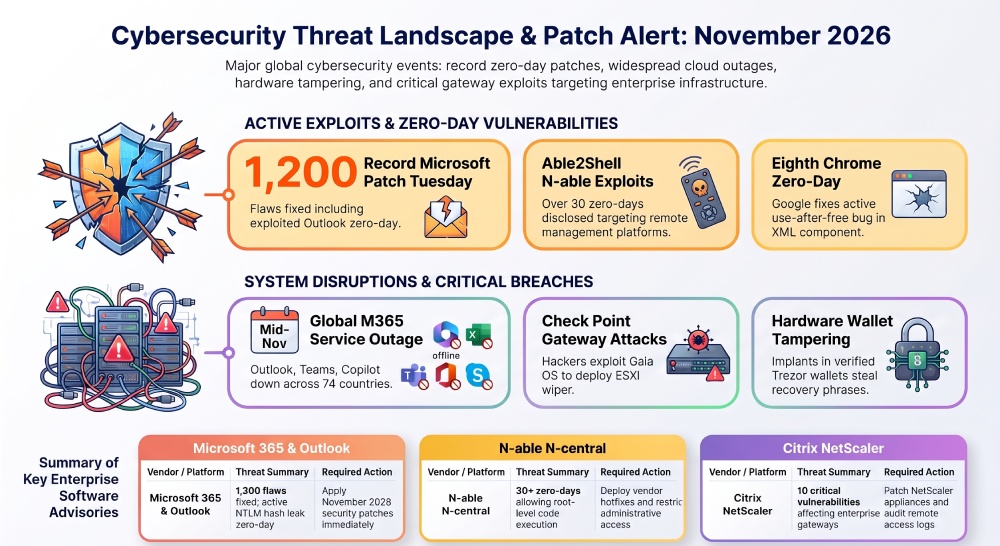
Microsoft’s Outlook, Teams, and Copilot went down for hours on 12 November and were still being restored the next day, affecting users across 74 countries and territories. Microsoft has said there is no indication of a cyberattack. Source: TechSpot and AP via KSL
Record November Patch Tuesday fixes a dangerous Outlook zero-day!
Microsoft’s November 2026 Patch Tuesday fixed roughly 1,200 flaws, the largest release on record, and included a Outlook zero-day that was already being exploited. The flaw, CVE-2026-124194, leaks NTLM password hashes when a user opens a crafted message file. Source: Sherlock Forensics weekly roundup
Check Point gateways hacked to deploy a VMware ESXi wiper!
An unknown threat actor is exploiting unpatched Check Point Security Gateways through the PHP2Shell vulnerabilities, then using a previously unreported privilege escalation flaw in Gaia OS to install a backdoor. The attackers also deployed a wiper aimed at VMware ESXi systems. Source: The Hacker News
CISA adds an UnrealIRCd flaw to its exploited vulnerabilities list!
CISA added a high-severity flaw in UnrealIRCd, an open-source chat server, to its Known Exploited Vulnerabilities catalog after reports of active attacks. The bug allows command injection at the server level. Source: The Hacker News
Citrix patches 10 critical NetScaler vulnerabilities!
Citrix released fixes for ten critical flaws in its NetScaler products, which are widely used to publish corporate applications and VPN access. Administrators should apply the patches quickly, as these devices are frequently targeted. Source: Parker Nathan, Cybersecurity News November 13, 2026
ConnectWise investigates unauthorized access to third-party extensions!
ConnectWise said it is investigating reports of unauthorized access to third-party extensions on its platform. Customers who use these integrations should watch for further guidance from the company. Source: Parker Nathan, Cybersecurity News November 13, 2026
Dire Wolf ransomware is stalking your data!
A new ransomware family called Dire Wolf is making the rounds, and researchers describe it as a predator that quietly hunts sensitive data before locking systems. The report recommends regular backups and tight access controls. Source: Parker Nathan, Cybersecurity News November 13, 2026
Attackers abuse T-SQL to deliver malware on Microsoft SQL servers!
Attackers are using T-SQL commands to deliver malware on compromised Microsoft SQL Server databases. Database administrators should review server permissions and watch for unusual query activity. Source: Parker Nathan, Cybersecurity News November 13, 2026
More than 30 zero-days disclosed against N-able’s N-central platform!
A researcher publicly disclosed over 30 alleged zero-day flaws, dubbed “Able2Shell,” with proof-of-concept exploits against N-able’s N-central remote management platform. The flaws can allow credential theft, admin account creation, and root-level code execution. N-able has released a second hotfix addressing seven of the CVEs. Source: Cybersecurity Hunter daily roundup, November 12, 2026
Google patches the eighth actively exploited Chrome zero-day of 2026!
Google released a Chrome security update fixing CVE-2026-125350, a use-after-free bug in the XML component that attackers were already exploiting. It is the eighth Chrome zero-day that has been actively exploited so far this year, so users should update their browsers now. Source: Cybersecurity Hunter daily roundup, November 12, 2026

Hidden implants found in Trezor-verified CryptoBilis wallets!
Trezor confirmed that some CryptoBilis-sold hardware wallets contained hidden implants capable of stealing recovery phrases. Anyone who bought a wallet through that channel should check its origin and consider moving funds to a freshly generated wallet from a trusted source. Source: The Hacker News
Coles investigates a cyber incident over the weekend!
Australian supermarket giant Coles is investigating a cybersecurity incident that happened over the weekend and says some customers are having problems with Liquorland click-and-collect. Coles says it has found no evidence that customer, staff, or supplier data was compromised, and it is working with outside experts to contain the incident. Source: ABC News live blog, 16 November 2026
Europol disrupts the Gootloader malware and two other major operations!
Europol has disrupted Gootloader, a long-running malware operation, along with two other major malware campaigns. The takedown is a reminder that law enforcement continues to dismantle the criminal infrastructure behind initial-access malware. Source: Cybernews

Thousands of school bomb threat emails sent from hacked accounts!
Thousands of bomb threat emails aimed at schools across Europe were sent from previously hacked email accounts, which made the threats harder to trace and more convincing. Schools should check whether their own accounts have been compromised. Source: Cybernews
Strong email security starts with properly configured SPF, DKIM, and DMARC to prevent email spoofing, block phishing attempts, and protect business communications from cyber threats.
SilentAir hackers intercept calls and SMS from inside mobile networks!
A group called SilentAir is intercepting phone calls and text messages from inside mobile networks, which would expose the communications of anyone on the affected networks. Mobile users should use end-to-end encrypted messaging for sensitive conversations. Source: Parker Nathan, Cybersecurity News November 13, 2026
General Manager
General Manager at DuoCircle. Product strategy and commercial lead across the email security portfolio.
Secure your email infrastructure
Protect, authenticate, and deliver. Contact our team to find the right solution.