How OEM Anti-Phishing Detects Spoofed Domains And Malicious Email Links

Quick Answer
OEM anti-phishing solutions detect spoofed domains by analyzing sender identities, domain reputation, and email authentication. They scan links for malicious URLs, phishing websites, and suspicious redirects, helping businesses block threats, prevent credential theft, and strengthen email security.
OEM email security solutions allow vendors and managed service providers (MSPs) to integrate phishing detection into their existing products and services. Depending on the capabilities of the integrated solution, these tools can help identify spoofed domains, malicious email links, and suspicious messages through domain authentication checks, URL reputation analysis, and threat intelligence. By combining these safeguards, providers can strengthen email security and help reduce the risk of business email compromise (BEC), account takeover, and credential theft.
What OEM Anti-Phishing Is and Why It Matters for Email Security
OEM anti phishing is a security capability embedded into another vendor’s product, platform, or managed service to detect phishing, spoofed domains, credential theft, and malicious links before users interact with them. Instead of building every detection engine from scratch, software vendors, telecom providers, hosting companies, and an MSP (Managed Service Provider) can integrate proven phishing protection into existing email security, collaboration, or cyber protection offerings.
This model is especially valuable for cloud email security because organizations rely heavily on Microsoft 365, Google Workspace, Open-Xchange, and other SaaS-based communication platforms. While Microsoft Defender for Office 365 provides an important security layer, many organizations add Advanced Email Security capabilities to improve spoofing detection, business email compromise protection, and account takeover prevention.
Why OEM matters in modern phishing protection
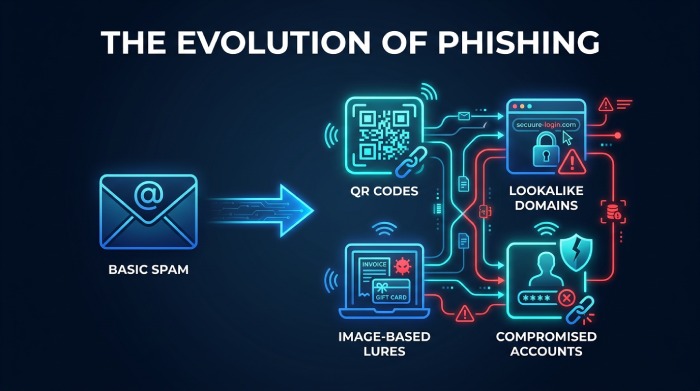
Phishing has evolved beyond obvious spam. Modern attacks use lookalike domains, compromised legitimate accounts, QR-code phishing, image-based lures, and multi-stage redirects. OEM anti phishing gives security vendors access to multi-layered defenses without increasing engineering complexity.
For example, Acronis Email Security, delivered through the Acronis Cyber Platform and Cyber Protect Cloud, can support cloud email security use cases for service providers that need phishing protection, malware prevention, and incident response workflows at scale. Platforms such as Perception Point and other advanced detection providers also emphasize real-time analysis across email, files, URLs, and collaboration channels.
The risks: BEC, ATO, and credential theft
The most damaging phishing campaigns often lead to Business Email Compromise (BEC), Account takeover (ATO), or direct credential theft. Business email compromise can involve invoice fraud, executive impersonation, or payment redirection. BEC attacks are difficult to detect because they may contain no malware and may come from a trusted or compromised sender.
Account takeover is equally dangerous. Once an attacker gains mailbox access, ATO enables lateral movement prevention challenges, internal phishing, data theft, and outbound scanning abuse. Strong anti phishing controls improve credential theft prevention by identifying malicious login pages, suspicious sender behavior, and impersonation attempts before compromise occurs.
How Spoofed Domains Are Identified Through Domain, DNS, and Brand Impersonation Checks
Spoofed domains are designed to look trustworthy. Attackers register domains that imitate banks, cloud services, suppliers, or executives, then use those domains in phishing emails. Effective anti phishing detection evaluates the sender identity, domain reputation, authentication results, visual similarity, and message context.
Domain similarity and spoofing detection
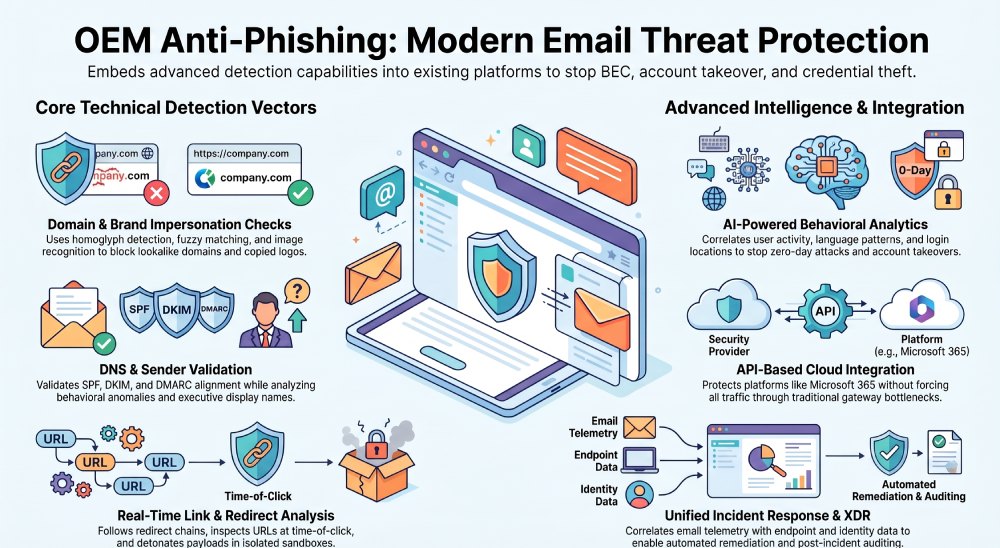
Spoofing detection starts by comparing sender domains against trusted brands, customer domains, executive names, supplier records, and known abuse patterns. A domain such as micros0ft-login.example or paypaI-security.example may pass a quick visual scan by a user but can be flagged through fuzzy matching, homoglyph detection, and anomaly detection.
Brand impersonation checks also use image recognition to identify copied logos, fake sign-in pages, and visual templates that mimic Microsoft 365, Google Workspace, financial institutions, or internal portals. These checks are essential for phishing protection because many impersonation attempts rely on visual trust rather than technical compromise.
DNS and authentication validation
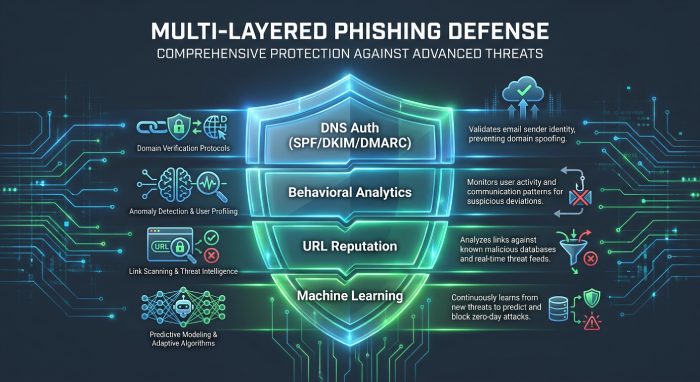
DNS-based checks help determine whether an email sender is authorized to send on behalf of a domain. OEM anti phishing engines commonly perform an SPF check, inspect the DKIM record, and apply DMARC validation to detect domain spoofing and alignment failures. SPF, DKIM, and DMARC are not complete phishing protection by themselves, but they are foundational signals in email security scoring.
A failed authentication result does not always mean malicious activity, and a passed result does not guarantee safety. Attackers can use newly registered domains with valid SPF, DKIM, and DMARC. That is why modern cloud email security combines authentication with behavioral analytics, URL reputation, and machine learning algorithms.
Brand and executive impersonation
Business email compromise often depends on impersonation rather than technical exploits. A BEC message may claim to come from a CEO, finance executive, legal department, or trusted vendor. Anti phishing systems compare display names, reply-to addresses, sender history, and writing patterns to identify business email compromise indicators.
This is where AI-powered defense becomes important. By learning normal communication patterns, AI-powered defense can detect unusual requests, new payment instructions, or suspicious timing. The same approach supports ATO detection when a legitimate mailbox suddenly sends abnormal messages or attempts mass outbound scanning.
Detecting Malicious Email Links with URL Reputation, Redirect Analysis, and Sandboxing
Malicious links are one of the most common phishing delivery methods. A link may point directly to a credential-harvesting site, or it may route through multiple redirects to evade detection. Strong email security must evaluate URLs before delivery, at click time, and during post-delivery remediation.
URL reputation and real-time link inspection
URL reputation is a core signal in anti phishing detection. Security engines compare links against known malicious domains, newly registered domains, suspicious hosting providers, and phishing kits. However, URL reputation alone is not enough because zero-day attacks often use domains that have not yet been reported.
To close this gap, cloud email security platforms perform real-time analysis and a dynamic scan of links. This helps detect newly weaponized infrastructure and reduces the success rate of zero-day attack campaigns. AI-powered defense can also evaluate URL structure, domain age, certificate metadata, page content, and hosting patterns.
Redirect analysis and anti-evasion
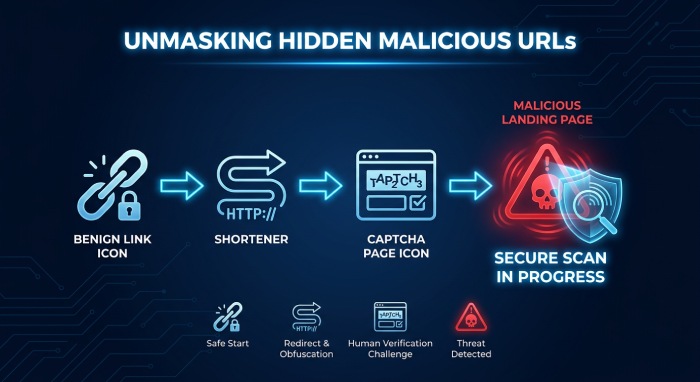
Attackers frequently hide malicious destinations behind URL shorteners, compromised websites, CAPTCHA pages, or geofenced redirects. Anti-evasion capabilities follow redirect chains safely to determine the final landing page. This is critical because the first URL may appear benign while the destination hosts a fake Microsoft 365 login page or malware payload.
Advanced systems also inspect links at time of click. This protects users when a link becomes malicious after initial delivery, a common tactic in modern phishing protection bypass attempts.
Sandboxing and payload-based protection
Sandboxing allows suspicious links, files, or payloads to be opened in an isolated environment. If a URL downloads malware, launches scripts, or redirects to a credential theft page, the system can block access and trigger incident response. Payload-based protection is especially useful against advanced persistent threats, APTs, and targeted attacks where the threat vector is customized for a specific organization.
For malware prevention, sandboxing can be combined with secure email gateway controls, API-based mailbox scanning, and XDR Integration. This creates a stronger bridge between email security, endpoint telemetry, and incident response.
Real-Time Threat Intelligence and Machine Learning in OEM Anti-Phishing Detection
OEM anti phishing works best when detection decisions are informed by broad, constantly updated threat intelligence. Signals may come from global telemetry, honeypots, user reports, malware analysis, phishing kits, dark web monitoring, and cyber analysts investigating active campaigns.
Machine learning and AI-powered defense
Machine learning algorithms help classify suspicious emails by analyzing thousands of signals: sender reputation, language patterns, attachment behavior, URL characteristics, authentication results, and user interaction history. AI-powered defense is particularly useful for identifying BEC, ATO, and business email compromise attempts that do not contain traditional malware.
For example, an account takeover may be detected when a user logs in from an unusual location, creates suspicious forwarding rules, and sends urgent payment requests. ATO signals can also include abnormal mailbox access, unusual API activity, or internal phishing behavior. Effective anti phishing platforms correlate these signals quickly to support proactive threat blocking.
Threat intelligence, APTs, and zero-day attacks
Threat intelligence improves detection of zero-day attacks, Advanced Persistent Threat (APT) activity, and emerging phishing infrastructure. In some cases, cyber analysts identify a phishing kit or campaign pattern before it becomes widespread. That intelligence can then update detection rules across customers, improving cloud email security at scale.
Sources such as CSO Online and vendor research, including resources like a Whitepaper Evaluating Email Security, often highlight how attackers adapt to secure email gateway controls. This is why real-time analysis, anomaly detection, and AI-powered defense are now essential components of phishing protection.

Incident response and forensic analysis
Detection is only one part of the workflow. When a threat is found, the platform should support incident response, remediation, and forensic analysis. Security teams need visibility into who received the email, who clicked the link, whether credentials were submitted, and whether lateral movement prevention controls were triggered.
An audit log is also important for compliance, regulatory compliance, and post-incident review. Strong incident response workflows help teams remove malicious messages, invalidate sessions, reset passwords, and investigate account takeover or BEC exposure.
Best Practices for Integrating OEM Anti-Phishing into Security Products and Workflows
Successful OEM anti phishing integration requires more than adding an API (Application Programming Interface). Vendors and service providers should design detection, deployment, administration, and incident response around customer workflows.
Prioritize cloud-native deployment and API-based provisioning
Cloud-native deployment and API-based integration can help email security providers protect environments such as Microsoft 365 and Google Workspace without requiring all email traffic to pass through a traditional email gateway. Depending on the integration method, these approaches can support automated setup, mailbox visibility, threat detection, and post-delivery remediation.
Operational Scalability for MSPs
Managed service providers (MSPs) need centralized policy management, tenant isolation, reporting, and efficient false-positive handling to manage email security across multiple customers. Integration workflows should also account for data residency, performance, access permissions, and customer-specific security requirements. These capabilities help providers scale their services while maintaining appropriate security controls and administrative oversight.
Combine email security with broader protection layers
Integrating email security with Extended Detection and Response (XDR) platforms can help security teams correlate phishing alerts with endpoint and identity activity. This broader visibility supports faster investigations, coordinated incident response, and the identification of related threats across an organization’s environment.
This layered approach improves phishing protection against business email compromise, BEC, account takeover, ATO, malware, and advanced persistent threats. It also gives incident response teams the evidence needed to understand the full attack path.
Tune policies, reporting, and remediation workflows
Security teams should tune policies based on business risk, user roles, and compliance needs. Executives, finance teams, and administrators may need stricter anti phishing rules because they are frequent targets for BEC and ATO campaigns.
Reporting should include blocked threats, allowed messages, user-reported phishing, remediation actions, and audit log details. False positive handling must be fast and transparent so users trust the system. With accurate detections, clear reporting, and automated remediation, OEM anti phishing becomes a core part of modern email security and cloud email security operations.
General Manager
General Manager at DuoCircle. Product strategy and commercial lead across the email security portfolio.
Secure your email infrastructure
Protect, authenticate, and deliver. Contact our team to find the right solution.