6 Best Frontline Training Platforms for Workplace Skills

Quick Answer
The six best frontline training platforms for workplace skills are iTacit (regulated teams without company email), eduMe (lessons by SMS or QR code), HSI (OSHA-focused safety course library), Mitti Training (training tied to inspections), TalentCards (budget microlearning), and Axonify (adaptive daily quizzes for large retail and distribution networks). Choose by no-email login, certification expiry tracking, and safety workflow links.
Frontline training platforms exist for one reason: the people who drive the trucks, run the lines and staff the floor do not sit at a desk, and most of them never open a company inbox. If your training still lives in a classroom binder or an email link, it is not reaching them.
The pressure on skills is real. The World Economic Forum’s Future of Jobs Report 2025 found that nearly 40% of skills required on the job are set to change, and that 63% of employers already name the skills gap as the key barrier they face. For a warehouse, a fleet or a care home, that gap shows up as a forklift ticket nobody renewed or a new procedure half the shift never saw.
We compared six platforms that train deskless workers on their phones. We looked at how a worker gets in (with or without a company email), how fast a supervisor can see who is current, what the published pricing looks like, and where each tool falls short.
How we compared these frontline training platforms
We started from the vendors that show up most on the first page of search results for this category, then checked each one against its own product and pricing pages and its public review profile. Ratings below are quoted as they appeared on G2, Capterra or Software Advice in October 2026.
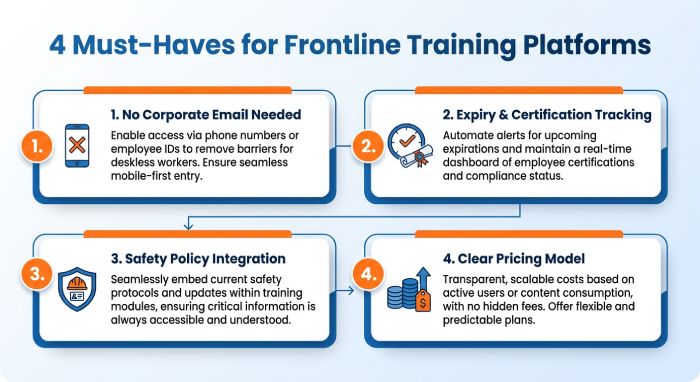
Four questions decided the order:
- Can a worker without a corporate email log in and finish a lesson on a personal phone?
- Does the platform track certifications and expiry dates, or only course completions?
- Can training be tied to the safety side of the job (incidents, inspections, policy sign-offs)?
- Is there a published price, or at least a clear pricing model?
One opinion up front: completion is not comprehension. A 100% completion rate tells you people tapped Next. It does not tell you a driver understood the new load-securement rule, so we gave extra weight to tools that let a supervisor check skills in person and record it.
Frontline training platforms at a glance
| Platform | Best for | Standout feature | Pricing | Rating |
|---|---|---|---|---|
| iTacit | Regulated frontline teams without company email | Training, certifications, forms and sign-offs in one app | Per-user monthly subscription, quoted by tier | 4.6/5 on Software Advice |
| eduMe | Hourly teams reached by SMS or QR code | Lessons delivered by text link, no app install required | Quote-based core platform plus add-ons | 4.7/5 on G2 |
| HSI | Safety-heavy employers that want ready-made courses | Large OSHA-focused safety course library | Priced by courses, employees and LMS hosting | 4.5/5 on Capterra |
| Mitti Training | Teams already running inspections in Mitti | Failed inspection items turn into courses | Free up to 10 seats; Premium $24 per seat per month (annual) | 4.6/5 on G2 |
| TalentCards | Budget microlearning at scale | Card lessons with QR codes on equipment | Free up to 5 users; from $0.80 per user per month | 4.6/5 on Capterra |
| Axonify | Large retail and distribution networks | Daily adaptive quizzes and reinforcement | Quote-based Core, Pro and Premium packages | 4.7/5 on G2 |
1. iTacit
Best for: regulated frontline teams in logistics, transportation, manufacturing and healthcare that need a frontline training platform workers can open on their own phones, with no company email required.
iTacit is a frontline training and digital workplace platform. It puts courses, compliance tracking, forms, sign-offs and company messages into one mobile app (My iTacit on iOS and Android, or any browser), built for deskless staff who were never given a corporate inbox.
In practice, a supervisor assigns a learning path by role, job or site. The worker gets a push notification, takes a short course between routes or at a shift change, and signs off on the new policy in the same app. The supervisor then checks completions, upcoming certification expiries and form submissions from one dashboard instead of three spreadsheets.
Key features:
- Full LMS with SCORM 1.2 and 2004, AICC, Articulate Storyline and Captivate support, plus a drag-and-drop course builder
- Learning paths by role, position, department or group, with automated reminders
- Certification and compliance tracking, digital forms, inspections and supervisor sign-offs
- An AI Assistant that answers employee questions only from your approved internal documents (a question tool, not a compliance engine)
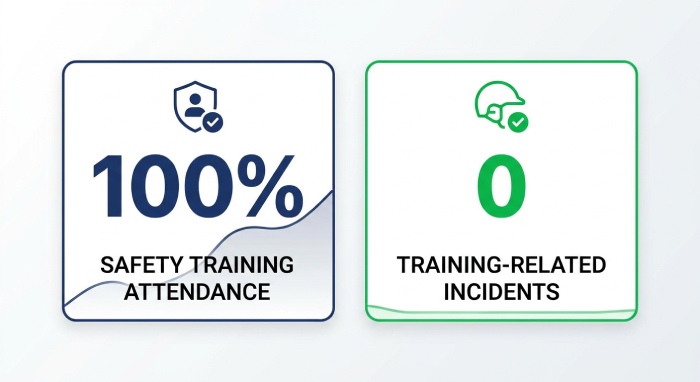
Proof: Seaboard Transport, a transport company that uses iTacit for its frontline workforce training, reports 100% safety training attendance and zero training-related incidents. Medavie Health Services digitized more than 5,000 paramedics on the platform.
Rating: 4.6/5 on Software Advice (42 reviews).
Pricing: per-user monthly subscription, quoted to headcount and to one of four tiers (Connect, Educate, Engage, Operate).
Where it falls short: here is no public price list, so you cannot compare costs without a sales call. The platform is cloud-based email and requires a data or Wi-Fi connection for workers to access and complete courses.
2. eduMe
Best for: hourly and gig-style workforces where getting people into an app at all is the hard part.
eduMe is a mobile training tool that sends short lessons straight to a worker by SMS, email or a QR code. The worker taps the link and starts. For high-turnover frontline workforce training, skipping the app download removes the first place people drop off.
Admins build lessons with an AI lesson generator or convert an existing PDF. Quiz questions resurface over time so knowledge sticks. Add-on modules cover the rest: in-person assessments and attendance tracking for live sessions, checklists built from SOPs with evidence capture, and broadcasts with acknowledgement tracking.
Key features:
- Lesson delivery by SMS, email or QR code
- AI lesson generator and PDF-to-lesson converter
- Optional compliance add-on with in-person assessments
- Broadcasts with acknowledgement tracking (add-on)
Rating: 4.7/5 on G2 (35 reviews).
Pricing: quote-based. You build a package from a core platform plus add-ons, and no prices are posted.
Not good for: buyers who want everything at the base price. SCORM playback, the compliance tools and the HRIS sync are all add-ons, so the real cost depends on how many you need.
3. HSI
Best for: safety and EHS teams that would rather buy a ready-made course library than write their own.
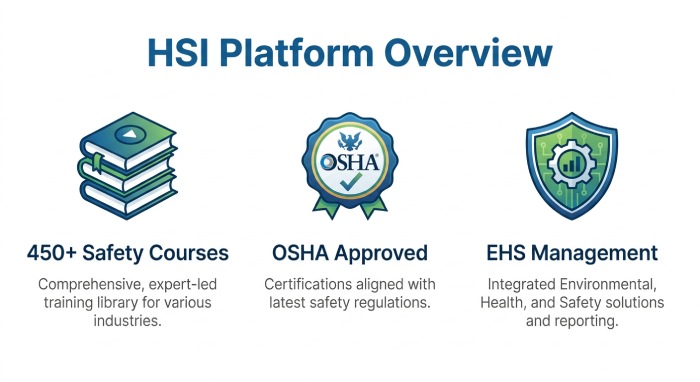
HSI is a cloud-based EHS and safety training company. Its main draw for frontline workforce training is content: HSI says it offers a library of over 450 online safety courses, and it is an OSHA-approved provider of OSHA 10 and 30 training in English and Spanish for General Industry and Construction.
You pick the courses, set passing scores and question randomization, and assign them through HSI’s LMS. The wider HSI platform also covers incident management, audit tracking and compliance management, which matters if you want the training record and the incident record in the same vendor.
Key features:
- Large off-the-shelf safety course library, including OSHA 10 and 30
- Configurable exams with passing scores and question randomization
- Incident management and audit tracking in the broader EHS suite
- Courses in a growing set of languages
Rating: 4.5/5 on Capterra (80 reviews).
Pricing: quote-based. HSI describes the cost as the number of courses plus the number of employees plus LMS hosting.
Where it falls short: HSI is content-first. If most of your workplace skills training is your own SOPs, site rules and product knowledge, you will pay for a library you only partly use.
4. Mitti Training (formerly SafetyCulture Training)
Best for: operations that already run inspections and checklists in Mitti and want frontline training software in the same app. Mitti Training is the training module of Mitti, the frontline operations platform that SafetyCulture renamed itself to in August 2026. (It also absorbed EdApp, so you will still see three names in older reviews.) Lessons are short and designed for phones, with spaced repetition that brings earlier lessons back.
The useful trick is the link to inspections. When an item fails on an inspection, it can become a training course without leaving the app. You can also upload a PDF, PowerPoint or Word file and have AI turn it into a structured course.
Key features:
- Mobile microlearning with quizzes and spaced repetition
- In-person competency checks and pass/fail assignments
- Failed inspection items convert into courses
- AI course creation from uploaded documents
Rating: 4.6/5 on G2 (472 reviews, under the Mitti by SafetyCulture listing).
Pricing: free for up to 10 seats with basic training. Premium is $24perseatpermonthbilledannually($29 monthly) and includes advanced training. Enterprise is custom.
Where it falls short: pricing is per seat for every worker, so a 400-person warehouse on Premium adds up quickly unless you negotiate location-based pricing. The rebrand also means some help articles and integrations still carry the old names.
5. TalentCards
Best for: teams that want low-cost microlearning on phones and are happy to keep formal records elsewhere.
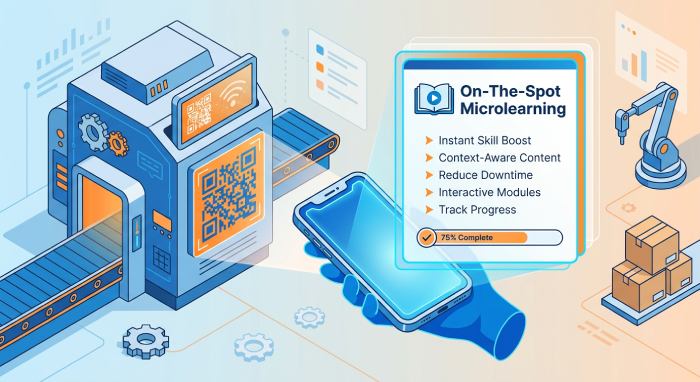
TalentCards, from the makers of TalentLMS, is a microlearning app. Training arrives as short card-style lessons, and you can stick QR codes on equipment, products or workstations so a worker scans the code and gets the instructions right there. That is a simple, good fit for workplace skills training on a specific machine.
Learners are invited by email or text message. Content can be translated into more than 100 languages, and learners can download lessons ahead of time for offline access.
Key features:
- Short card-based lessons built for phones
- QR codes that open on-the-spot instructions
- Translation into 100+ languages
- Offline access to downloaded content
Rating: 4.6/5 on Capterra (22 reviews).
Pricing: free for up to 5 users. Standard is $0.80 and Premium $1.20 per user per month, sold in 50-user increments, with custom pricing above 2,000 users.
Not good for: organizations that need certification expiry tracking, incident follow-up or policy sign-offs. In our view, TalentCards works best as the lesson layer next to a fuller compliance system, not as the system of record.
6. Axonify
Best for: large retail, grocery and distribution networks with thousands of hourly staff across many locations.
Axonify is a frontline training platform built around short daily sessions. Workers answer a few questions each shift, and the system adjusts what it asks next based on what each person gets wrong. Points, leaderboards and games keep participation up.
Higher packages add communication and task tools. Core covers training paths, refreshers, reporting and the Max Assistant. Pro adds group chat, polls and Max Coach, and Premium adds task assignment and execution tracking across locations.
Key features:
- Adaptive daily reinforcement quizzes
- Gamification with points, leaderboards and rewards
- Manager and team reporting plus learning impact analysis
- Task execution tracking across locations (Premium)
Rating: 4.7/5 on G2 (about 160 reviews).
Pricing: quote-based, built from team size, locations and features across Core, Pro and Premium packages.
Where it falls short: it is a big-company product with a big-company rollout. Axonify says most customers go live in as little as 8 weeks, and the gamified daily model can feel heavy for a 60-person trucking firm that mainly needs certifications tracked.
How to choose frontline training software for your workforce
The right pick depends on the gap you are actually trying to close.
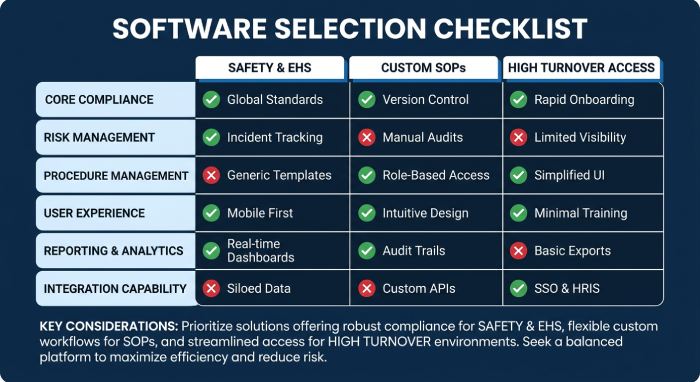
If you are in logistics or transportation, start with the safety side. A buyer asking for the best safety and compliance platform for a logistics company usually needs four things to connect: incident management (capture, triage, corrective action and closure), inspection workflows (mobile checklists with photos and evidence), policy acknowledgement (a timestamped record that each driver signed the new procedure) and safety training. The last link is the one most stacks miss. When an incident happens, the platform should let you assign remedial training to the people involved and see it close out.
Many safety teams still run all of this in a SharePoint list and an Excel file. It holds up right until an auditor asks for three years of certification records in a week.
Email security is also an important part of frontline workforce management and cybersecurity, helping protect sensitive employee information, safety reports, and compliance-related communications from phishing, cyber threats, and unauthorized access.
If workers hold licences or tickets that expire, you need certification tracking on top of course tracking. Ask the vendor to show you an expiry report filtered by site.
Teams with high turnover should weigh how the worker gets in. No-email login, SMS links and QR codes matter more than an elegant course builder.
When your content is mostly off-the-shelf safety material, a library vendor makes sense. When it is mostly your own SOPs, pay for authoring and learning paths instead.
Structured, on-the-job training tends to keep people. The U.S. Department of Labor reported in a 2020 apprenticeship announcement that 94 percent of apprentices are retained in employment six months after completion. A good deskless worker training platform is one way to bring that structure to the floor.
Frequently asked questions
What is a frontline training platform?
It is training software built for workers who do not sit at a desk. Lessons are short, run on a phone, and can usually be reached without a company email address. Most also record completions and certifications for compliance.
What is the difference between a safety platform and an LMS for logistics?
A safety platform centres on incidents, inspections and policy sign-offs. An LMS centres on courses and training records.
Which platforms are built for fleet and logistics operations?
They split by their main job. Telematics tools such as Samsara and Motive start from the vehicle and add driver coaching. EHS suites such as VelocityEHS and HSI start from incidents and regulatory records. Frontline-first tools start from the worker’s phone and add training, forms and sign-offs.
Do frontline workers need a company email to use these tools?
Not with most of the tools on this list. iTacit, eduMe and TalentCards all offer ways in without a corporate inbox, such as a personal phone login, a text message or a QR code.
Bottom line
If you only need cheap microlearning, TalentCards is hard to beat on price. If you live inside inspections, Mitti Training keeps everything in one place, and Axonify suits the largest networks.
For logistics, transportation and other regulated teams that want frontline training platforms covering courses, certification tracking, digital forms and policy sign-offs in one app their workers can open without a company email, iTacit offers per-user monthly pricing across its Connect, Educate, Engage and Operate tiers.
Topics
General Manager
General Manager at DuoCircle. Product strategy and commercial lead across the email security portfolio.
Secure your email infrastructure
Protect, authenticate, and deliver. Contact our team to find the right solution.