How Healthcare Facilities Can Improve Informed Consent Documentation

Quick Answer
Healthcare facilities can strengthen informed consent documentation by using clear, standardized forms, explaining treatment options and risks, verifying patient understanding, documenting discussions, obtaining valid signatures, and regularly auditing records for accuracy and compliance.
A patient arrives for surgery, but the consent form still describes the originally planned procedure. The surgeon changed the treatment approach yesterday, and the updated details appear in the clinical notes. Nobody updated the consent document before the patient arrived.
This kind of error can happen even when staff follow most of their usual procedures. Information moves between clinicians, departments, and medical records, leaving opportunities for important details to get missed. Healthcare facilities need a documentation process that keeps consent records accurate as treatment plans change.
Where Informed Consent Documentation Goes Wrong
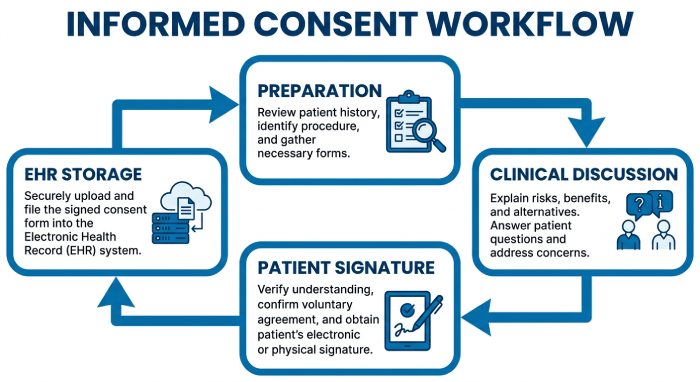
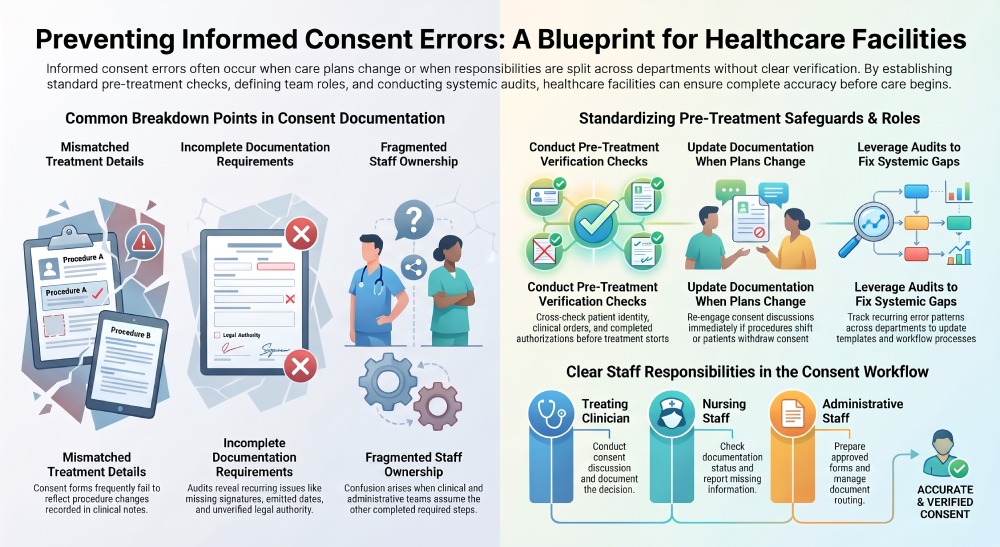
The informed consent documentation process often involves several people before a patient receives treatment. A physician explains the procedure, another staff member prepares the form, and someone else stores it in the medical record. Problems can arise when these steps happen separately without a clear process for checking the completed record.
The 2025 Joint Commission training materials identified recurring documentation problems, including missing signatures, incorrect procedure details, and incomplete consent discussions. Some records lacked dates or required information about the responsible practitioner. Others contained verbal consent when written authorization was required.
These findings point to a problem beyond incomplete paperwork. Facilities need to know who is responsible for each documentation stage and how to catch errors before treatment. A missing signature may be easy to spot, but an outdated form can be harder to identify without checking the current treatment order.
Build a Standard Process for Recording Consent
A reliable documentation process starts before the consent form reaches the patient. Healthcare facilities need consistent steps to prepare documents and link them to the correct medical records.
Match Consent Documents to the Current Treatment
Consent forms need to describe the treatment the patient is actually receiving. If the clinician changes the planned procedure, the documentation process must account for that decision. Staff can compare the current treatment order with the prepared consent form before presenting it for signature.
Record the Person Authorized to Make the Decision
The person signing the form may be the patient or an authorized representative. The record must identify that individual and, if someone else makes the decision, the basis for their authority. Healthcare teams also need to follow applicable requirements when assessing a patient’s ability to consent.
Connect the Discussion to the Signed Document
A signed form may be stored separately from the clinical note describing the consent discussion. Keeping the records linked lets clinicians review the information tied to the treatment decision. The medical record can then show the discussion, the patient’s decision, and the completed authorization when required.
Assign Clear Responsibilities to Healthcare Staff
Consent documentation often involves clinical and administrative staff working at different stages of care. Confusion can arise when one department assumes another has already completed a required step. A defined workflow gives each team member a responsibility without shifting clinical decisions to administrative staff.
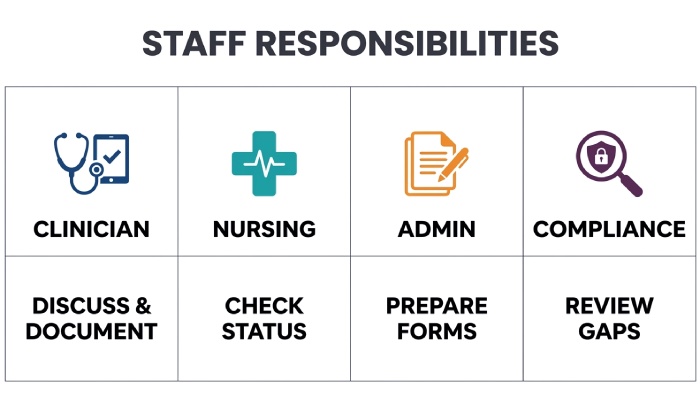
| Team Member | Documentation Responsibility |
|---|---|
| Treating clinician | Conduct the consent discussion and document the decision |
| Nursing staff | Check documentation status and report missing information |
| Administrative staff | Prepare approved forms and manage document routing |
| Medical records team | Maintain records and support document retrieval |
| Quality or compliance team | Review documentation gaps and recurring errors |
Exact responsibilities depend on facility policy and which professionals are authorized to obtain consent. AHRQ’s training guidance recommends defining team responsibilities as part of the consent process. Clinical accountability remains with the appropriate healthcare professional, even when other staff supports the paperwork.
Facilities also need a process for handling missing documents. A nurse who discovers an incomplete form must know which clinician to contact. The issue should reach the authorized person before treatment proceeds, unless an applicable exception permits otherwise.
Check Consent Records Before Treatment Begins
Consent documentation checks can catch errors while the patient and treating clinician are still available. Facilities can include these checks in their existing pre-treatment workflows instead of creating a separate review process.
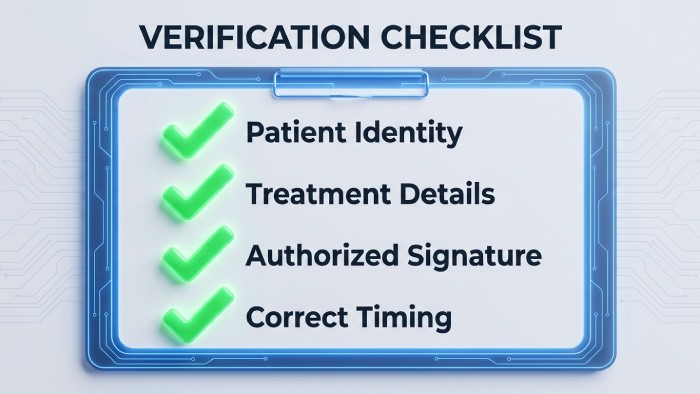
A practical review can cover the following information:
- Patient identity: Correct patient and medical record details
- Treatment details: Procedure matches the current clinical order
- Responsible clinician: Appropriate treating professional clearly identified
- Authorization: Signature belongs to the authorized decision-maker
- Timing: Required signatures completed before the planned treatment
- Communication support: Interpreter involvement recorded when applicable
- Record status: Required consent documents available in the chart
- Changes: Earlier forms reviewed against updated treatment plans
These checks are especially important when patients move between departments. A document prepared during an outpatient visit may need review when the patient arrives for surgery. Staff should also flag any difference between the consent form and the planned treatment.
For hospitals, CMS requires properly executed consent forms for procedures covered by applicable consent requirements. The specific details depend on federal rules, state law, and facility policy. A checklist can support compliance, but it does not replace the required clinical discussion.
Manage Consent Documentation When Care Plans Change
A completed consent record reflects a particular treatment decision at a particular time. Later changes may require a new discussion or additional documentation. Facilities need to account for those changes without losing the history of earlier decisions.
When the Planned Procedure Changes
A surgeon may change the proposed procedure after reviewing new test results. The earlier consent form may no longer describe the recommended treatment. The clinician needs to determine the new consent requirements and document the updated discussion before proceeding.
When a Patient Withdraws Consent
A patient may withdraw consent after initially agreeing to a procedure. The medical record must reflect that decision and any relevant discussion of the consequences. Staff must also follow the appropriate process to stop or change the planned care.
When a New Representative Becomes Involved
A patient’s decision-making capacity or authorized representative may change during an extended stay. An earlier signature does not automatically authorize every later decision. Facilities need current information about the person legally authorized to participate in treatment decisions.
Use Documentation Audits to Find Repeated Errors
Finding one incomplete consent form does not explain why the error occurred. A documentation audit can reveal patterns across departments or treatment types. Facilities can use these findings to improve the process rather than treating each missing document as an isolated problem.
Consider a hospital that reviews 30 consent records and finds six with missing timestamps. Further review shows that most of those forms came from one department using an older template. Replacing the template may address the underlying problem more effectively than repeatedly asking staff to correct individual forms.
Audits can also examine how often staff discover missing documents before treatment. This gives quality teams information about when errors occur, not just how often. A form completed after a procedure presents a different concern from one corrected during a pre-treatment check.
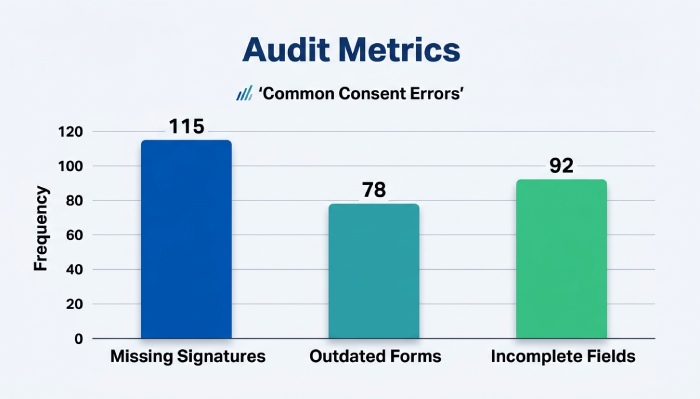
When reviewing errors, facilities can track several measures:
- Percentage of records with complete required fields
- Number of incorrect or outdated consent forms
- Missing signatures found during pre-treatment checks
- Time taken to resolve documentation problems
- Frequency of errors across clinical departments
- Number of records requiring later corrections
- Repeated gaps linked to specific workflows
The results can guide staff training and changes to documentation procedures. A department with frequent form errors may need better templates, while another may need clearer staff responsibilities. Regular reviews also let facilities see whether those changes reduce incomplete records.
Medical record corrections require particular care. Medicare contractor Noridian’s June 2025 guidance states that amended records should preserve the original entry and identify the correction. Facilities must follow applicable recordkeeping requirements rather than replacing an earlier entry without a trace.
Protect Consent Records and Maintain Their History
Consent records often contain sensitive patient information, including proposed treatments and medical conditions. Facilities need to control who can access these documents and what each person can do with them. Staff responsibilities can guide permissions so employees have access only as needed for their work.
Healthcare facilities should also prioritize email security by implementing SPF and DKIM to help protect sensitive communications from email spoofing and unauthorized use.
Electronic systems can also record when documents are created or changed. An audit trail may identify who updated a record and when. This information matters when administrators need to review a consent document’s history.
The Office of the National Coordinator for Health Information Technology maintains certification criteria covering audit functions in health IT. These include protections against unauthorized changes to certain audit records. Facilities still need to assess their specific systems, because not every document platform offers the same controls.
Record retention is another consideration. Consent documents may need to remain accessible long after the original treatment, according to applicable law and facility policy. Healthcare organizations need a process for retrieving archived records without relying on individual staff members or outdated storage systems.
How Digital Tools Can Improve Consent Record Management
Digital tools can reduce manual work when healthcare facilities manage large numbers of consent-related documents. Electronic templates let staff prepare forms without recreating them from scratch. Document routing can also make it easier to identify forms awaiting signatures or review.
Platforms like Informed Medical support consent-related documentation through educational materials and its Smart Signing feature. Skilled nursing and assisted living facilities can use reusable signing templates, including documents related to psychotropic medications. Its PointClickCare integration also automatically stores signed documents and communication records in resident charts.
Automated education adds another part to the documentation process. Facilities can share relevant information with residents and families when residents are admitted, or their conditions change. However, educational delivery records and electronic signatures remain supporting evidence; they do not replace a clinician’s responsibility to obtain valid consent.
Conclusion
Healthcare facilities can improve consent documentation by examining how information moves from the clinical discussion into the medical record. Errors often occur when staff prepare forms separately from treatment decisions or when responsibilities are unclear. A consistent review process can identify these gaps before they affect patient care.
Standard templates, clear ownership, and regular audits can make documentation more reliable. Digital tools can support the process, particularly when records need to move between departments or connect with an EHR. The priority remains an accurate record of the patient’s decision and the care discussed at that time.
Topics
General Manager
General Manager at DuoCircle. Product strategy and commercial lead across the email security portfolio.
Secure your email infrastructure
Protect, authenticate, and deliver. Contact our team to find the right solution.