12 DNS Scanning Techniques for Domain Intelligence and Email Security

Quick Answer
DNS scanning techniques help uncover domain records, subdomains, mail servers, DNS misconfigurations, and security risks. Explore 12 DNS scanning methods to strengthen domain intelligence, identify email security gaps, detect spoofing risks, and improve overall domain protection.

DNS is frequently perceived as a straightforward tool for converting domain names into IP addresses. However, it serves as a critical repository of insights concerning an organization’s infrastructure, services, email settings, and security framework. By diligently examining DNS records, security teams can uncover assets, identify misconfigurations, detect irregular changes, and enhance email authentication practices.
The application of DNS scanning techniques proves particularly beneficial for organizations overseeing multiple domains, cloud services, email systems, and third-party applications. An effectively structured DNS scanning methodology can disclose information that might otherwise be obscured within various systems.
In this guide, we will discuss 12 techniques for DNS scanning aimed at enhancing domain intelligence and email security, outline the insights each method provides, and demonstrate how organizations can leverage DNS information to bolster their overall security strategy.
What Is DNS Scanning?
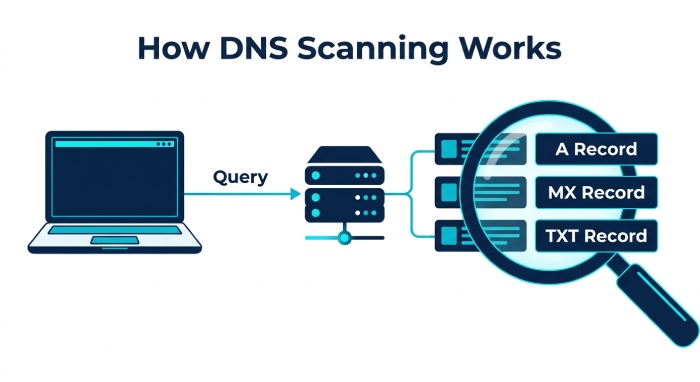
DNS scanning involves querying DNS servers to analyze records tied to a domain or hostname, aiming to uncover details about domain infrastructure, services, mail systems, and security configurations.
It examines records such as A, AAAA, MX, NS, TXT, CNAME, and SOA, with advanced scans including DNSSEC validation, reverse lookups, subdomain discovery, SPF analysis, and DMARC checks.
Unlike intrusive network scans, DNS scanning relies on publicly available DNS information, making it valuable for legitimate security assessments, asset discovery, email security audits, and domain intelligence.
Why DNS Scanning Matters for Domain Intelligence and Email Security
DNS records offer insight into an organization’s infrastructure. Security teams can leverage this data to identify exposed systems, email hosting locations, and approved third-party services linked to a domain.
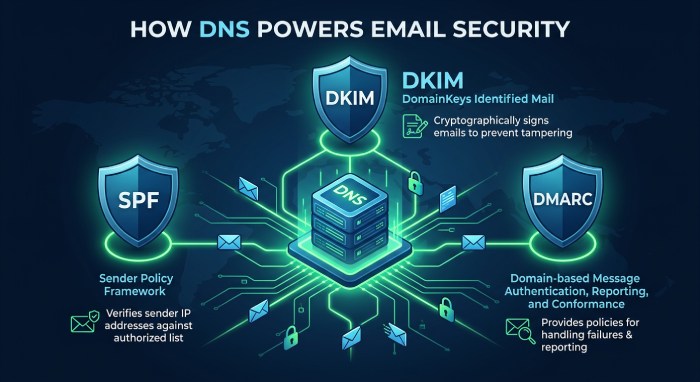
In the context of email security, DNS is crucial as protocols like SPF, DKIM, and DMARC rely on these records. Inaccurate or outdated entries can hinder email delivery and elevate the risk of spoofing and phishing attacks.
DNS scanning can therefore support several objectives, including:
- Discovering domain infrastructure
- Identifying email providers
- Finding forgotten subdomains
- Reviewing email authentication
- Detecting DNS misconfigurations
- Monitoring unauthorized changes
- Supporting attack-surface management
- Improving domain security visibility
Let’s look at the most useful techniques.
1. A and AAAA Record Scanning
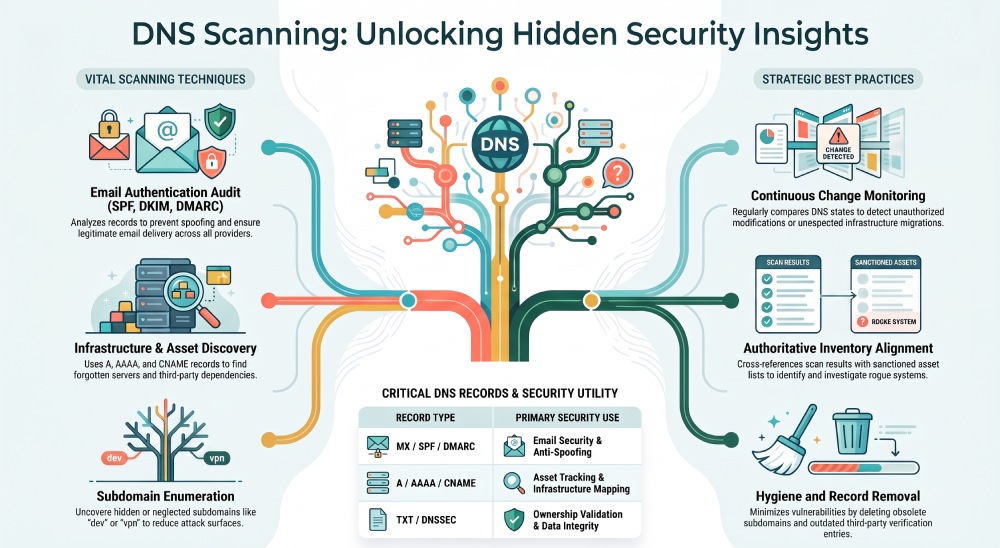
A records link domain names to IPv4 addresses, while AAAA records connect hostnames to IPv6 addresses. Scanning these records aids in identifying the servers tied to a domain, which may include distinct hostnames for websites, application servers, VPNs, and APIs. Security teams can match the identified IP addresses against their asset inventories; any unexpected ones may suggest forgotten infrastructure, third-party hosting, or a need for further investigation. With the rise of IPv6, scanning AAAA records is crucial as some services may be overlooked during regular asset discovery.
2. MX Record Scanning
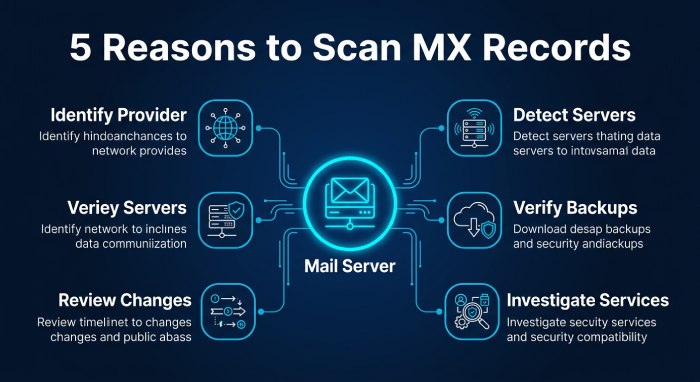
MX records specify the mail servers designated to handle email for a domain. Examining these records offers quick insights into an organization’s email setup, revealing if it utilizes cloud-based services, dedicated gateways, or various email providers.
MX analysis can help security teams:
- Identify the primary email provider
- Detect unexpected mail servers
- Verify backup mail systems
- Review changes to email infrastructure
- Investigate potentially abandoned services
Because attackers frequently target email infrastructure, monitoring MX records can become an important part of domain intelligence.
3. NS Record Enumeration
NS (Name Server) records pinpoint the authoritative DNS servers for a domain.
Examining these records reveals where DNS management occurs and if various providers are utilized — insightful information for security evaluations and infrastructure assessments.
It’s crucial for organizations to verify that their authoritative name servers are expected, secure, and under active management. Unrecognized name servers may require further scrutiny, as they are vital for domain security and availability.
Additionally, NS scanning can indicate alterations related to DNS migrations, hosting changes, or infrastructure updates.
4. TXT Record Analysis
TXT records are capable of holding significant security-related information. Organizations utilize them for SPF, domain verification, service ownership validation, and various security protocols. A DNS scanner can gather TXT records to assess crucial configurations.
In terms of email security, analyzing TXT records is particularly beneficial since SPF records are stored as TXT entries. Scanning can determine the existence of SPF records, check for multiple entries, and highlight any concerning configurations. Additionally, TXT records may indicate integrations with cloud platforms and third-party services, enhancing domain intelligence.
5. SPF Record Scanning
The Sender Policy Framework (SPF) defines the servers permitted to send emails for a specific domain.
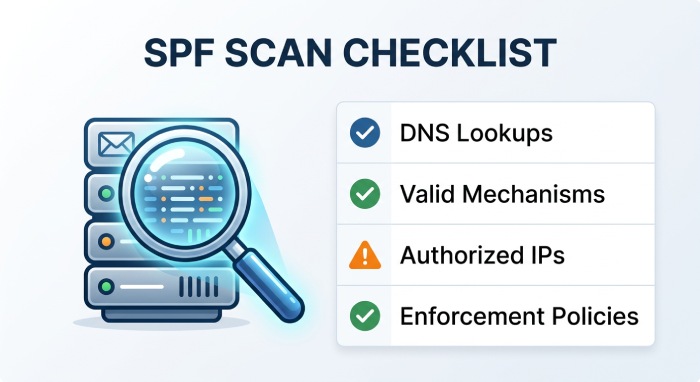
An SPF scan involves fetching the domain’s SPF record and examining its components, such as mechanisms, inclusions, redirects, IP addresses, and overall policy.
A proper SPF scan should look for issues such as:
- Multiple SPF records
- Excessive DNS lookups
- Invalid mechanisms
- Unauthorized sending sources
- Deprecated or unnecessary entries
- Incorrect use of include statements
- Weak or missing enforcement policies
During SPF evaluation, DNS-query-generating mechanisms and modifiers are subject to a limit of 10 lookups. Routine SPF checks enable organizations to detect configuration issues early, ensuring proper email authentication and deliverability.
6. DMARC Record Scanning
DMARC enhances email authentication by introducing policy and reporting features. A DNS scanner can verify the presence of a DMARC record, typically located at the _dmarc subdomain, and assess settings like policy, alignment modes, reporting addresses, and percentage controls.
A DMARC scan can identify whether the organization is using:
p=nonep=quarantinep=reject
It also assesses SPF and DKIM alignment and identifies reporting settings. For those worried about phishing and domain spoofing, DMARC scanning offers crucial insights into email authentication for the domain.
7. DKIM Selector Discovery
DKIM, or DomainKeys Identified Mail, employs cryptographic signatures that enable receiving systems to confirm email authorization by the sending domain. Public keys for DKIM are published in DNS records based on selectors, allowing scanners to locate known selectors and their corresponding keys. Selector discovery aids security teams in verifying the DKIM configurations of intended email platforms and can reveal outdated selectors from discontinued services. DKIM scanning is especially beneficial for organizations using multiple email providers, as each may utilize distinct selectors.
8. CNAME Enumeration
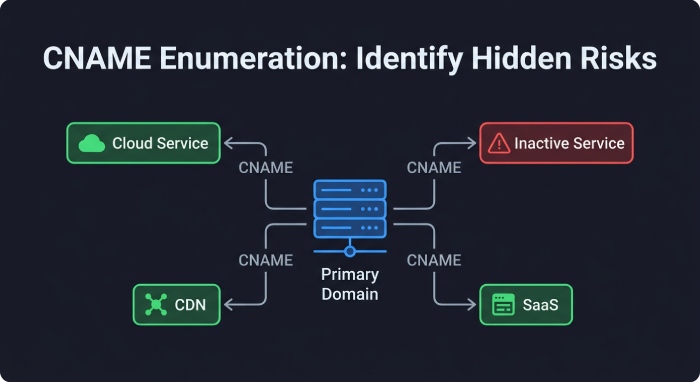
CNAME records establish aliases for different hostnames. Examining these records can uncover connections between an organization’s domains and external systems. For instance, a specific hostname might direct traffic to a cloud service, content delivery network, Software as a Service (SaaS) provider, or an email service.
CNAME enumeration serves as a valuable tool for assessing reliance on third-party services and for identifying DNS entries that may have been overlooked.
Security teams should especially monitor CNAME records that lead to services that are no longer in active use. Neglected third-party resources can sometimes present vulnerabilities that could be exploited through configuration-related attacks.
9. Subdomain Enumeration
Organizations often have significantly more subdomains than they realize.
Common examples include:
mail.example.comvpn.example.comapi.example.comdev.example.comportal.example.com
A DNS scanning process can uncover subdomains using DNS queries, certificate data, passive datasets, and other authorized methods. This subdomain enumeration enhances domain awareness by revealing the organization’s external-facing assets and services. Security teams can identify active subdomains, assess their services, and address any neglected systems that require removal or protection.
10. Reverse DNS Scanning
Reverse DNS translates an IP address to its corresponding hostname through PTR records. This method is beneficial for organizations that wish to link known IP addresses with their hostnames. It’s valuable for email investigations, infrastructure assessments, and threat analysis. Properly configured reverse DNS can support reliable mail-server identification and is an important consideration for email deliverability. Security teams can use forward and reverse DNS comparisons to spot discrepancies that may require further scrutiny.
11. DNSSEC Validation
DNSSEC, or Domain Name System Security Extensions, enhances DNS response security through cryptographic authentication. Scanning for DNSSEC verifies the presence and proper configuration of DNSSEC records, including DNSKEY, DS, and RRSIG. For security teams, analyzing DNSSEC reveals the ability to cryptographically validate DNS responses, highlighting risks like misconfigurations, expired keys, or compromised trust chains. It’s important to note that DNSSEC does not replace email authentication technologies like SPF, DKIM, or DMARC; rather, it secures the integrity of the DNS data itself.
12. DNS Change and Configuration Monitoring
A single DNS scan offers a momentary view, while continuous monitoring yields ongoing insights. Organizations can regularly check key DNS records and compare current results with previous states, enabling the identification of unexpected changes to records like MX, SPF, DKIM, DMARC, CNAME, and NS.
For instance, an unexpected alteration in an MX record might signal infrastructure migration or a security issue, while modifications to SPF or DMARC can impact email authentication and delivery. Thus, DNS change monitoring acts as an early-warning tool for both operational and security challenges.
How DNS Scanning Supports Email Security
The effectiveness of DNS scanning is significantly enhanced when integrated with email security monitoring. Since email authentication relies on DNS settings such as SPF for sender verification, DKIM for key publication, and DMARC for policy enforcement a comprehensive DNS security assessment should address these elements collectively. For instance, an organization may find that its SPF record permits an outdated email service while its DMARC policy is insufficient. By leveraging DNS intelligence, security teams can identify necessary updates based on these interconnected configurations.
Best Practices for DNS Scanning
Effective DNS scanning requires more than collecting records. Organizations should establish a repeatable process for analyzing and acting on the results.
- Maintain an Authoritative Asset Inventory: Cross-reference DNS findings with the organization’s sanctioned domain and infrastructure inventory. Rather than taking it for granted that every record is valid, delve into any unfamiliar systems.
- Monitor Critical DNS Records: Focus on the critical record types, including MX, NS, SPF, DKIM, DMARC, CNAME, as well as any additional records that have a direct impact on security or email functionality.
- Look for Configuration Drift: While not all DNS modifications indicate malicious intent, it is essential to assess any unexpected alterations. Maintaining a historical record of changes facilitates the differentiation between intended updates and potentially harmful actions.
- Validate Email Authentication Regularly: As organizations integrate new email providers, marketing tools, ticketing systems, and SaaS applications, the configurations for SPF, DKIM, and DMARC may require updates. Conducting periodic scans is essential to ensure that authentication remains consistent with the existing infrastructure.
- Remove Unused Records: Obsolete subdomains, CNAME records, email services, and verification records can lead to unwarranted vulnerabilities. A thorough review of DNS configurations should encompass the removal of outdated entries to enhance security.
General Manager
General Manager at DuoCircle. Product strategy and commercial lead across the email security portfolio.
Secure your email infrastructure
Protect, authenticate, and deliver. Contact our team to find the right solution.