9 Ways AI and Automation Improve Email Queue Management

Quick Answer
AI and automation improve email queue management by prioritizing critical messages, balancing workloads, reducing delays, removing duplicates, detecting delivery issues, and optimizing routing. This ensures faster, more reliable email delivery while reducing manual effort and improving performance.

Email remains a vital communication tool for businesses, serving various purposes such as sending transactional notifications, marketing messages, password resets, invoices, and customer support updates. To ensure efficient operations, a robust email infrastructure is essential for quick and reliable message delivery. At the core of seamless email communication is an effective email queue management system.
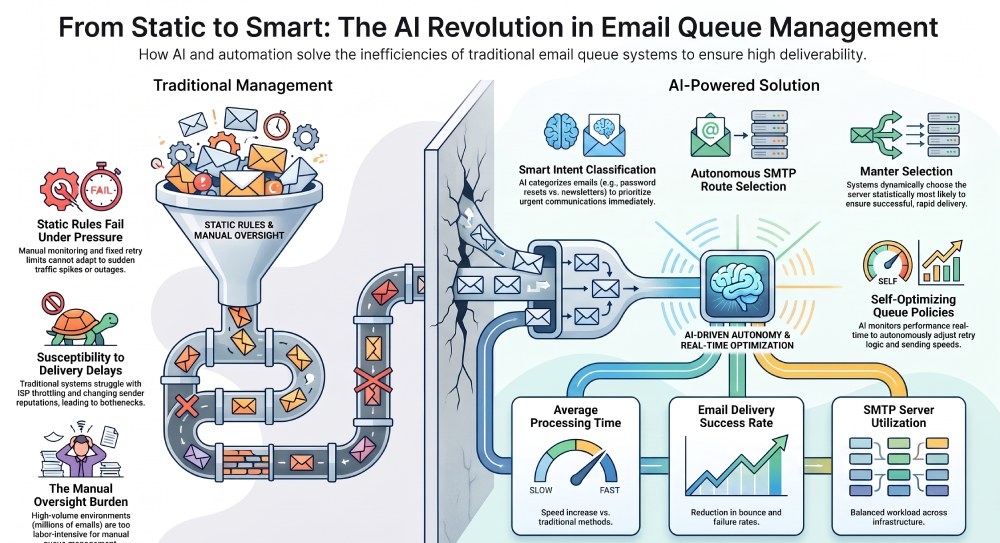
Historically, traditional email queue management has depended on set rules and manual oversight. While this strategy may suffice for smaller enterprises, many contemporary organizations dispatch thousands — or even millions — of emails each day. Handling such substantial volumes manually can be labor-intensive, inefficient, and susceptible to delays.
This is where Artificial Intelligence (AI) and automation come into play, reshaping the landscape of email queue management. AI-driven systems possess the capability to analyze delivery trends, foresee potential obstacles, prioritize critical emails, enhance sending speeds, and autonomously recover from failures, all without the need for human oversight.
In this article, we will delve into nine effective ways that AI and automation are enhancing email queue management, highlighting why businesses should consider integrating these advanced technologies.
What Is Email Queue Management?
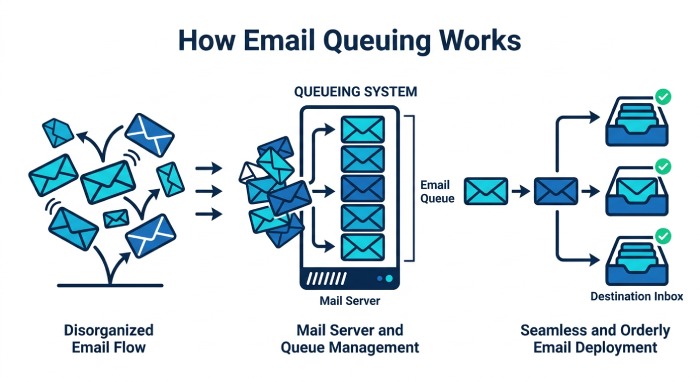
Email queue management involves the systematic organization, scheduling, prioritization, and transmission of outgoing emails via a mail server.
Rather than sending each email instantly, mail servers hold outgoing messages in a queue until they can be successfully delivered. Effective queue management plays a crucial role in this process:
- Which emails should be sent first
- How quickly emails should be delivered
- When failed messages should be retried
- How server resources are allocated
- How delivery issues are resolved
Effective queue management helps to avoid server overload, enhances deliverability, and guarantees prompt communication.
Why Traditional Queue Management Falls Short
Traditional email queue systems generally operate based on established guidelines, such as:
- First In, First Out (FIFO)
- Maximum retry attempts
- Static sending limits
- Manual queue monitoring
- Scheduled maintenance
While these approaches are generally effective, they face difficulties when addressing dynamic challenges, including:
- Sudden traffic spikes
- ISP throttling
- Temporary SMTP failures
- Blacklisting events
- Server outages
- Changing sender reputation
- Complex hybrid cloud environments
AI empowers systems to autonomously adjust to these scenarios, moving beyond the constraints of fixed regulations.
1. Smart Email Classification Before Queueing
Prior to an email being placed in the delivery queue, artificial intelligence can assess its intent and categorize it accordingly — be it as transactional, marketing, security-related, customer support, or system notification. This classification enables each email type to take the optimal delivery route and to be prioritized appropriately. By managing email traffic from the outset, organizations can minimize bottlenecks in the queue and enhance overall delivery efficiency.
Benefits
- Better queue organization
- Faster routing of critical emails
- Improved processing efficiency
- Reduced delivery conflicts
2. AI-Powered SMTP Route Selection
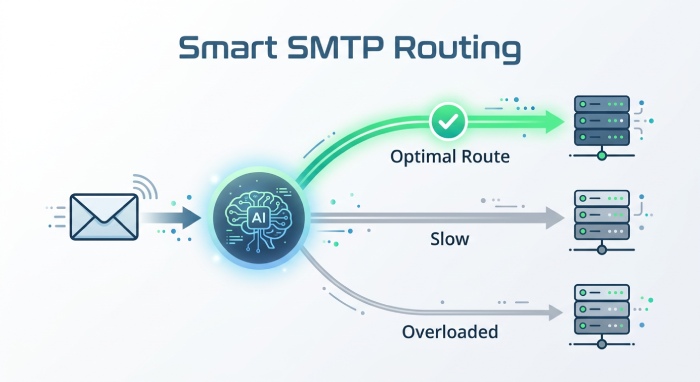
Numerous organizations employ a variety of SMTP servers or relay providers to enhance reliability. Artificial Intelligence systematically evaluates the status of servers, response times, and delivery success metrics, enabling it to identify the most optimal path for each outgoing email. Rather than depending on predetermined routing protocols, the system autonomously channels messages through the server that is statistically most likely to ensure successful delivery.
Benefits
- Higher delivery reliability
- Improved SMTP performance
- Reduced server overload
- Better utilization of available infrastructure
3. Automated Email Batch Optimization
Extensive email campaigns frequently dispatch thousands of messages simultaneously, which can put significant strain on mail servers. Artificial intelligence effectively segments outgoing emails into optimized groups, taking into account recipient domains, server capabilities, and current traffic conditions. This strategic allocation reduces congestion and ensures consistent delivery speeds.
Benefits
- Balanced server workloads
- Faster campaign execution
- Lower risk of bottlenecks
- Improved delivery consistency
4. AI-Based Queue Anomaly Detection
Artificial intelligence continually monitors queue activities to detect any irregularities that may suggest operational challenges. Significant increases in the number of queued messages, irregular bounce rates, or unanticipated delays in delivery can serve as early warnings of potential issues. Recognizing these signs promptly enables administrators to address problems proactively, ensuring seamless email delivery.
Benefits
- Early problem detection
- Reduced service interruptions
- Faster troubleshooting
- Improved system reliability
5. Automated Queue Cleanup and Maintenance
As time progresses, email queues can gather messages that are expired, duplicated, or undeliverable, leading to significant consumption of system resources. Utilizing AI technology, unnecessary emails are effectively identified and eliminated, while ensuring that valid email security communications remain intact. This automated maintenance process enhances the efficiency of email queues, all without the need for manual oversight.
Benefits
- Cleaner email queues
- Improved server performance
- Lower storage requirements
- Reduced administrative workload
6. Intelligent Workload Distribution Across Servers
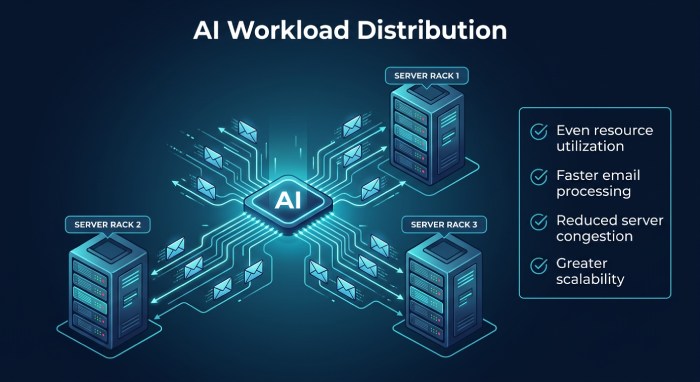
In distributed email systems, artificial intelligence effectively manages the distribution of outgoing email traffic among various servers by assessing their present workload and capacity. This proactive approach prevents any single server from becoming overwhelmed while others sit unused, ensuring that traffic is consistently redistributed to enhance overall efficiency.
Benefits
- Even resource utilization
- Faster email processing
- Reduced server congestion
- Greater scalability
7. Automated Compliance-Aware Queue Processing
Various sectors and geographic areas establish particular regulations for email communications. Artificial intelligence can identify these compliance requirements and facilitate the handling of emails in accordance with established policies, including encryption protocols, retention guidelines, and geographical sending limitations. This capability assists organizations in upholding regulatory standards while optimizing their email processes.
Benefits
- Improved regulatory compliance
- Reduced risk of policy violations
- Consistent email handling
- Enhanced data protection
8. AI-Driven Queue Performance Reporting
AI offers dynamic insights into email queue performance, moving away from conventional static reports. By evaluating factors such as delivery speed, processing durations, bounce rates, and server efficiency, these advanced analyses provide IT teams with valuable information. This enables them to pinpoint areas for improvement and make data-driven decisions effectively.
Benefits
- Better operational visibility
- Data-driven decision making
- Easier performance tracking
- Continuous process improvement
9. Self-Optimizing Queue Policies
Conventional email systems rely on manually set queue rules, necessitating regular updates. In contrast, AI monitors queue performance in real-time and autonomously enhances processing strategies in response to evolving traffic patterns, delivery results, and infrastructure conditions. This capability enables the queue management system to adjust dynamically, reducing the need for ongoing administrative intervention.
Benefits
- Reduced manual configuration
- Adaptive queue management
- Improved delivery efficiency
- Long-term operational optimization
Best Practices for Implementing AI in Email Queue Management
Prioritize Emails Based on Business Importance
Emails vary in urgency, and it’s essential to adapt AI systems to categorize and prioritize them according to their intent. Important messages, such as password reset notifications, one-time passwords (OTPs), transaction receipts, and security alerts, should take precedence over promotional content or newsletters. By intelligently prioritizing these communications, we can minimize delays for urgent matters and enhance the overall customer experience.
Continuously Monitor and Train AI Models
AI systems enhance their performance by incorporating fresh data. It is essential to consistently monitor key delivery metrics, including queue lengths, bounce rates, delivery times, and server efficiency. Updating AI models with current email traffic trends allows them to adjust to seasonal fluctuations, shifts in user behavior, and changing sending demands.
Integrate AI with Real-Time Queue Monitoring
AI achieves optimal performance when it can utilize real-time queue information. Integrate your AI system with monitoring tools that provide insights into email traffic, the status of SMTP servers, delivery delays, and retry attempts. This integration empowers AI to efficiently manage workloads, mitigate potential bottlenecks, and swiftly address sudden increases in traffic.
Combine AI Automation with Human Oversight
AI is capable of automating processes such as queue prioritization, retry logic, and routing decisions. However, it remains essential for administrators to examine key alerts and performance reports. Human oversight plays a critical role in verifying AI suggestions, refining policies, probing into atypical delivery problems, and maintaining compliance with both business and regulatory standards.
Establish Clear Performance Metrics
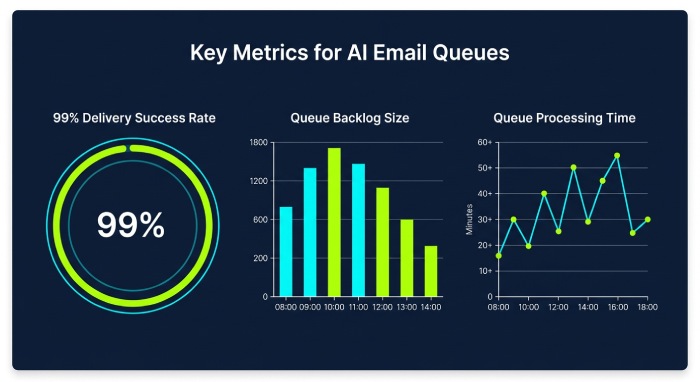
Establish clear, measurable objectives prior to integrating AI into your email queue management system. Monitor essential Key performance metrics (KPIs) including:
- Average queue processing time
- Email delivery success rate
- Queue backlog size
- Retry success rate
- SMTP server utilization
- Customer response times
Consistently assessing these metrics enables the evaluation of AI’s impact on efficiency and highlights potential areas for additional enhancement.
Common challenges when using AI for Email Queue Management:
Data Quality and Accuracy
Artificial Intelligence depends on accurate and comprehensive data to function effectively. If there are gaps or errors in email metadata, recipient details, or past sending patterns, the AI’s ability to prioritize messages correctly could be compromised, potentially resulting in delayed deliveries or diminished operational efficiency.
Integration with Existing Email Infrastructure
Numerous organizations rely on outdated email servers or a variety of email platforms. The integration of AI-driven queue management systems with current SMTP servers, email gateways, and cloud services can be intricate and might necessitate further configuration or bespoke development.
Balancing Automation with Human Control
Although AI has the capability to manage the prioritization and distribution of emails, it remains essential for businesses to maintain human supervision for crucial communications. Excessive dependence on automation can occasionally lead to significant emails being miscategorized or delayed due to inaccuracies in AI decision-making.
Privacy, Security, and Compliance Concerns
AI technologies frequently examine email metadata and transmission behaviors to enhance queuing efficiency. It is crucial for organizations to guarantee that their AI applications adhere to regulatory standards such as GDPR, HIPAA, or PCI DSS, and to establish robust security protocols to safeguard sensitive email information.
Continuous Training and Performance Monitoring
AI models require ongoing attention and cannot simply be deployed without further consideration. The dynamics of email traffic, emerging spam threats, and shifts in customer behavior are continually changing. To ensure precise email prioritization and effective queue management, organizations must consistently evaluate AI performance, update models with new data, and adjust algorithms as needed.
The Future of AI in Email Queue Management:
- Autonomous Email Queue Optimization: If your roadmap includes building such autonomous systems, an agentic AI course covering agent architectures, reinforcement learning, and production MLOps can accelerate delivery.
- Predictive Queue Management: Artificial intelligence will analyze past sending behaviors, recipient interactions, and the performance of the infrastructure to forecast potential traffic surges in advance. By implementing this forward-looking strategy, it aims to mitigate queue congestion and minimize delivery delays.
- Smarter Multi-Channel Integration: Email queue management systems are set to progressively incorporate SMS, push notifications, and collaborative tools. Artificial intelligence will identify the most efficient communication medium and facilitate message dissemination across various platforms. This shift accelerated in 2025 after verizon email to text discontinued its free gateway, pushing businesses to adopt registered email-to-text services that route operational messages through compliant channels.
- Advanced Deliverability Intelligence: Advanced AI systems will oversee Internet Service Provider activities, assess the credibility of senders, track spam patterns, and evaluate authentication signals in real time. These systems will dynamically modify sending strategies to enhance delivery into inboxes and reduce bounce rates.
- Self-Healing Email Infrastructure: Upcoming AI-driven systems will identify problems such as delivery failures, server disruptions, or configuration errors, and subsequently implement automatic corrective measures. This self-correcting feature will enhance system availability, minimize the need for manual problem solving, and guarantee uninterrupted email delivery.
AI-powered queue management helps organizations deliver email faster, reduce server overload, and improve operational efficiency. When combined with secure SMTP relay, email authentication, and email continuity solutions from DuoCircle, businesses can build a more reliable and resilient email infrastructure.
General Manager
General Manager at DuoCircle. Product strategy and commercial lead across the email security portfolio.
Secure your email infrastructure
Protect, authenticate, and deliver. Contact our team to find the right solution.