Authoritative vs. Recursive DNS: Understanding the Key Differences

Quick Answer
Recursive DNS finds and returns DNS information for clients, often using cached results. Authoritative DNS maintains the official records for a domain or zone. Together, they enable reliable DNS resolution, caching, website access, and email authentication.

The Domain Name System (DNS) is one of the core technologies that keeps the internet working. Whenever you type a website address into a browser, DNS helps locate the server associated with that domain name. Although this process usually happens in the background within seconds, several types of DNS servers work together to complete a lookup.
Two of the most important components are recursive DNS servers and authoritative DNS servers. They perform different jobs, but both are essential to DNS resolution.
A recursive resolver searches for the information requested by a user, while an authoritative DNS server maintains the official DNS records for a domain. Understanding how these systems interact makes it easier to understand website accessibility, DNS performance, caching, and domain management.
What Is DNS?
DNS stands for Domain Name System. It is a distributed naming system that connects easy-to-remember domain names with numerical IP addresses.
For example, people can enter:
example.com
instead of remembering an IP address such as:
203.0.113.10
When you request a website, your device needs to determine which IP address corresponds to the domain. DNS performs that lookup so the browser can establish a connection with the appropriate server.
DNS does much more than resolve website addresses. It can also provide information through records such as:
- A records for IPv4 addresses
- AAAA records for IPv6 addresses
- MX records for mail servers
- TXT records for text-based information
- CNAME records for aliases
- NS records for name servers
- SOA records for zone administration
Different DNS servers and systems cooperate to retrieve this information.
How DNS Resolution Works
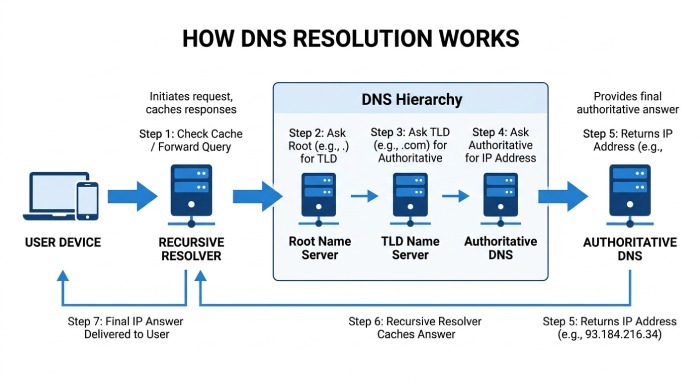
When a user enters a domain into a browser, the device generally sends a DNS request to a recursive resolver.
The resolver checks whether it already knows the answer. If the required record is available in its cache and has not expired, the resolver can return the cached response immediately.
If the information is not cached, the recursive resolver searches through the DNS hierarchy to locate the appropriate authoritative server.
A simplified process looks like this:
User device → Recursive resolver → Root DNS → TLD DNS → Authoritative DNS → Recursive resolver → User device
The exact process can vary depending on the request and available cached information, but the fundamental idea remains the same: the recursive resolver finds the answer, while the authoritative server provides the official information for the domain.
What Is Recursive DNS?
A recursive DNS server, also called a recursive resolver, handles DNS requests on behalf of users and applications.
Its job is to find an answer to a DNS query. Rather than requiring the user’s device to communicate with multiple DNS servers, the resolver performs much of the lookup process for the client.
For example, if someone requests the IP address of example.com, the recursive resolver may need to locate the appropriate authoritative server before it can return the requested address.
What Does a Recursive DNS Server Do?
A recursive resolver typically performs several tasks during DNS resolution:
- Receives a DNS request from a client.
- Checks its local cache for an existing answer.
- Searches the DNS hierarchy if the answer is unavailable.
- Contacts the appropriate DNS servers.
- Obtains the requested DNS record.
- Returns the result to the requesting device.
- Stores the response temporarily when caching is permitted.
This process allows end users to make simple DNS requests without having to understand the underlying DNS hierarchy.
Recursive DNS and Caching
Caching is one of the most important functions of recursive DNS.
Suppose thousands of users request the same domain. Without caching, a resolver might need to repeatedly contact authoritative servers for identical information.
Instead, the resolver can temporarily store the response.
The amount of time a DNS response can remain cached is controlled by its Time to Live (TTL) value. Once the TTL expires, the resolver needs to obtain a fresh response.
Caching can:
- Reduce DNS lookup time
- Lower traffic between DNS servers
- Reduce repeated requests to authoritative infrastructure
- Improve the overall responsiveness of applications and websites
However, caching also means that DNS changes may not appear everywhere immediately. Different resolvers may retain older information until the relevant TTL expires.
What Is Authoritative DNS?
An authoritative DNS server is responsible for providing the official DNS information for a particular domain or DNS zone.
Instead of searching elsewhere for an answer, an authoritative server maintains the records that define how the domain should resolve.
For example, a domain’s authoritative DNS zone may contain records identifying:
- Website IP addresses
- Mail servers
- DNS name servers
- Domain aliases
- TXT information
- Other DNS configuration details
When a recursive resolver reaches the authoritative server responsible for a domain, it can request the required record directly.
What Makes an Authoritative DNS Server Different?
The defining characteristic of an authoritative server is that it has authority over the DNS zone it serves.
For example, if a domain’s DNS zone contains an A record pointing a hostname to an IP address, the authoritative DNS infrastructure is responsible for providing that record when queried.
This makes authoritative DNS the source from which recursive resolvers obtain the domain’s DNS information.
DNS Zones and Authoritative Servers
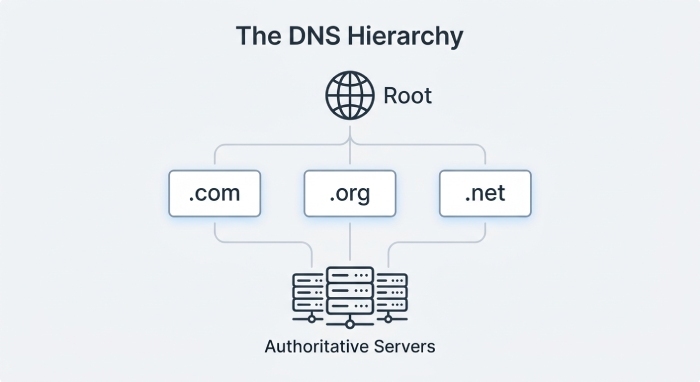
DNS is organized into a hierarchy.
At the top is the root DNS system, followed by top-level domains (TLDs) such as .com, .org, and .net. Individual domains are then delegated to authoritative name servers.
For example, when resolving a domain ending in .com, the DNS hierarchy can help identify which authoritative name servers are responsible for the specific domain.
The authoritative servers then provide the DNS records configured for that domain.
Recursive DNS vs. Authoritative DNS
Although both server types participate in DNS resolution, they have different responsibilities.
| Feature | Recursive DNS | Authoritative DNS |
|---|---|---|
| Primary purpose | Finds DNS answers for clients | Provides official DNS records |
| Main users | Devices, applications, networks | Domain owners and DNS infrastructure |
| Stores DNS records | Temporarily through caching | Maintains records for assigned zones |
| Searches other DNS servers | Yes | Generally no |
| Provides authoritative answers | No | Yes |
| Uses caching | Commonly | Not typically for its own authoritative data |
| Client interaction | Receives queries from users and applications | Usually receives queries from DNS resolvers |
| Main responsibility | DNS resolution | DNS data management |
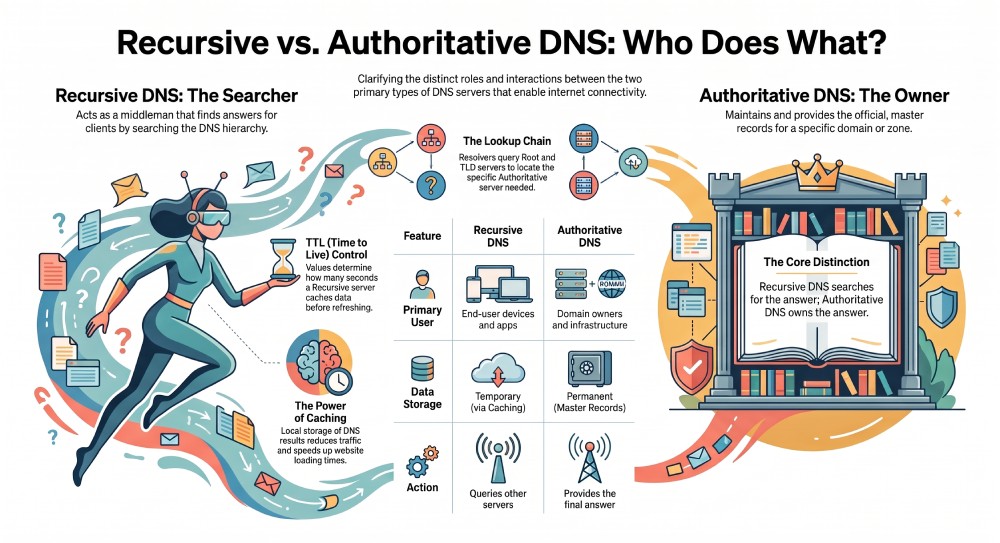
The simplest way to remember the distinction is:
Recursive DNS finds the answer. Authoritative DNS owns the answer.
Recursive DNS: Step-by-Step Example
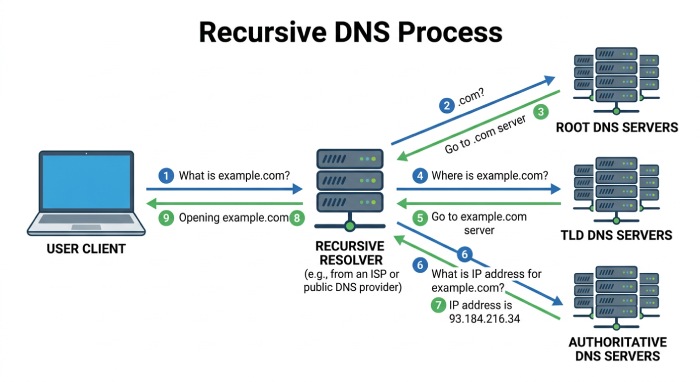
Imagine a user enters example.com into a browser.
Step 1: The Device Sends a DNS Query
The user’s device needs an IP address for the requested domain. It sends a DNS query to its configured recursive resolver.
Step 2: The Resolver Checks Its Cache
The recursive resolver first determines whether it already has a valid response.
If a cached record exists and its TTL has not expired, the resolver can respond without performing another full lookup.
Step 3: The Resolver Searches the DNS Hierarchy
If the answer is not available in the cache, the resolver begins looking for the appropriate DNS information.
It may communicate with root and TLD DNS infrastructure to determine where the domain’s authoritative servers are located.
Step 4: The Authoritative Server Responds
The resolver eventually reaches the authoritative server responsible for the requested domain.
The authoritative server provides the relevant DNS record.
Step 5: The Resolver Returns the Result
The recursive resolver sends the answer back to the user’s device.
The browser can then use the returned IP address to connect to the requested service.
Step 6: The Response May Be Cached
The recursive resolver can store the response according to its TTL.
Future requests for the same information may therefore be answered more quickly.
Why Recursive DNS Matters
Recursive DNS is essential because it hides much of the complexity of DNS resolution from end users.
Without recursive resolvers, individual devices would need to perform much more of the DNS lookup process themselves.
Recursive infrastructure helps:
- Simplify DNS requests
- Reduce repeated queries
- Improve lookup performance through caching
- Distribute DNS traffic
- Provide centralized DNS resolution for networks
- Support large numbers of simultaneous users
Recursive resolvers are commonly operated by network providers, organizations, public DNS services, and other infrastructure operators.
How Recursive and Authoritative DNS Work Together
Recursive and authoritative DNS should not be viewed as competing systems. They perform complementary functions.
A typical interaction looks like this:
1. Client requests DNS information
↓
2. Recursive resolver receives the request
↓
3. Resolver checks its cache
↓
4. Resolver searches the DNS hierarchy when necessary
↓
5. Authoritative server provides the domain’s official record
↓
6. Recursive resolver sends the answer to the client
↓
7. Resolver may cache the response
This division of responsibilities makes DNS scalable. Recursive systems handle requests from clients, while authoritative systems maintain DNS information for the domains under their control.
DNS Caching and TTL
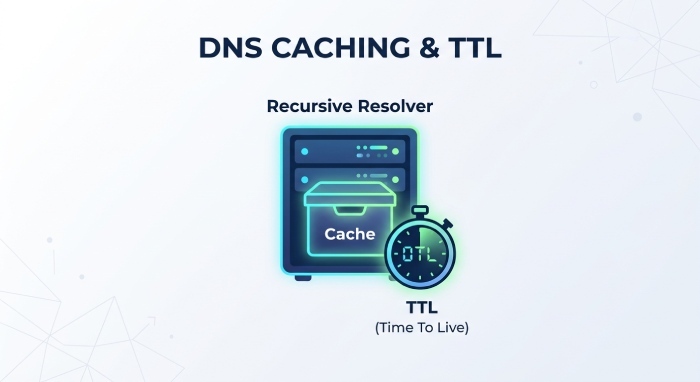
Caching deserves special attention because it affects how quickly DNS changes become visible.
Every DNS record can have a TTL value. This value tells recursive resolvers how long the information can generally be retained in their caches.
For example, if a record has a TTL of 3,600 seconds, a resolver can typically retain that response for up to one hour before needing to retrieve fresh information.
A shorter TTL causes recursive resolvers to refresh cached DNS information sooner, while a longer TTL can reduce repeated DNS lookups and improve caching efficiency.
DNS administrators therefore need to consider both performance and update requirements when selecting TTL values.
Recursive DNS and Authoritative DNS Security
Security is another important consideration for DNS infrastructure.
Recursive and authoritative systems face different operational challenges.
Recursive resolvers need to handle potentially large numbers of requests and protect against abuse such as excessive query traffic, cache-related attacks, and malicious DNS activity.
Authoritative servers need to protect the DNS records they publish and maintain the integrity and availability of their DNS zones.
DNSSEC can also be used to provide cryptographic validation for DNS data. It helps DNS resolvers verify that certain DNS responses originate from the correct DNS chain and have not been altered.
Proper DNS configuration, access controls, monitoring, redundancy, and security practices can help protect both recursive and authoritative infrastructure.
Why DNS Matters for Email Security
DNS plays an important role in email security because email systems rely on DNS records to identify mail servers and verify sending domains. Recursive resolvers retrieve these records, while authoritative DNS servers publish the records configured for a domain.
Several DNS record types are especially important for email:
- MX records identify the mail servers responsible for receiving email for a domain.
- SPF records specify which servers are authorized to send email on behalf of a domain.
- DKIM records publish the public key used to verify DKIM email signatures.
- DMARC records define how receiving mail servers should handle messages that fail authentication checks and can provide reporting instructions.

Because these records are retrieved through DNS, accurate and reliable DNS configuration is an important part of email delivery and authentication. Problems with DNS records can contribute to email delivery failures or authentication issues.
Final Thoughts
Recursive and authoritative DNS servers are two essential parts of the DNS ecosystem, but their responsibilities are different.
A recursive DNS server acts as the resolver between clients and the wider DNS hierarchy. It searches for requested information, uses caching to improve performance, and returns DNS responses to users and applications.
An authoritative DNS server maintains the official DNS records for a domain or DNS zone. When a recursive resolver needs information that is not already cached, it can obtain the relevant answer from the authoritative source.
In simple terms:
Recursive DNS searches. Authoritative DNS answers.
Understanding this distinction makes it easier to troubleshoot DNS issues, manage domains, evaluate DNS performance, and understand how users are connected to websites and online services.
General Manager
General Manager at DuoCircle. Product strategy and commercial lead across the email security portfolio.
Secure your email infrastructure
Protect, authenticate, and deliver. Contact our team to find the right solution.