Common PCI DSS Email Security Audit Findings And How To Avoid Them

Quick Answer
Common PCI DSS email security audit findings include weak email authentication, missing encryption, poor access controls, and inadequate monitoring. Prevent compliance issues by implementing SPF, DKIM, DMARC, MFA, email encryption, regular audits, and continuous employee security training.
Organizations that process, store, or transmit payment card data face increasing pressure to maintain strong cybersecurity controls. While firewalls, endpoint protection, and network segmentation often receive significant attention, email security remains one of the most overlooked areas during a PCI DSS assessment. Unfortunately, attackers know this too. Phishing campaigns, compromised mailboxes, insecure email configurations, and weak authentication policies continue to be common pathways for data breaches involving cardholder information.
The Payment Card Industry Data Security Standard (PCI DSS) establishes a framework designed to protect payment card data from unauthorized access. Version 4.0 places even greater emphasis on continuous security practices, risk assessments, and protecting systems that can impact the Cardholder Data Environment (CDE). Because email is frequently used for communication, file sharing, customer support, invoices, and notifications, email systems often become part of the security conversation during audits.
PCI DSS email security audits regularly uncover similar weaknesses across organizations of all sizes. The good news is that most findings are preventable with proactive planning, strong policies, and layered email security controls. Understanding the most common audit findings can help your organization reduce compliance risks, improve cyber resilience, and strengthen overall protection against modern email threats.
Why Email Security Matters for PCI DSS Compliance
Although PCI DSS does not focus exclusively on email, many email-related vulnerabilities can directly affect the confidentiality and integrity of cardholder data. A successful phishing attack against an employee may provide attackers with access to systems connected to the CDE. Malware delivered through email attachments can compromise endpoints that handle payment information. Unauthorized email forwarding can expose sensitive customer records.
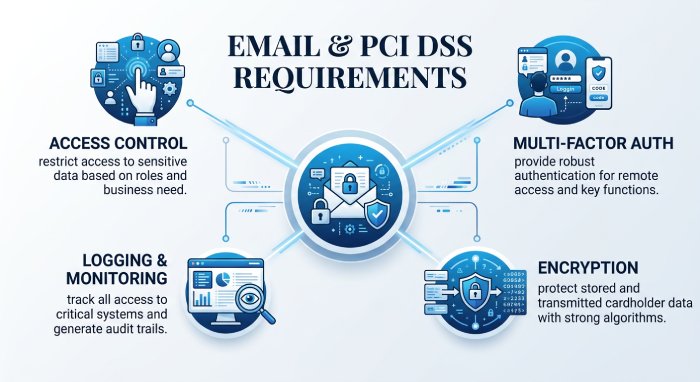
Email also intersects with several PCI DSS requirements, including:
- Access control
- Multi-factor authentication
- Logging and monitoring
- Security awareness training
- Vulnerability management
- Incident response
- Encryption of sensitive data
- Authentication and identity management
As a result, auditors frequently review email configurations, security controls, policies, and employee practices during PCI DSS assessments.
Finding #1: Missing or Misconfigured SPF, DKIM, and DMARC Records
One of the most common PCI DSS email security audit findings is incomplete email authentication. Many organizations either fail to implement SPF, DKIM, and DMARC or configure them incorrectly.
Without these protocols, attackers can spoof your domain and send phishing emails that appear legitimate. Domain spoofing can lead to credential theft, malware infections, and reputational damage that may ultimately affect systems involved in payment processing.
How to Avoid It
Implement all three email authentication protocols:
- SPF to identify authorized sending servers.
- DKIM to digitally sign outgoing emails.
- DMARC to define policies for handling authentication failures.
Regularly validate DNS records after changes, monitor DMARC reports, and ensure all legitimate email services are included in SPF records. Periodic reviews are especially important after cloud migrations, mergers, acquisitions, or the addition of new email platforms.
Finding #2: Lack of Multi-Factor Authentication for Email Accounts
Email accounts are prime targets for attackers because they often contain password reset links, internal communications, invoices, and access to sensitive systems.
PCI DSS 4.0 places strong emphasis on multi-factor authentication (MFA), particularly for administrative access and access into the CDE. Auditors frequently identify organizations that still rely solely on passwords for email access.
How to Avoid It
Require MFA for:
- All administrator accounts.
- Remote email access.
- Cloud email platforms.
- Privileged users.
- Any account with access to systems impacting cardholder data.
Use phishing-resistant MFA methods whenever possible. Hardware security keys, authenticator applications, and FIDO2-based authentication generally provide stronger protection than SMS-based verification.
Finding #3: Inadequate Email Access Controls
Auditors commonly discover excessive permissions within email environments. Employees may retain access after changing roles, shared mailboxes may have too many authorized users, or former employees may still possess active accounts.
Excessive privileges violate the principle of least privilege and increase the risk of unauthorized access.
How to Avoid It
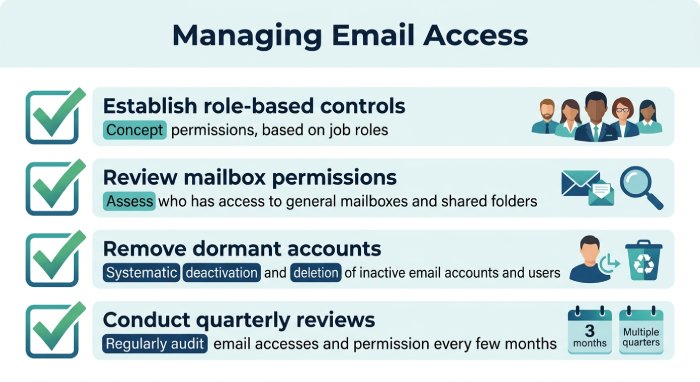
Establish role-based access controls for all email systems. Access should be granted strictly according to business requirements.
Organizations should also:
- Review mailbox permissions regularly.
- Remove dormant accounts promptly.
- Disable accounts immediately after employee termination.
- Conduct quarterly access reviews.
- Document all approval workflows.
A well-documented identity and access management process can significantly reduce audit findings.
Finding #4: Weak Password Policies
Weak password requirements continue to appear in PCI DSS assessments despite years of security awareness efforts. Auditors may find inadequate password lengths, reused passwords, or a lack of controls preventing compromised credentials.
How to Avoid It
Implement modern password policies that include:
- Long passphrases.
- Password managers.
- Prohibited password lists.
- Monitoring for compromised credentials.
- MFA as an additional layer of security.
Avoid forcing frequent password changes unless there is evidence of compromise, as unnecessary password resets can encourage weaker password habits.
Finding #5: Unencrypted Transmission of Sensitive Information Through Email
Some organizations still send sensitive customer information, internal reports, or payment-related data through unencrypted email channels.
Even if complete card numbers are not transmitted, unencrypted sensitive information can still create compliance concerns and expose the organization to unnecessary risk.
How to Avoid It
Deploy secure email encryption solutions for sensitive communications.
Best practices include:
- TLS enforcement for email transport.
- Secure email portals when exchanging confidential information.
- Data Loss Prevention (DLP) tools.
- Automatic encryption policies.
- User guidance on secure communication procedures.
Employees should understand which information can be transmitted through email and which information requires secure alternatives.
Finding #6: Insufficient Email Logging and Monitoring
PCI DSS requires organizations to track and monitor access to systems and security events. Auditors frequently identify inadequate logging within email environments.
Missing logs can make it difficult to investigate incidents, detect suspicious activity, or demonstrate compliance.
How to Avoid It
Ensure email systems generate logs for:
- Authentication attempts.
- Administrative actions.
- Mail flow activity.
- Permission changes.
- Mailbox access events.
- Forwarding rule creation.
- Security policy modifications.
Centralized logging through a SIEM platform can improve visibility and accelerate incident response.
Finding #7: Poor Email Retention and Data Retention Practices
Organizations sometimes retain emails indefinitely without documented retention policies. Others delete records prematurely, preventing forensic investigations or compliance verification. Poor data retention practices can complicate both PCI DSS compliance and legal obligations.
How to Avoid It
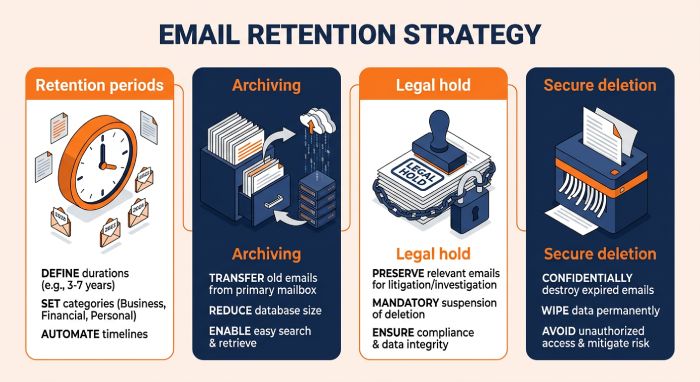
Develop formal email retention policies that define:
- Retention periods.
- Archiving requirements.
- Legal hold procedures.
- Secure deletion processes.
- Backup retention schedules.
Retention policies should align with compliance requirements, business needs, and broader data retention strategies.
Finding #8: Lack of Security Awareness Training
Employees remain one of the most targeted attack vectors. Auditors frequently identify inadequate security awareness programs or inconsistent phishing education.
A single successful phishing email can lead to compromised credentials, malware infections, or unauthorized access to systems associated with cardholder data.
How to Avoid It
Provide regular security awareness training covering:
- Phishing attacks.
- Business email compromise.
- Malicious attachments.
- Social engineering tactics.
- Password hygiene.
- Reporting suspicious emails.
Conduct simulated phishing campaigns to measure employee readiness and continuously improve training effectiveness.
Finding #9: Insecure Email Forwarding Rules
Automatic forwarding rules are often overlooked during security reviews. Attackers who compromise an account frequently create hidden forwarding rules to maintain access to sensitive communications.
Auditors may identify uncontrolled forwarding practices as a security weakness.
How to Avoid It
Monitor and restrict:
- External auto-forwarding.
- Hidden inbox rules.
- Unauthorized mailbox delegation.
- Automatic forwarding to personal accounts.
Organizations should alert security teams whenever forwarding rules are created or modified.
Finding #10: Unsupported or Unpatched Email Systems
Running outdated email servers or unsupported software versions is a major red flag during PCI DSS assessments. Unpatched vulnerabilities can provide attackers with direct entry points into the environment.
How to Avoid It
Establish a formal vulnerability and patch management program that includes:
- Regular vulnerability scans.
- Prompt security updates.
- Asset inventories.
- Software lifecycle tracking.
- Configuration management.
Cloud-based email platforms should also be monitored to ensure security settings remain aligned with organizational policies.
Finding #11: Missing Incident Response Procedures for Email Attacks
Organizations often have general incident response plans but fail to include specific procedures for email-related threats.
Auditors may find no documented process for handling:
- Phishing incidents.
- Compromised accounts.
- Business email compromise.
- Malware delivered via email.
- Credential theft.
How to Avoid It
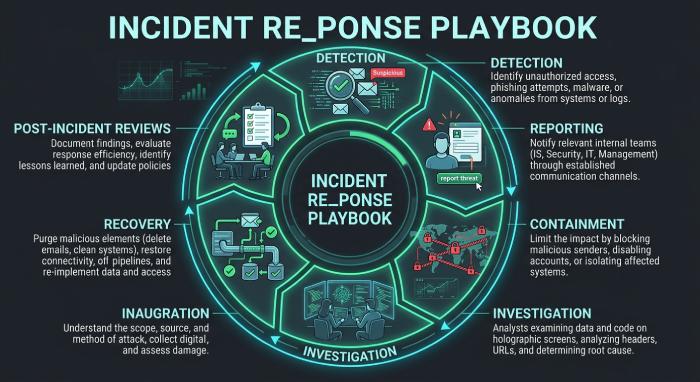
Develop email-specific incident response playbooks that clearly define:
- Detection procedures.
- Reporting channels.
- Containment steps.
- Investigation requirements.
- Recovery actions.
- Notification processes.
- Post-incident reviews.
Practicing tabletop exercises can help teams respond more effectively during real incidents.
Finding #12: Poor Vendor and Third-Party Email Security Oversight
Many organizations rely on third-party email providers, marketing platforms, payment vendors, or cloud services. Auditors may identify insufficient oversight of these vendors.
Third-party compromise can still impact your security posture and potentially affect systems connected to cardholder data.
How to Avoid It
Implement a vendor risk management program that evaluates:
- Security controls.
- Compliance certifications.
- Access permissions.
- Contractual obligations.
- Incident reporting requirements.
- Authentication practices.
- Encryption standards.
Periodic reviews help ensure vendors continue to meet your security expectations.
Building an Email Security Strategy That Supports PCI DSS Compliance
Avoiding audit findings requires more than deploying individual security tools. Effective PCI DSS email security relies on a layered approach that combines technology, policies, employee awareness, and continuous monitoring.
A mature strategy should include:
- SPF, DKIM, and DMARC implementation.
- Strong identity and access management.
- Multi-factor authentication.
- Email encryption.
- Security awareness training.
- Logging and monitoring.
- Vulnerability management.
- Incident response planning.
- Data retention policies.
- Vendor risk assessments.
Organizations that treat email security as an ongoing process rather than a one-time compliance exercise are typically better prepared for both audits and real-world threats.
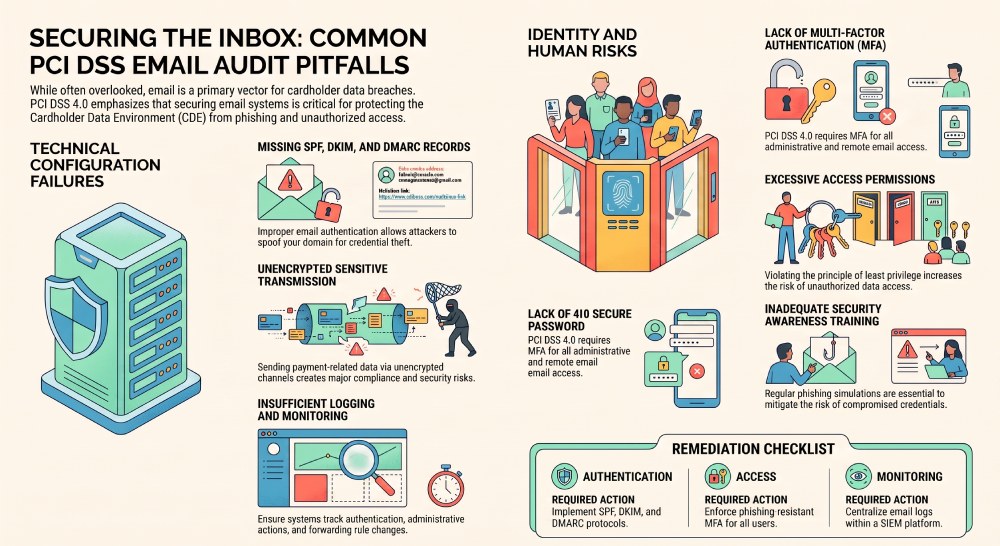 PCI DSS audits often reveal recurring email security weaknesses because email touches nearly every department, user, and business process. From phishing and credential theft to weak authentication and poor logging, email remains one of the most significant security risks facing organizations that handle payment card data.
By addressing common PCI DSS email security audit findings before an assessment occurs, organizations can strengthen compliance readiness, reduce operational risk, improve cyber resilience, and better protect sensitive information. Proactive email security is not only about passing an audit—it is a critical component of safeguarding customer trust and maintaining a secure payment ecosystem.
General Manager
General Manager at DuoCircle. Product strategy and commercial lead across the email security portfolio.
Secure your email infrastructure
Protect, authenticate, and deliver. Contact our team to find the right solution.