DNS A Vs AAAA Records: Key Differences And When To Use Each

Quick Answer
DNS A records point domains to IPv4 addresses, while AAAA records point to IPv6 addresses. Use A for IPv4 connections and AAAA for IPv6-enabled networks. Understanding the difference helps ensure reliable DNS resolution and connectivity.
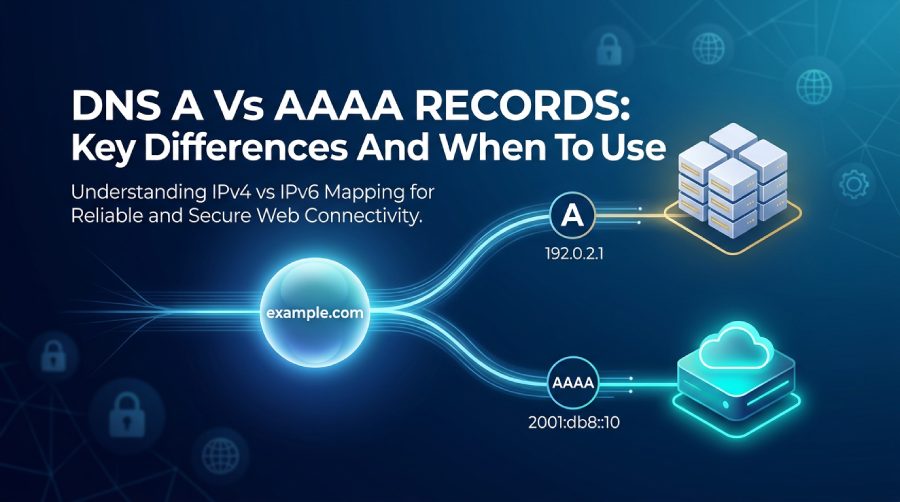
DNS A and AAAA records are essential building blocks of the Domain Name System (DNS), connecting human-readable domain names to the IP addresses that computers use to access websites, applications, APIs, and other online services. While both records perform the same basic function of mapping a hostname to an IP address, they support different Internet Protocol versions: A records use IPv4, while AAAA records use IPv6. Understanding the differences between them helps you choose the right DNS configuration, avoid connectivity issues, and support reliable dual-stack infrastructure.
In this guide, we’ll explain how A and AAAA records work, compare their key differences, explore common use cases, and show when you should use one or both for modern websites and applications.
What DNS Records Do and Where A/AAAA Fit In
The domain name system is the distributed naming layer that translates a human-readable domain name such as example.com into an IP address that computers can use to reach a web server, app endpoint, API, or other internet service. Without DNS, users would need to remember numeric internet addresses instead of memorable names.
At a technical level, DNS records are instructions stored in a DNS zone. Each resource record has a record type, a name, a TTL, and a record value. A name server hosts the authoritative data for the zone, while a DNS resolver performs a DNS lookup on behalf of the user or application. During that DNS lookup, the resolver sends a DNS query to locate the correct DNS server and retrieve the requested DNS resource.
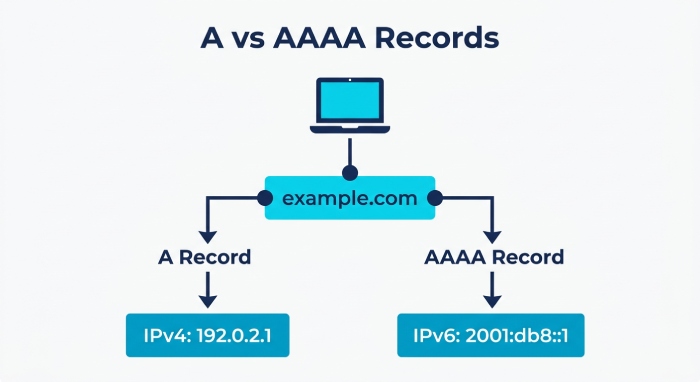 A and AAAA records are both address records. An A record maps a hostname to an IPv4 address, while an AAAA record maps a hostname to an IPv6 address. In other words, both serve the same broad purpose address mapping but they use different IP version formats.
Other DNS records serve different purposes. An MX record identifies the mail servers responsible for receiving email for a domain, while a CNAME record aliases one hostname to another. Other records, such as SPF, DKIM, DMARC, BIMI, MTA-STS, and TLS-RPT, support email authentication, security, and deliverability. Together, these DNS records help organizations maintain reliable web and email services while reducing configuration and security issues.
How a DNS Lookup Uses Address Records
When a browser loads a website, it usually begins with a DNS lookup for an address record. When a client connects to a hostname, its DNS resolver may retrieve both A and AAAA records. The client can then use the available IPv4 or IPv6 path based on network connectivity and connection-selection behaviour. Many modern systems request both DNS records and choose the best reachable path.
Authoritative DNS and Zone Files
In traditional DNS management, address records are stored in a zone file managed by a DNS provider or managed DNS platform. Organizations often centralize DNS configuration to simplify record management, reduce the risk of outages, and maintain reliable access to public-facing websites, applications, and services.
TTL and DNS Propagation
A low Time to live (TTL) can help changes to an A or AAAA record take effect sooner, but the timing still depends on DNS resolver caching behaviour. This matters when migrating hosting providers, changing a web application’s IP address, or moving services between cloud, hosting, and CDN environments.
DNS A Records Explained: IPv4 Mapping, Use Cases, and Examples
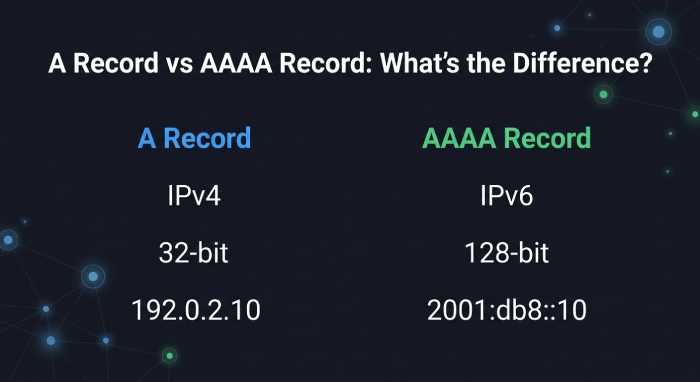
An A record is a DNS resource record that maps a hostname to an IPv4 address. IPv4 is the older and still widely used Internet Protocol addressing system. It uses 32-bit addresses written in dotted-decimal notation, such as:
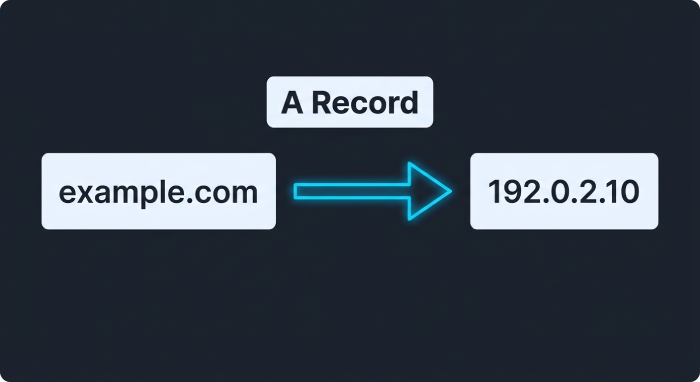
example.com.      3600    IN    A      192.0.2.10
www.example.com.  3600    IN    A      192.0.2.20
In this example, the A record for example.com points to 192.0.2.10, and the A record for www.example.com points to 192.0.2.20. During a DNS lookup, the resolver retrieves the A record and returns the IPv4 IP address to the client.
 Common A record use cases include:
- Hosting a website on an IPv4-enabled server
- Pointing an app subdomain, such as app.example.com, to an IPv4 endpoint
- Directing Application Programming Interfaces traffic to an IPv4 load balancer
- Mapping internal or external services in hybrid environments
- Supporting legacy systems that do not fully support IPv6
Because IPv4 has been used for decades, an A record offers broad compatibility. Many networks, older routers, legacy devices, and enterprise systems still rely heavily on IPv4. For businesses running outbound email systems, customer portals, or supplier platforms, the A record remains essential for reachability.
However, IPv4 address space is limited. Public IPv4 addresses are scarce, which is one reason the internet continues to move toward IPv6. Even so, the A record is not going away soon; it remains one of the most important DNS records in practical DNS configuration.
DNS AAAA Records Explained: IPv6 Mapping, Use Cases, and Examples
An AAAA record is the IPv6 equivalent of an A record. It maps a hostname to an IPv6 address instead of an IPv4 address. IPv6 uses 128-bit addresses written in hexadecimal notation, such as:
example.com.      3600    IN    AAAA   2001:db8::10
www.example.com.  3600    IN    AAAA   2001:db8::20
In this case, the AAAA record tells the domain name system that example.com and www.example.com can be reached over IPv6. When a client performs a DNS lookup, the resolver can return the AAAA record value if the client, network, and destination all support IPv6.
IPv6 was designed to solve the shortage of IPv4 addresses and improve long-term scalability. It is also important for modern cloud hosting, mobile networks, CDNs, IoT environments, and globally distributed applications. A properly configured AAAA record allows IPv6-capable users to connect without falling back to IPv4.
Typical AAAA record use cases include:
- Enabling IPv6 access for websites and web apps
- Supporting modern mobile carrier networks
- Preparing infrastructure for future internet growth
- Reducing dependency on scarce IPv4 space
- Improving compatibility with IPv6-first networks
From a network protocol perspective, IPv6 is not simply a longer address format. It is a newer generation of the Internet Protocol with a much larger address pool. Still, an AAAA record only works when the server, firewall, Content Delivery Network (CDN) , DNS provider, and application stack are all configured correctly for IPv6 traffic.
Key Differences Between A and AAAA Records: Address Format, Compatibility, and Performance
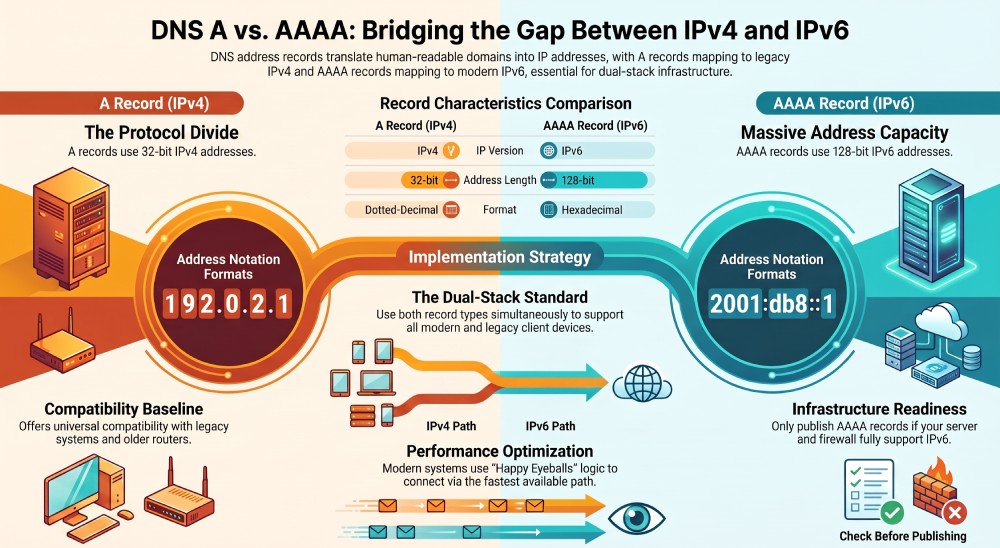
The main difference between an A record and an AAAA record is the type of IP address each returns. An A record returns an IPv4 address, while an AAAA record returns an IPv6 address.
Address Format
IPv4 addresses are shorter and use dotted-decimal notation:
192.0.2.10IPv6 addresses are longer and use hexadecimal notation:
2001:db8::10
This address format difference reflects the underlying IP version. IPv4 uses 32-bit addressing, while IPv6 uses 128-bit addressing.
Compatibility
An A record is still the safest baseline for universal compatibility because IPv4 remains widely supported. An AAAA record is essential for IPv6 reachability, but it should only be published when the destination service truly supports IPv6.
If an AAAA record points to an unreachable IPv6 endpoint, some users may experience slow page loads, connection failures, or fallback delays. This can affect user experience and, for web applications, revenue-critical conversion paths. For email-related hostnames, poor DNS records can also complicate domain health, although mail routing itself usually depends more directly on MX record, SPF, DKIM, DMARC, MTA-STS, and TLS-RPT configuration.
Performance and Routing
IPv6 may perform better in some networks, especially where carriers and cloud providers have optimized IPv6 routing. In other cases, IPv4 may still be faster or more stable. Modern operating systems often use connection selection logic, such as Happy Eyeballs, to test IPv4 and IPv6 paths and connect through the fastest working route.
For this reason, performance is not determined by the A record or AAAA record alone. It depends on hosting infrastructure, CDN edge locations, DNS resolver behavior, network routing, firewall policies, and the quality of the authoritative DNS server.
When to Use A, AAAA, or Both for Modern Website and App Hosting
Use an A record when your website, app, API, or service needs to be reachable through an IPv4 address. Because IPv4 remains widely supported across global networks, A records are still commonly used in production environments.
Use an AAAA record when the same service is fully reachable through an IPv6 address. Before publishing the AAAA record, confirm that the server listens on IPv6, the firewall allows IPv6 traffic, TLS certificates are valid for the hostname, and monitoring checks both IP versions.
Use both an A record and an AAAA record when you want dual-stack hosting. Dual-stack is the recommended approach for many modern websites and applications because it supports both IPv4 and IPv6 clients. In a dual-stack setup, the domain name system can return both DNS records during a DNS lookup, allowing the client to choose the best connection path.
For production DNS management, follow these practices:
- Keep A record and AAAA record values aligned with your hosting provider or CDN documentation.
- Test every hostname after DNS propagation using a DNS Record Checker.
- Monitor domain health, uptime, and reputation monitoring signals.
- Avoid publishing an AAAA record until IPv6 is fully configured end to end.
- Review related DNS records, including MX and CNAME records, and verify that SPF, DKIM, and DMARC are properly configured for email services.
- Use managed DNS from reliable DNS Providers for resilience and faster failover.
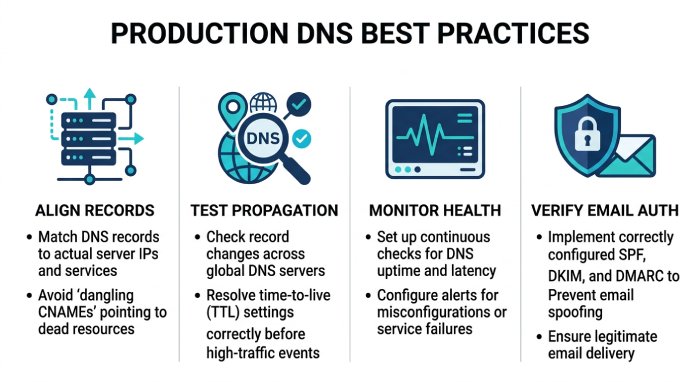 For organizations managing outbound email, accurate DNS configuration is essential for reliable delivery and domain security. Properly configured DNS records can support email authentication, reduce the risk of spoofing and phishing, and help maintain a strong sender reputation. Organizations should regularly review their DNS records and monitor authentication results to identify configuration issues before they affect email security or delivery.
General Manager
General Manager at DuoCircle. Product strategy and commercial lead across the email security portfolio.
Secure your email infrastructure
Protect, authenticate, and deliver. Contact our team to find the right solution.