How To Build A Cybersecurity Team That Protects Email In The Cloud

Quick Answer
A strong cloud email cybersecurity team combines security experts, email administrators, and IT staff to prevent phishing, spoofing, malware, and data breaches. Use DMARC, SPF, DKIM, MFA, threat monitoring, and regular security training to protect email.
Quick Answer
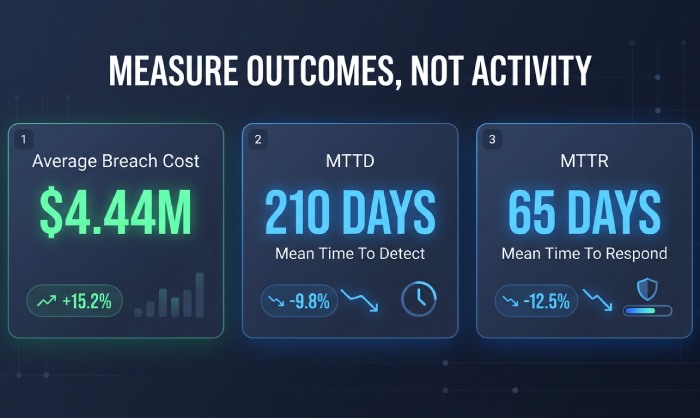
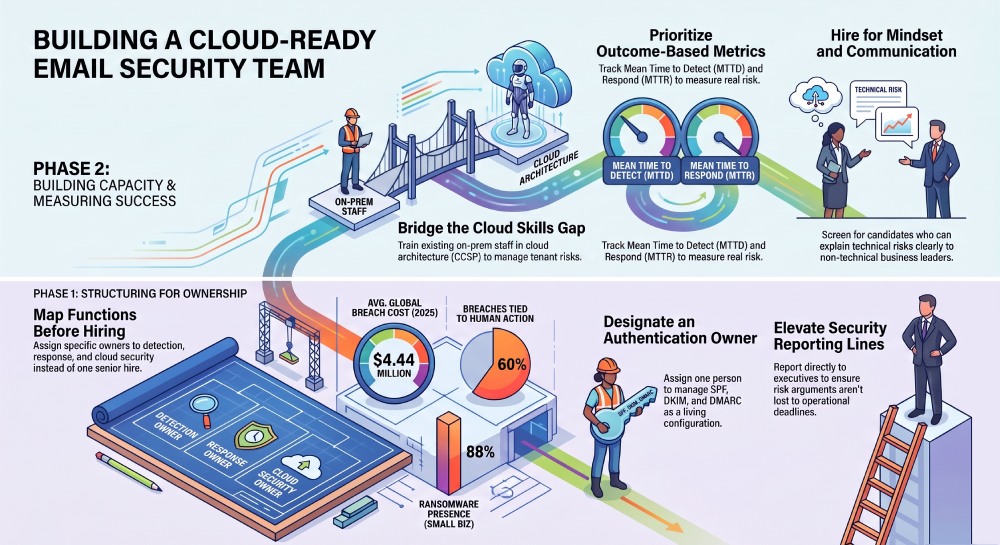
Most email breaches come down to people and process, not a missing tool. Business email now lives in Microsoft 365 and Google Workspace, and that shift moved the authentication, identity, and misconfiguration risk the provider does not cover onto the customer. A well-run program builds the team around functions rather than headcount, gives one person standing ownership of email authentication (SPF, DKIM, and DMARC, monitored through aggregate reports and pushed to a p=reject policy), closes the cloud skills gap with dedicated cloud security training, and runs regular phishing simulations while tracking detection and response times. IBM puts the 2025 global average breach cost at $4.44 million.
The tools are usually in place. A secure email gateway, spam filtering, maybe a phishing add-on, and a SIEM where the budget stretched. So why do the breach reports keep reading the same way?
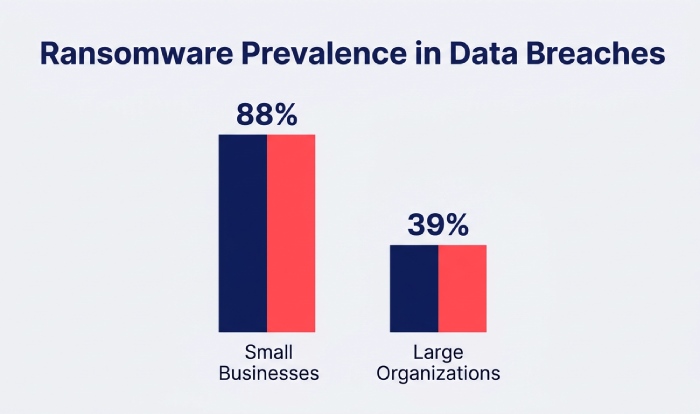
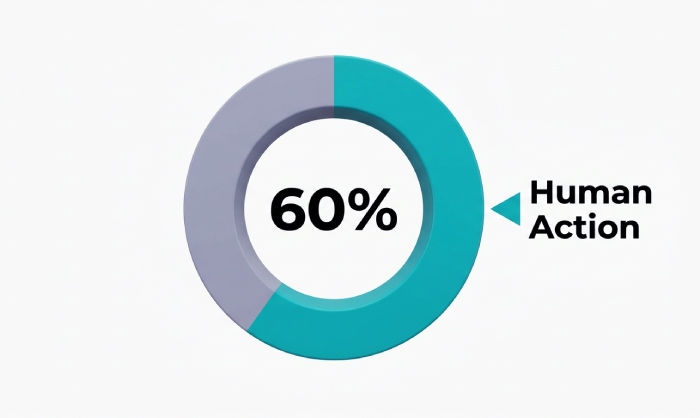
Because tools do not run themselves. Across the businesses that take the worst hits, the failure is rarely a missing product. It is a missing owner, a skills gap, or a process nobody kept current. Verizon’s 2025 Data Breach Investigations Report tied roughly six in ten breaches to human action, and small businesses absorb the brunt of it: ransomware showed up in 88% of small-business breaches, against 39% at large organizations.
The ground has also shifted. Email no longer lives in a server room down the hall. It lives in Microsoft 365 or Google Workspace, which means the cloud now decides a large share of the exposure, and a team running on on-prem instincts can miss that completely.
Here is how we would build a team that closes that gap, from the cloud email now runs on down to the inbox itself.
1. Map security functions before hiring
One senior hire cannot own detection, response, compliance, cloud, and end-user training all at once. Push a single person to cover all of it and the result is burnout, plus blind spots that surface mid-incident.
Before any job description gets written, list the functions the business actually needs someone accountable for:
- Threat detection and monitoring
- Incident response and recovery
- Identity and access management
- Cloud and infrastructure security
- Email security and domain authentication
- Compliance, risk, and security awareness across the wider staff
Not every function needs a separate person on day one. Each one does need a name next to it. In a small company, one strong hire might own four of these while a managed provider covers the rest. Mapping it first brings the hiring plan, the job specs, and the gaps into focus.
One thing quietly decides how well this works: reporting lines. A security function buried under IT tends to lose its risk arguments to operational deadlines. Give it a line to a CISO or a senior executive and it gets the standing to say no when no is the right answer.
2. Close the cloud skills gap behind the inbox
Look again at that functions list. Cloud and infrastructure security is the one most on-prem teams underestimate, and email is exactly where that shows.
A Microsoft 365 or Google Workspace tenant runs on a shared responsibility model. The provider secures the data centers and the platform. Everything above that line belongs to the customer: configuration, identities, sender permissions, and data.
That is a different discipline with its own traps. A single over-permissive OAuth app granted read-and-send access to a mailbox, quietly moving mail on a user’s behalf. Tenant settings left at insecure defaults. Third-party SaaS tools authorized to send as the domain and never reviewed again. An engineer who hardened an on-prem Exchange server for a decade does not automatically know where those bodies are buried in a cloud tenant.
So the investment goes into knowledge, not just tooling. The Certified Cloud Security Professional (CCSP) credential covers cloud architecture, data security, identity, and the operational and legal realities of running workloads a team does not physically control. The most practical move is usually to build that depth from within: fund CCSP training for the people already administering the tenant and running mail flow, instead of waiting to hire the skill set in. Comparing the best CCSP courses is a practical first step, matching the format and depth to the people who need it. That is how an on-prem team turns into a cloud-ready one without restarting the headcount search.
3. Put a named owner on email authentication
Inside that cloud environment, one surface gets attacked more than any other, and it is still email. Phishing sits behind roughly 16% of breaches in Verizon’s 2025 data, and with the average breach now running $4.44 million globally, the cost of getting it wrong is not abstract. The reason so many domains stay wide open is almost always the same, and it is boring: nobody owns the fix.
Give one person documented ownership of SPF (Sender Policy Framework), DKIM (DomainKeys Identified Mail), and DMARC (Domain-based Message Authentication, Reporting, and Conformance). Not as a setup ticket to close and forget, but as a standing responsibility.
Treat SPF, DKIM, and DMARC as a living configuration
That owner keeps the authorized sender list current as vendors come and go, watches DMARC aggregate reports for unfamiliar sources, and acts on what those reports show. Small failures compound here. An SPF record that has quietly drifted past the ten DNS lookup limit starts failing for legitimate mail. A DMARC record left at p=none collects reports but blocks nothing, so an attacker can still send as the domain while the dashboard looks busy.
Push toward enforcement on purpose
Spoofing works because it wears a familiar name. A forged message from your own domain reaches customers and staff far more easily than one from a stranger could. Moving DMARC to p=quarantine and then to p=reject shuts that door, but only if someone owns the monitoring and holds the authority to advance the policy once the mail flow is clean. Paired with regular phishing simulations, it surfaces who needs coaching before an attacker does.
4. Hire for mindset, then train for skill
Certifications and hands-on skills matter. But the person who matters on a bad day is the one who asks the odd question and reasons through a problem they have never seen, not the one who recites textbook answers.
The threat picture keeps moving. What was sharp two years ago now sits in every attacker’s playbook, so someone who stopped learning is already behind. Screen for how people think. A good interview asks a candidate to walk through a real incident they handled, or to explain a technical mess to a non-technical audience. Either one reveals more than a column of acronyms on a resume.
Communication counts for just as much. Security teams brief executives, work alongside legal, and write up incidents under pressure. An analyst who cannot make a risk legible to the business creates a vulnerability of its own, because budgets and buy-in follow the people who can explain why something matters.
5. Measure outcomes, not activity
A team with no numbers is invisible to leadership, and invisible teams are the first to lose budget when priorities shift.
Start with two. Mean time to detect (MTTD) measures how long a threat goes unnoticed. Mean time to respond (MTTR) measures how fast it gets contained. Phishing simulation click rates over time and patch compliance sit alongside them, and the whole set translates into business language. When a leader hears that cutting MTTR from four hours to ninety minutes shrinks the blast radius of a live intrusion, security stops sounding like a cost center and starts sounding like risk management.
Vanity metrics deserve suspicion. Tickets closed and alerts reviewed can all look healthy while real risk grows underneath them. The number that matters is what happened to exposure, not how busy the team looked.
6. Fund the team every year, not just after an incident
The strongest security programs are not the ones that hired well once and stopped. They keep investing: a training budget every year, clear career paths so strong people do not leave to grow, and a structure that gets revisited as the business changes.
That last point loops straight back to the cloud. As more workloads move into Microsoft 365 or onto a new SaaS platform, the coverage map has to move with them. An annual review of both the threat picture and the team’s real skills is what keeps the gap from turning up the hard way. A culture where people can flag a risk without fighting through red tape matters too, because the most common line in a breach post-mortem is that somebody saw it coming and could not get heard.
Strong tools, a clear owner for authentication, and people who understand the cloud email runs on. That combination is what keeps your domain off the next breach list. It starts with the function that touches every employee and every customer, and builds out from there.
General Manager
General Manager at DuoCircle. Product strategy and commercial lead across the email security portfolio.
Secure your email infrastructure
Protect, authenticate, and deliver. Contact our team to find the right solution.