Mail Server Authentication Strategies For High-Volume Email Senders

Quick Answer
Mail Server Authentication Strategies for High-Volume Email Senders help improve email security, protect sender reputation, and increase inbox placement. Using SPF, DKIM, and DMARC correctly reduces spoofing risks, prevents phishing attacks, and ensures reliable email delivery at scale.
High-volume email senders face unique challenges when it comes to maintaining strong deliverability, protecting domain reputation, and preventing unauthorized email abuse. As mailbox providers like Gmail and Google continue tightening authentication and anti-spam requirements, implementing effective mail server authentication strategies has become essential for organizations that send large volumes of transactional, marketing, or business-critical emails.
From SMTP authentication and secure relay configurations to advanced protocols such as SPF, DKIM, and DMARC, modern authentication frameworks help verify sender identity, prevent spoofing, and ensure message integrity throughout the email delivery process. This article explores the key authentication strategies, infrastructure considerations, and best practices that high-volume senders must adopt to scale secure, reliable, and compliant email delivery operations.
Why Authentication Matters for High-Volume Email Deliverability
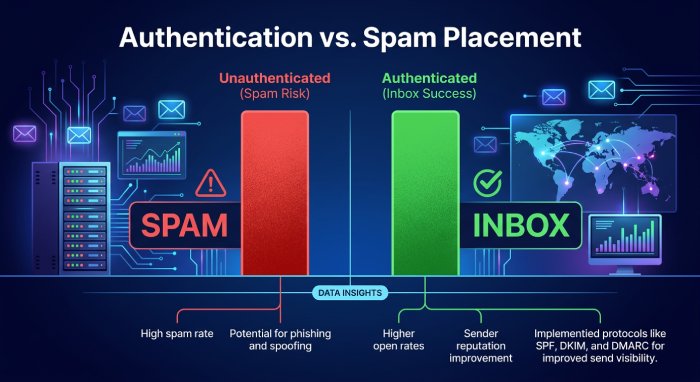
For high-volume email senders, robust email authentication is essential to maintain a positive sender reputation and maximize deliverability rates. Without effective SMTP authentication and correctly implemented email authentication protocols, even legitimate messages risk being flagged as spam or rejected by recipient mail servers such as Google or Gmail. This is especially vital given that high-volume traffic is more likely to trigger anti-spam systems that rely on authentication methods, relaying permissions, and sender reputation signals.
SMTP authentication is the cornerstone technology that allows an SMTP client (mail user agent or MUA) to prove its identity to the SMTP server before emails are accepted for relay. Using standardized methods—guided by RFC 4954—such as the AUTH extension, this process typically involves the submission of a username and password over the SMTP session.
 High-volume senders often manage multiple clients or applications submitting email, making secure authentication with protocols like STARTTLS or TLS encryption crucial for password security and spam prevention. Modern ESMTP servers enforce access control measures and client authentication not only on port 25 (traditionally for server-to-server traffic), but also on designated submission ports like port 587 or port 465 (for SMTPS), which offer an additional layer of security and more granular server configuration options.
Beyond SMTP authentication, sophisticated email authentication approaches and policy enforcement are required to prevent spoofing and guarantee message integrity. These multilayered strategies establish sender legitimacy, prevent unauthorized relays, ensure the correct use of the envelope sender and MAIL FROM address, and support compliance with evolving anti-abuse standards in the global messaging ecosystem.
SPF, DKIM, and DMARC: Core Protocols and How They Work Together
Understanding Core Email Authentication Protocols
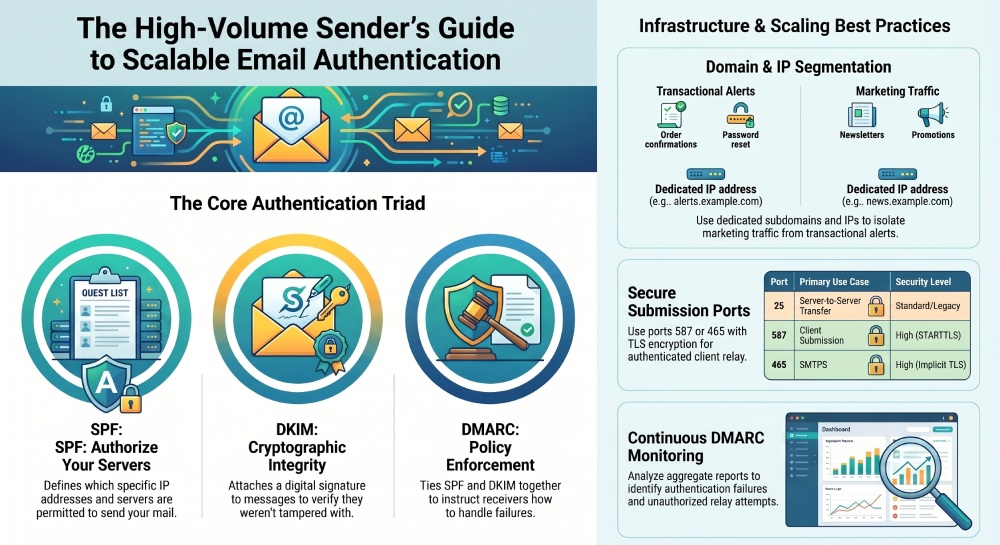
Sender Policy Framework (SPF), DomainKeys Identified Mail (DKIM), and Domain-based Message Authentication, Reporting & Conformance (DMARC) form the triad at the center of modern email authentication infrastructure. SPF focuses on defining which SMTP servers are authorized to send mail for a particular domain by publishing DNS records that recipient servers check when processing incoming messages. It helps ensure that only valid servers—not spam relays or hijacked services—can send on behalf of a given sender address.
DKIM builds on this by attaching a digital signature to outgoing messages. Using cryptographic keys associated with the sending domain, it allows recipients to verify that the message was not tampered with in transit and that the header sender genuinely represents the organization. This is critical for high-volume systems, as unsigned or incorrectly signed mail can trigger failures and damage domain reputation.
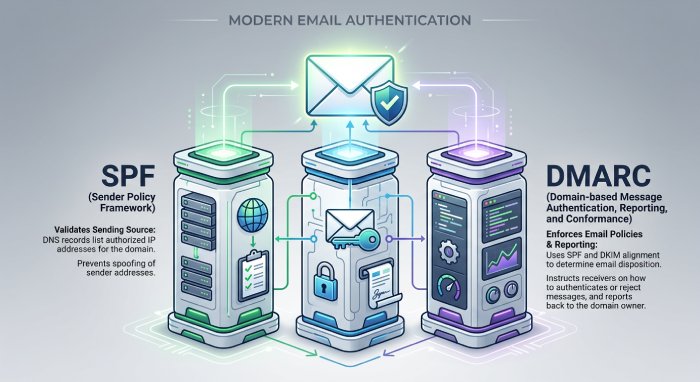 DMARC ties SPF and DKIM together by setting a policy for handling authentication failures, specifying how recipient servers should process mail that fails these checks. By enforcing alignment—meaning the MAIL FROM (envelope sender) and the DKIM-signed domain should match—DMARC further reduces the risk of phishing and spoofing while strengthening overall email security. The coordinated use of these protocols is particularly important for high-volume senders, where the threat of domain impersonation, spam, reputation damage, and email security risks is amplified.
The interplay between these mechanisms is also evaluated by major providers like Google and Gmail, whose servers look for strict protocol adherence before accepting high-volume mail for delivery. Proper setup, including accurate server response codes on authentication failure or authentication successful events, is crucial for email acceptance and for troubleshooting with tools like Postfix, Telnet, or openssl s_client.
Domain Alignment, Dedicated Sending Domains, and IP Reputation Management
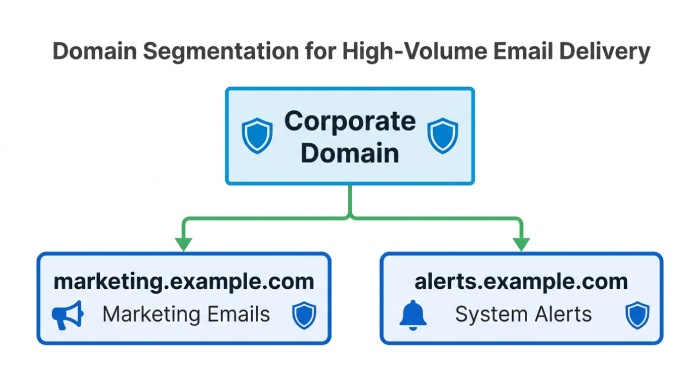
For organizations sending large volumes of email, domain alignment and infrastructure segmentation are indispensable. Using dedicated sending domains—distinct from the company’s main domain, such as marketing.company.com or alerts.company.com—offers several benefits. It enables more granular control over authentication records, simplifies monitoring, and isolates the main domain’s reputation from bulk or marketing streams, reducing risk.
Strict domain alignment means ensuring the envelope sender (specified in the MAIL FROM SMTP command) and the DKIM signing domain, as well as the header sender, all match or align with each other. This alignment is increasingly scrutinized by ISPs and mailbox providers enforcing DMARC and related anti-abuse standards.
 IP reputation management goes hand-in-hand with domain management. Maintaining a pool of dedicated, authenticated IPs for outbound SMTP relay allows better segregation by sending purpose (transactional vs. bulk), easier blacklisting remediation, and more accurate tracking of authentication failures or spam complaints to the correct source. This is especially relevant for organizations using complex mail relay architectures or partnering with third-party SMTP servers where multiple clients or services may interact with a shared relay.
Ensuring every authenticated session, whether over port 587 (SMTP Submission) or port 465 (SMTPS), leverages secure authentication via STARTTLS, TLS encryption, and modern authentication methods such as CRAM-MD5, DIGEST-MD5, or PLAIN mechanism (preferably over encrypted links) reduces exposure to password interception and account compromise.
Monitoring, Reporting, and Troubleshooting Authentication Failures
Monitoring authentication status at every step is a foundational component of both security and deliverability for high-volume email operations. This involves tracking server response codes, analyzing SMTP session logs, and reviewing DMARC aggregate and forensic reports. Effective monitoring helps identify patterns of authentication failure, whether due to incorrect SMTP server configuration, expired cryptographic keys, or sender address misalignments.
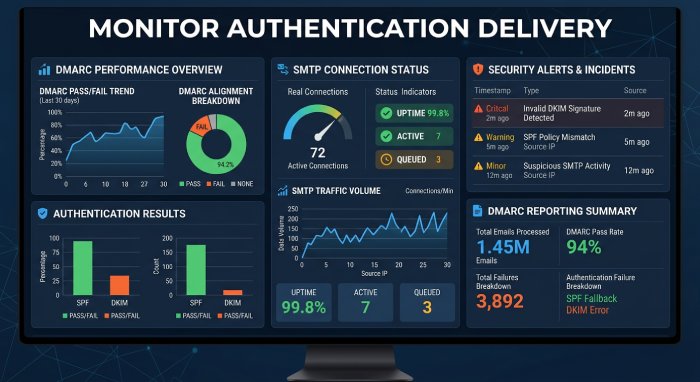 Employing open-source and commercial tools—including Postfix’s verbose logging, Telnet or openssl s_client for manual protocol checks, and dashboards that parse DMARC and DKIM reports—enables proactive detection of issues. For further troubleshooting, referencing community-driven knowledge bases like Server Fault, Stack Overflow, or the broader Stack Exchange network can resolve edge-case errors and inform nuanced configuration choices.
Report analysis is especially vital when scaling operations across international or distributed internal network segmentation. Differentiating between authentication failures resulting from user authentication problems, challenge response (e.g., due to CRAM-MD5 or DIGEST-MD5 misconfiguration), or from envelope sender/domain errors is crucial.
A robust SASL library can streamline the support for multiple authentication methods and extensions, helping resolve incompatibilities during SMTP sessions. Prompt resolution of authentication failures ensures authentication successful states are consistently achieved, improving reputation and reducing delivery delays.
Best Practices for Scaling Secure Email Authentication Infrastructure
High-volume mailers must continually evolve their email authentication infrastructure to meet ever-increasing scalability, security, and compliance demands. Some best practices include:
- Adopting Layered Authentication: Always enable SMTP authentication using strong authentication methods. Prefer the use of the AUTH extension with mechanisms like CRAM-MD5, DIGEST-MD5, and PLAIN, but only over secured SMTP sessions using STARTTLS or native TLS encryption. Avoid plain text authentication on insecure channels at all costs.
- Leveraging Secure Submission Ports: Direct clients to connect via submission port 587 (for authenticated relay with STARTTLS) or port 465 for SMTPS. Reserve port 25 for server-to-server communications unless absolutely necessary for legacy interop. Carefully manage server configuration to only permit authenticated mail relay from trusted sources or internal network segments.
- Implementing Rigorous Access Controls: Regularly audit network access permissions, server extensions, and SASL library configurations. Limit relaying permissions based on IP whitelisting, client authentication status, and the specific authentication methods in use.
- Ongoing Security Audits: Periodically perform security audits covering password security, TLS upgrades, authentication method deprecation (phasing out weak logins like AUTH LOGIN in favor of more resilient protocols), and credential management for all mail server instances.
- Automated Monitoring and Reporting: Use automation to continuously monitor authentication failures, DMARC reports, and server response codes. Set up alerts for authentication anomalies—unauthorized relay attempts, unexpected access control changes, or unexplained login successes—which could indicate abuse or misconfiguration.
- Scalable Infrastructure Design: Distribute mail relay and SMTP server resources to handle load spikes, while retaining centralized control over authentication and reporting. Align infrastructure scaling with robust policy enforcement for spam prevention and sender authentication.
By adhering to these strategies, enterprises not only meet compliance standards set by email providers and standards bodies but also sustain high deliverability and sender reputation—even as daily email volumes reach hundreds of thousands or more.
General Manager
General Manager at DuoCircle. Product strategy and commercial lead across the email security portfolio.
Secure your email infrastructure
Protect, authenticate, and deliver. Contact our team to find the right solution.