SPF Include Mechanism Explained: Balancing Deliverability, Security, And Scalability

Quick Answer
SPF include mechanisms help organizations authorize third-party mail servers while maintaining strong email security. Proper SPF configuration improves email deliverability, supports phishing protection, and ensures scalable email authentication without exceeding SPF DNS lookup limits.
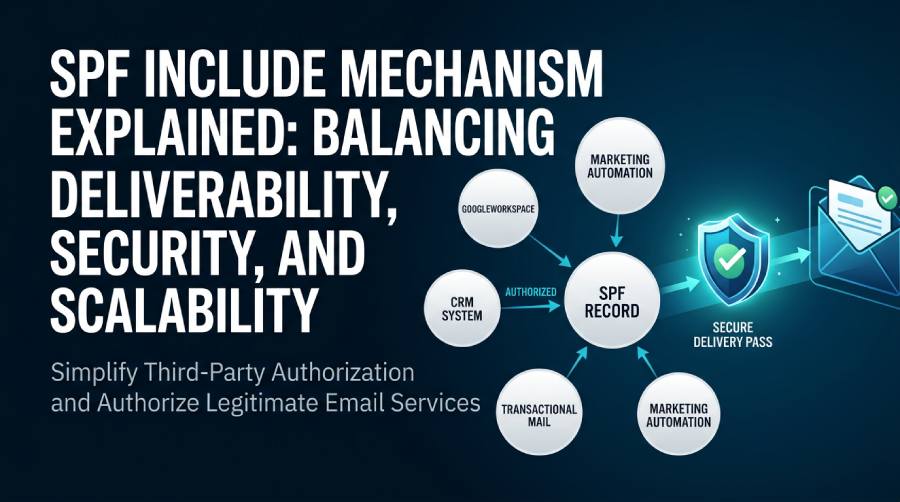
The SPF include mechanism plays a critical role in modern email authentication by allowing organizations to authorize third-party email services within their SPF records. As businesses increasingly rely on platforms such as Google Workspace, marketing automation tools, CRM systems, and transactional email providers, SPF include helps simplify sender authorization while maintaining secure email delivery.
This article explains how the SPF include mechanism works, how receiving mail servers evaluate included domains during SPF checks, and why proper SPF configuration is essential for balancing deliverability, security, and scalability. It also explores common SPF include mistakes, DNS lookup limitations, security considerations, and best practices for managing SPF records effectively in growing organizations.
What the SPF include Mechanism Is and How It Works
The SPF include mechanism lets a domain authorize another domain’s mail-sending infrastructure inside its own SPF record. SPF, or sender policy framework, is an email authentication standard defined in RFC 7208 that helps a receiving mail server determine whether an SMTP server is allowed to send mail for a domain.
In practice, an SPF record is published as a DNS TXT record in the Domain Name System, or DNS. The old SPF RR and dedicated SPF resource record type are obsolete; modern SPF compliance requires publishing SPF as a TXT record.The active SPF version is v=*spf1*, often referred to informally as SPF1. Historical references such as SPF2 should not be used for standard SPF authentication.
Basic SPF record structure
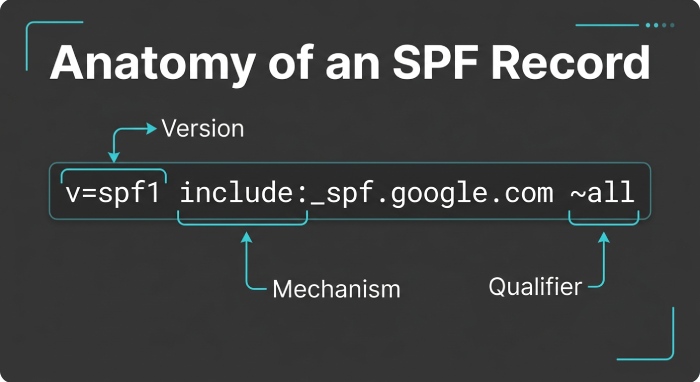
A typical SPF record structure starts with the SPF version, followed by one or more mechanisms and optional modifiers:
v=*spf1* include:_spf.*google.com* include:*examplesender.net* ip4:192.0.2.10 -all
This SPF record example authorizes Google Workspace through _spf.*google.com*, another provider through *examplesender.net*, and one direct IPv4 sender. The SPF syntax combines mechanisms, SPF qualifiers, and SPF modifiers to define policy. The SPF record syntax must be precise because even a small SPF record error can cause failed authentication or unpredictable delivery behavior.
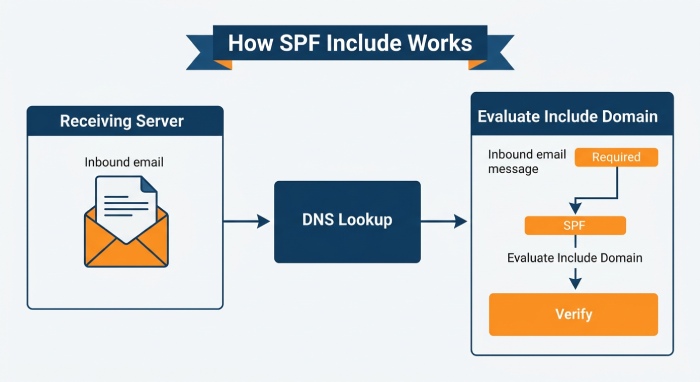
How SPF include is evaluated
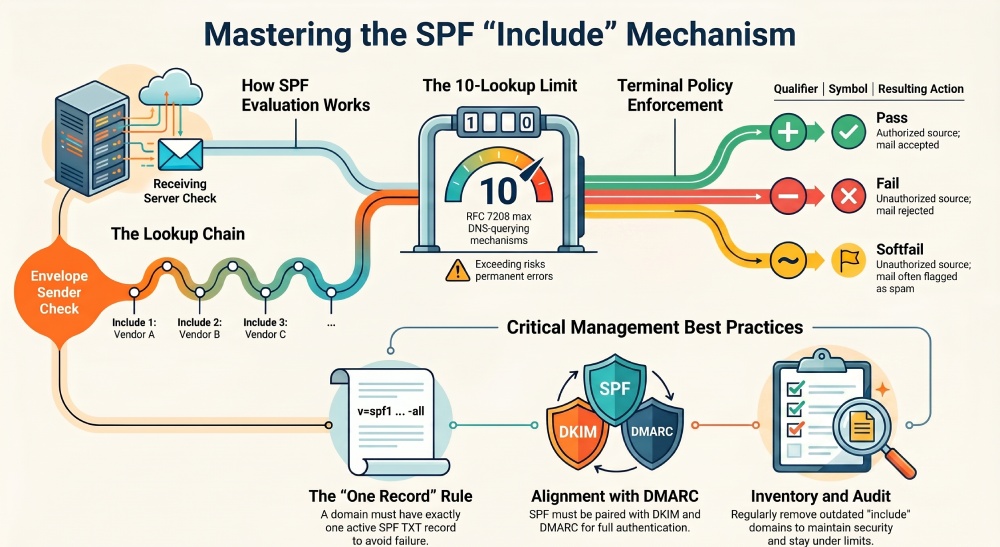
During SPF evaluation, the receiving mail server checks the domain in the SMTP envelope sender, performs an SPF record lookup, and reads the domain’s DNS TXT record. If the record contains an SPF include, the server looks up the included domain’s SPF policy as well.
For example:
v=*spf1* include:_spf.*google.com* include:*sendyourmail.com* -all
If a message is sent from Google infrastructure, the lookup of _spf.*google.com* may return a matching IP range, producing an SPF pass. If Send Your Mail operates from infrastructure listed under *sendyourmail.com*, that third-party email sender can also produce an SPF pass.
Important SPF mechanisms
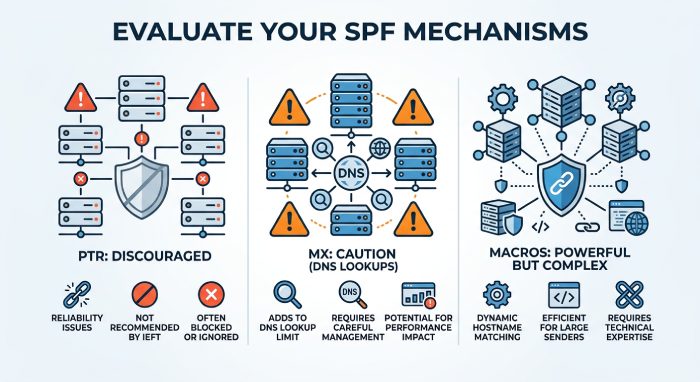
Common mechanisms in an SPF record include SPF IP4, SPF IP6, SPF MX, SPF PTR, SPF exists mechanism, and SPF include. The SPF mechanism determines how the sending IP is compared against authorized sources. For example, ip4: lists IPv4 addresses, ip6: lists IPv6 addresses, mx authorizes hosts behind an MX record, and include: delegates authorization to another domain’s policy.
About SPF qualifiers and results
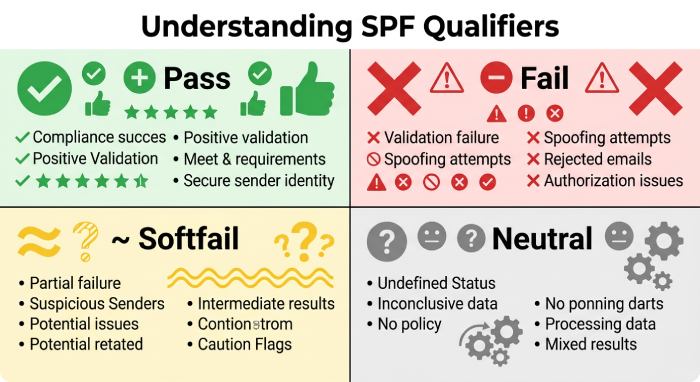
SPF qualifiers determine the result when a mechanism matches. The SPF qualifier symbols are +, -, ~, and ?, corresponding to SPF pass, SPF fail, SPF softfail, and SPF neutral. A common SPF record qualifier is -all, which uses the SPF all mechanism to say that all non-matching sources should fail.
Why include Matters for Email Deliverability and Third-Party Senders
Modern organizations rarely send all mail from one server. Marketing platforms, CRM (Customer Relationship Management), billing systems, help desks, and notification tools may all send on behalf of the same domain. The SPF include mechanism is essential because it allows the domain owner to authorize these services without manually maintaining every provider IP address.
Supporting legitimate sending sources
A business may use Google Workspace for employee mail, Send Your Mail at *sendyourmail.com* for campaigns, and another provider such as *examplesender.net* for transactional mail. Instead of adding every server manually, the domain publishes one DNS TXT record with multiple includes:
v=*spf1* include:_spf.*google.com* include:*sendyourmail.com* include:*examplesender.net* -all
This keeps the SPF record structure readable while allowing providers to update their own authorized IP addresses. When a provider adds a new SMTP server, their included DNS SPF record changes, and the customer’s domain can remain untouched.
Deliverability impact
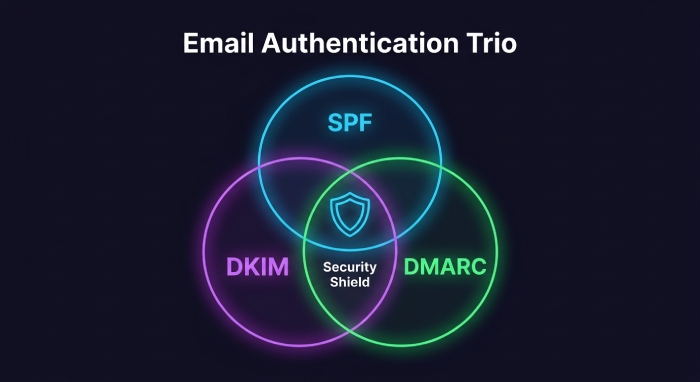
Mailbox providers such as google.com and enterprise gateways use email authentication signals to judge whether a message is legitimate. A correct SPF include can improve deliverability by ensuring that legitimate senders produce a valid SPF authentication result. SPF alone is not enough for full domain authentication, but it works with DKIM and DMARC to support trust, alignment, and policy enforcement.
Poor SPF record formatting, missing includes, or excessive includes can cause authentication failures. A failed SPF record check may not always block mail, but it can increase spam placement risk, especially when combined with weak DKIM or no DMARC policy.
Common SPF include Mistakes: DNS Lookup Limits, Misconfigurations, and Over-Permissive Records
The SPF include mechanism is powerful, but it is also one of the most common sources of SPF operational problems.
Exceeding the DNS lookup limit
RFC 7208 limits SPF to 10 DNS-querying mechanisms and modifiers. These include include, a, mx, ptr, exists, and redirect. If an SPF record exceeds the limit, SPF may return a permanent error. This is one of the most frequent causes of an SPF record error.
The SPF record length limit and DNS response-size constraints also matter. Long records with many includes, large IP ranges, or nested lookups can exceed practical DNS limits. Tools such as an SPF record analyzer, SPF lookup tool, SPF record checker, or SPF record analyzer tool from vendors like EasyDMARC or dmarcly can identify lookup depth, flattening risks, and invalid mechanisms.
Misconfigured include domains
An SPF include must reference a domain that publishes a valid SPF policy. For example, include:_spf.*google.com* is valid for Google’s sending infrastructure, but include:*google.com* may not authorize the same sources. Similarly, if a vendor instructs you to include *sendyourmail.com*, verify it with an SPF record lookup before deployment.
Invalid syntax and missing TXT records
A common mistake is publishing multiple SPF records for the same hostname. A domain should have only one active SPF record in one DNS TXT record. Another mistake is placing malformed SPF syntax, such as extra spaces, unsupported characters, or incorrect mechanisms. A reliable SPF record syntax tool or SPF record generator tool can help enforce valid SPF record validation before DNS publication.
Over-permissive SPF records
Some organizations use +all or broad IP ranges to avoid delivery issues. This defeats the purpose of email authentication because it allows almost any server to send mail. A balanced SPF record structure should list only genuine authorized IP addresses and authorized providers.
Security Considerations: Preventing Spoofing While Managing Sender Authorization
The main security goal of SPF is spoofing protection. By defining authorized IP addresses, an SPF record helps prevent attackers from sending mail that appears to originate from your domain.
Reducing email spoofing and phishing risk
Attackers use email spoofing to impersonate trusted brands, executives, or vendors during phishing attacks. Proper SPF implementation contributes to phishing prevention by allowing a receiving mail server to reject or flag mail from unauthorized infrastructure. However, SPF must be paired with DKIM and DMARC because SPF checks the envelope sender, while DMARC evaluates alignment with the visible From domain.
A strong policy might end with -all, while a transitional policy may use ~all. The choice of SPF qualifiers matters. -all signals SPF fail for unauthorized sources, while ~all signals SPF softfail. ?all produces SPF neutral, which offers little enforcement value.
Using SPF modifiers safely
SPF modifiers extend SPF behavior. The SPF redirect modifier points SPF evaluation to another domain’s record, while the SPF exp modifier can provide explanatory text when SPF fails. These SPF modifiers are less common than mechanisms but can be useful in centralized policy designs.
SPF macros and advanced policies
An SPF macro can dynamically expand values such as sender domain or IP address during lookup. Macros are powerful but should be used carefully because complex SPF syntax can make troubleshooting harder and may create unexpected DNS behavior.
Avoiding risky mechanisms
The SPF PTR mechanism is discouraged because it is slow and unreliable. The SPF MX mechanism can be useful, but it triggers DNS lookups for the domain’s MX record and related A record or AAAA record responses. The SPF exists mechanism is useful for specialized authorization logic but should be tested carefully to avoid hidden lookup costs.
Scalable SPF Management Best Practices for Growing Organizations
As organizations grow, SPF becomes a governance issue, not just a DNS task. Each new Software as a service (SaaS) platform, regional mail system, or acquisition may introduce another third-party email sender.
Core Areas Organizations Should Focus On
Authorized Sender Management
- Maintain a documented inventory of all approved email senders
- Track authorized IP addresses and SPF include domains
- Assign ownership for every third-party email service
- Remove outdated or inactive SPF includes regularly
SPF Validation and Monitoring
- Validate SPF records before publishing DNS updates
- Check for invalid SPF syntax and formatting errors
- Monitor DNS lookup counts to stay within SPF limits
- Detect duplicate SPF records and missing TXT entries
Scalability and Operational Control
- Use SPF flattening carefully to reduce lookup complexity
- Consider managed SPF services as environments expand
- Implement formal change-control processes for SPF updates
- Perform periodic SPF audits across all domains
DMARC and Authentication Alignment
- Align SPF with DKIM and DMARC policies
- Ensure SPF authentication supports domain alignment
- Limit SPF authorization to trusted infrastructure only
- Strengthen email delivery reliability and phishing protection
Maintain an Inventory of Authorized Senders
Create and maintain a registry of all authorized IP addresses, vendor include domains, business owners, and renewal dates. This inventory should map each SPF include to a real service. If include:examplesender.net no longer supports an active system, remove it from the SPF record.
Validate Before Publishing
Before changing production DNS, run an SPF record check with tools such as EasyDMARC, dmarcly, an SPF record generator, or an SPF record analyzer. A good SPF record checker should detect multiple records, invalid SPF syntax, lookup-limit problems, missing DNS TXT record entries, and weak terminal policies.
Use Managed SPF Services When Complexity Grows
For large environments, managed SPF can reduce operational risk. Services such as EasySPF or EasyDMARC’s EasySPF help organizations manage many senders without constantly editing DNS. These platforms can also help with flattening, monitoring, and change control while preserving a clean SPF record structure.
Design for DMARC Alignment
SPF is most effective when combined with DMARC and DKIM to strengthen overall email security. DMARC requires either SPF or DKIM to align with the visible From domain. Therefore, scalable email authentication and email security strategies should consider not only whether an SPF mechanism returns pass, but whether the result supports aligned domain authentication.
General Manager
General Manager at DuoCircle. Product strategy and commercial lead across the email security portfolio.
Secure your email infrastructure
Protect, authenticate, and deliver. Contact our team to find the right solution.