VOIP Spoofing: How It Works And How To Protect Your Business

Quick Answer
VoIP spoofing occurs when attackers manipulate caller ID to impersonate trusted individuals or businesses. Learn how VoIP spoofing works, common risks, warning signs, and effective security measures to protect your business from fraud, phishing, and unauthorized access.
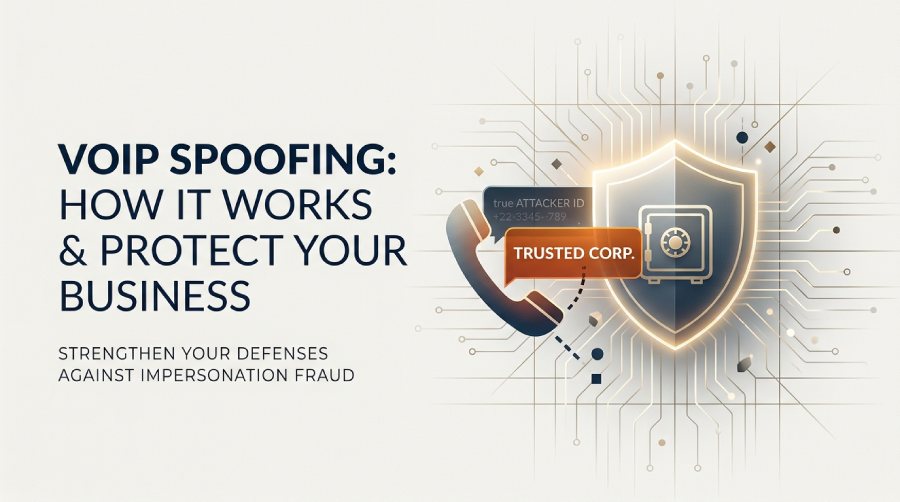
Voice over Internet Protocol (VoIP) has revolutionized the way businesses communicate by enabling calls to be made via the internet rather than relying on conventional telephone systems. While the adoption of VoIP brings advantages such as enhanced flexibility, scalability, and reduced communication expenses, it can also present certain security vulnerabilities. A prevalent threat associated with VoIP is spoofing, where attackers alter caller ID details to make a call seem like it originates from a reputable source, such as a trusted individual or organization.
VoIP spoofing can facilitate various malicious activities, including phishing, support scams linked to business email compromise, financial fraud, identity theft, and social engineering. For instance, an impersonator may pose as a company executive, bank official, customer, supplier, or IT administrator to manipulate employees into disclosing confidential information or granting unauthorized permissions. By comprehending the mechanics of VoIP spoofing and being aware of its red flags, businesses can enhance their defenses against potential attacks.
What Is VoIP Spoofing?
VoIP spoofing refers to the manipulation of caller ID information during internet-based phone calls by an attacker. Rather than revealing the actual number of the attacker, the recipient’s phone may display a number linked to a legitimate organization, employee, government entity, or a known contact.
This phenomenon is facilitated by the technology inherent in VoIP, which allows voice communications to be routed through internet-based systems and signaling protocols. Attackers exploit specific Voice over Internet Protocol (VoIP) services and tools to alter caller ID details prior to making a call.
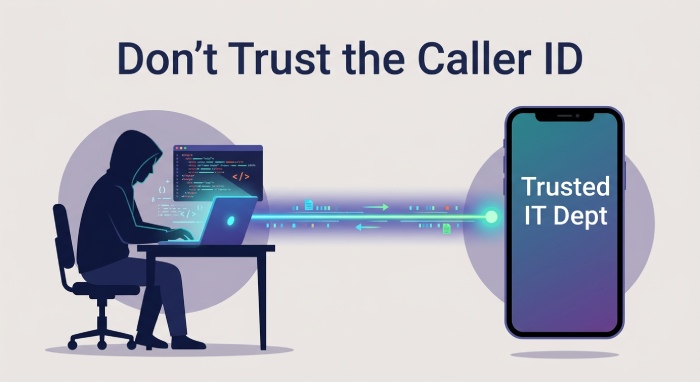
For instance, an attacker might disguise a call as coming from a company’s IT department. The recipient may see a familiar company number and mistakenly assume the call is genuine. Consequently, the attacker could request sensitive information, such as a password, verification code, payment information, or remote access.
Hence, the caller ID presented may not reliably indicate the true identity of the caller.
How Does VoIP Spoofing Work?
VoIP spoofing typically entails altering the data linked to a call prior to its arrival at the intended recipient. This manipulation may be executed through various means, such as VoIP platforms, breached accounts, caller ID alteration services, or other elements of telecommunications infrastructure.
During the initiation of a VoIP call, signaling information plays a crucial role in facilitating the connection between the caller and the recipient. In certain scenarios, the caller ID visible to the recipient can be changed. This vulnerability can be exploited by an attacker to make the incoming call seem more credible.
A typical attack may follow this pattern:
- The attacker identifies a trusted phone number or organization.
- The attacker uses a VoIP service capable of modifying caller ID information.
- A call is placed with the spoofed number displayed to the recipient.
- The attacker impersonates a trusted individual or organization.
- The victim is pressured into sharing information or taking an action.
- The attacker uses the obtained information for fraud, unauthorized access, or another malicious purpose.
Spoofing does not necessarily mean that the legitimate phone number has been compromised. In many cases, the attacker is simply manipulating what appears on the recipient’s caller ID.
Why Is VoIP Spoofing a Business Security Risk?
Companies are prime targets for attackers since employees often manage financial transactions, personal data, and sensitive business information. A deceptive phone call can exploit human trust, circumventing technical security measures.
For instance, an attacker could pose as an executive, urging an employee to quickly buy gift cards or transfer money. Alternatively, someone may impersonate an IT admin and seek authentication codes. Customer service representatives might also field calls from individuals claiming to be clients or partners.
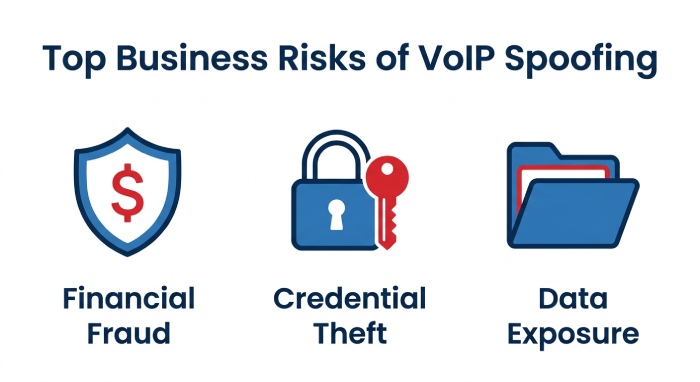
The main risks include:
- Financial fraud: Attackers may convince employees to authorize payments or provide banking information.
- Credential theft: Employees may disclose usernames, passwords, or authentication codes.
- Data exposure: A convincing caller may obtain customer or company information.
- Account compromise: Stolen information can support further attacks against business systems.
- Reputation damage: Customers may lose confidence if attackers successfully impersonate the company.
- Social engineering: Attackers can use urgency, authority, or fear to influence employee decisions.
VoIP spoofing becomes highly risky when paired with phishing emails or impersonation techniques. An attacker may initiate contact via email and then subsequently make a fraudulent call, enhancing the legitimacy of their scheme.
Common Signs of a VoIP Spoofing Attack
Recognizing spoofed calls goes beyond verifying caller ID. Employees should assess the caller’s demeanor and the nature of their requests.
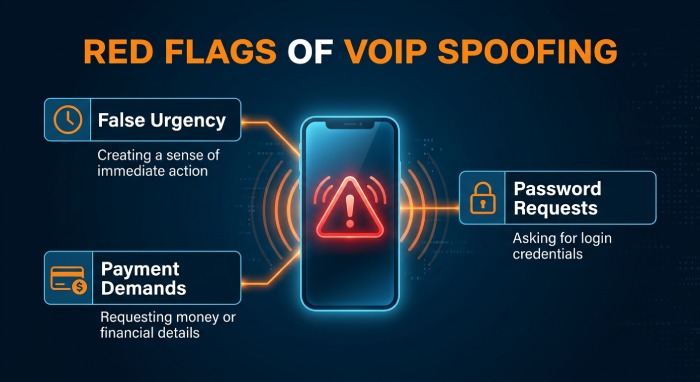
A suspicious call may involve:
Unexpected Requests for Sensitive Information
Authorized personnel, including employees, banks, suppliers, and service providers, typically have well-defined protocols for managing sensitive data. Any caller who makes an unexpected request for passwords, security codes, financial information, or private documents should be approached with caution.
Pressure to Act Immediately
Cyber attackers frequently instill a feeling of immediacy. Phrases like “this needs to be done immediately” or “your account is at risk of suspension” are intended to hinder the recipient from confirming the legitimacy of the request.
Requests for Payments or Transfers
Any unexpected requests for altering bank information, transferring funds, buying gift cards, or processing urgent payments should be subjected to further verification.
Caller ID Appears Familiar
Recognizing a familiar caller ID does not inherently guarantee trustworthiness. Techniques such as spoofing can enable an attacker to replicate or closely imitate the phone number of a legitimate business.
Unusual Technical Requests
An individual on the phone purporting to be from the IT department may ask for remote access, authentication codes, password resets, or modifications to security settings. It is essential that employees confirm these requests through the appropriate internal procedures.
How Businesses Can Protect Against VoIP Spoofing
To effectively combat VoIP spoofing, a multifaceted approach is essential. This includes implementing technical safeguards, fostering employee awareness, establishing verification processes, and conducting ongoing monitoring. It is important to recognize that no singular security approach can fully eradicate all instances of spoofing.
Establish Strong Call Verification Procedures
Organizations must implement robust protocols for validating unusual phone requests as part of their email security strategy. Employees should not depend solely on caller ID for sensitive matters involving financial transactions, credentials, or confidential data.
For instance, they can reach out to the individual using a verified company contact number instead of the one given during the suspicious call. Additionally, businesses should mandate approval for high-risk requests, such as financial transfers or password resets, requiring confirmation from a second authorized employee.
Train Employees to Recognize Social Engineering
Training on security awareness must encompass threats encountered via phone communications in addition to email phishing attacks. It is essential for employees to recognize that adversaries may pose as legitimate contacts when communicating over the phone.
Training should explain common manipulation techniques, including:
- Creating urgency or fear
- Impersonating executives or managers
- Requesting confidential information
- Asking employees to bypass normal procedures
- Requesting unexpected payments
- Pretending to be technical support
- Using information gathered from company websites or social media
Regular training helps employees recognize suspicious behavior before an attacker can gain their trust.
Use Multi-Factor Authentication
Multi-factor authentication (MFA) enhances security by adding an extra layer of protection in the event that user credentials are compromised during a spoofing or social engineering incident. MFA requires an additional form of verification beyond just passwords.
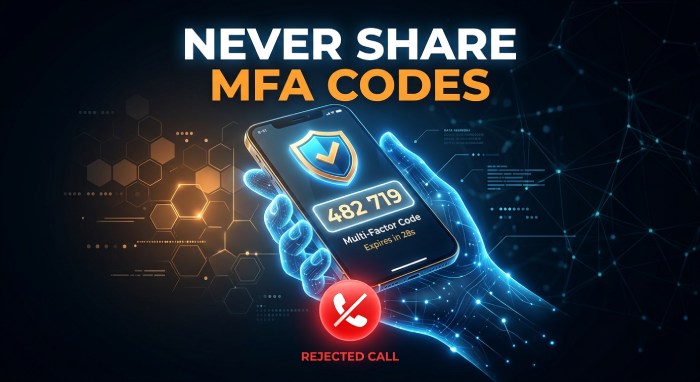
It is crucial that employees do not disclose MFA codes to individuals who call them. Cybercriminals who possess a username and password may try to deceive the employee into providing these two authentication factors.
Whenever feasible, organizations should implement phishing-resistant authentication techniques for their critical systems.
Secure Business VoIP Platforms
Organizations must ensure the security of their VoIP systems by implementing appropriate controls and regularly updating their platforms. It is essential for administrators to evaluate user account permissions, observe for any atypical activities, and deactivate accounts that are not in use.
Important VoIP security practices include:
- Use strong, unique passwords for VoIP accounts.
- Enable MFA where supported.
- Keep VoIP applications and devices updated.
- Restrict administrative access.
- Review call logs for unusual activity.
- Monitor international or high-cost calling activity.
- Disable unused extensions and accounts.
- Use encryption and secure signaling where supported.
- Separate administrative privileges from ordinary user accounts.
These measures can reduce the risk of attackers compromising internal VoIP accounts or using business communication systems for fraudulent activity.
Implement Caller Authentication Technologies
Telecommunications companies can utilize caller authentication systems to address the issue of illegal caller ID spoofing. A key framework is STIR/SHAKEN, which employs digital certificates to verify caller identity in compatible networks. This allows service providers to confirm the legitimacy of the originating number.
While STIR/SHAKEN cannot prevent all spoofing, especially across different networks or unsupported systems, it aids in identifying and tagging potentially fraudulent calls. Businesses should consult their VoIP providers about available caller authentication and anti-spoofing options.
Monitor VoIP Traffic and Call Logs
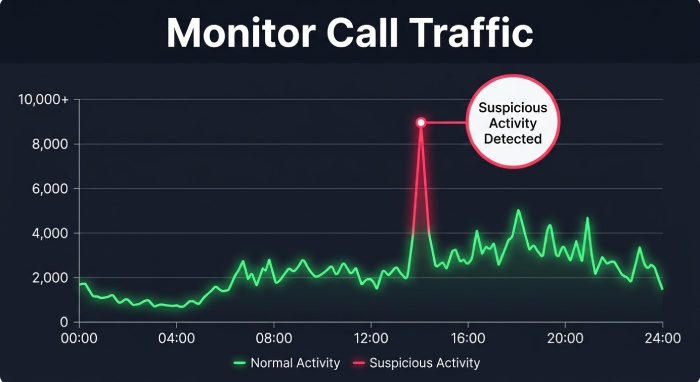
Monitoring VoIP activity can help businesses detect unusual calling patterns and identify potential social-engineering attempts before they escalate into broader security incidents. Security teams need to examine VoIP activities for indicators like unexpected international calls, significant spikes in call volume, frequent authentication failures, or calls from unusual locations. Call logs are valuable for understanding events following suspicious incidents. Organizations should set up alerts for irregular activities and ensure logging aligns with security, privacy, and compliance standards.
Create an Incident Response Process
Businesses should have a defined process for responding to suspected VoIP spoofing. Employees need to know exactly what to do if they receive a suspicious call or accidentally disclose information.
A basic response process may include:
- End the suspicious call.
- Report the incident to the IT or security team.
- Independently verify any requested transaction.
- Reset compromised credentials if necessary.
- Review relevant account and VoIP activity.
- Notify financial institutions if fraudulent transactions are involved.
- Preserve call details and other evidence.
- Escalate the incident according to the company’s security response plan.
Quick reporting can reduce the impact of an attack, particularly when credentials or financial information may have been exposed.
VoIP Spoofing vs. Legitimate Caller ID
Caller ID serves primarily as a convenience and should not be considered definitive proof of identity. While it can offer helpful context, it does not ensure the caller’s true identity.
To enhance security, businesses should integrate caller ID with identity verification protocols, employee training, and robust technical safeguards.
For high-risk situations, employees must confirm the caller’s identity via a separate communication method. For instance, if an individual claims to be an executive requesting a financial transfer, the employee should reach out to the executive using a verified corporate number or approved messaging platform.
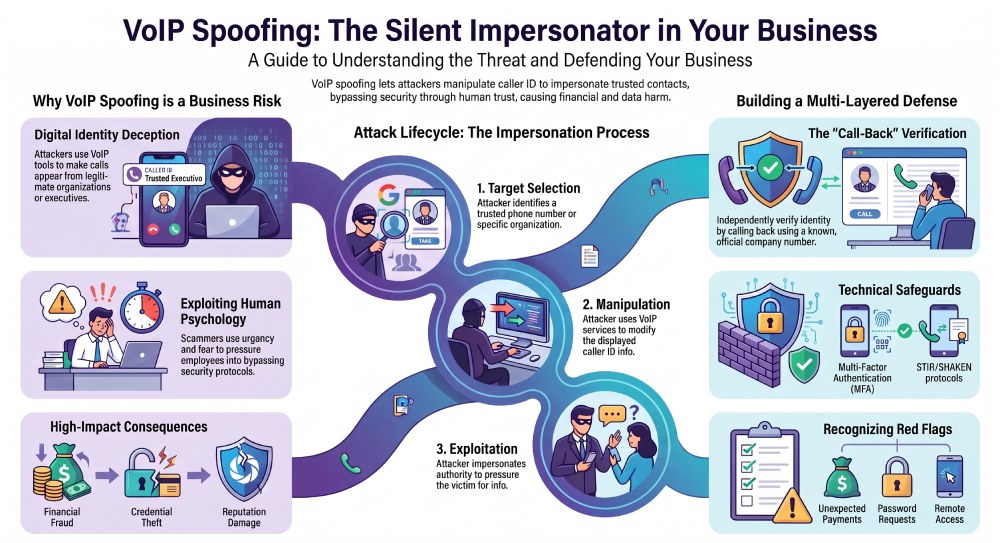
VoIP spoofing allows attackers to manipulate caller ID information and impersonate trusted individuals or organizations. Because businesses rely heavily on phone-based communication, these attacks can lead to financial fraud, credential theft, data exposure, and other security incidents.
To mitigate these risks, businesses should combine employee training with technical measures. Implementing strong authentication, secure VoIP settings, caller verification technologies, and effective incident response strategies fortifies defenses.
Crucially, employees must not base important decisions solely on caller ID. Independent verification can thwart spoofing attempts, safeguarding communications against advanced social engineering tactics.
General Manager
General Manager at DuoCircle. Product strategy and commercial lead across the email security portfolio.
Secure your email infrastructure
Protect, authenticate, and deliver. Contact our team to find the right solution.