What Is an ARP Spoofing Attack? Understanding the Risks and How to Defend Your Network

Quick Answer
ARP spoofing is a cyberattack where an attacker sends fake ARP messages to associate their MAC address with a trusted IP address on a local network. This allows them to intercept, modify, or block network traffic, steal sensitive data, launch man-in-the-middle attacks, and disrupt communications.
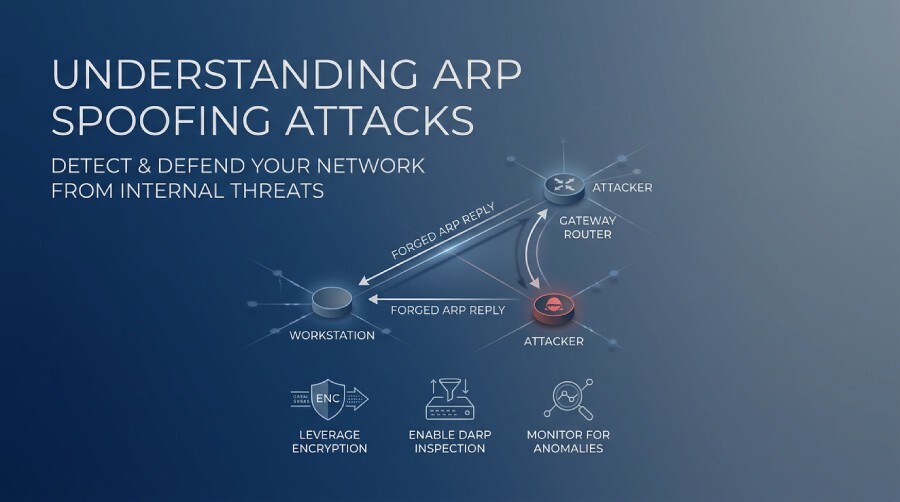
Many cyberattacks begin by exploiting weaknesses that exist inside trusted networks rather than targeting internet-facing systems directly. One such threat is the ARP spoofing attack, also known as ARP poisoning. This technique enables attackers connected to the same local network to intercept communications, steal sensitive information, or manipulate network traffic without users realizing anything is wrong.
Although modern organizations deploy firewalls, endpoint security, and email protection, internal network attacks remain a significant concern. Understanding how ARP spoofing works is an important step toward strengthening your overall cybersecurity posture.
This guide explains the fundamentals of ARP spoofing, its objectives, warning signs, potential consequences, and effective methods for preventing these attacks.
What Is ARP?
The Address Resolution Protocol (ARP) is a networking protocol used within IPv4 local area networks. Its purpose is to connect IP addresses with their corresponding physical hardware addresses, known as MAC addresses.
Whenever one device needs to communicate with another device on the same network, it broadcasts an ARP request asking which device owns a particular IP address. The device with the matching IP responds with its MAC address, allowing direct communication.
This process happens automatically and usually takes only milliseconds.
Understanding ARP Spoofing
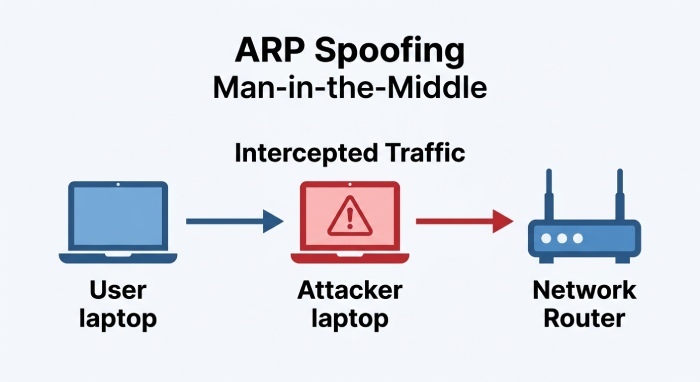
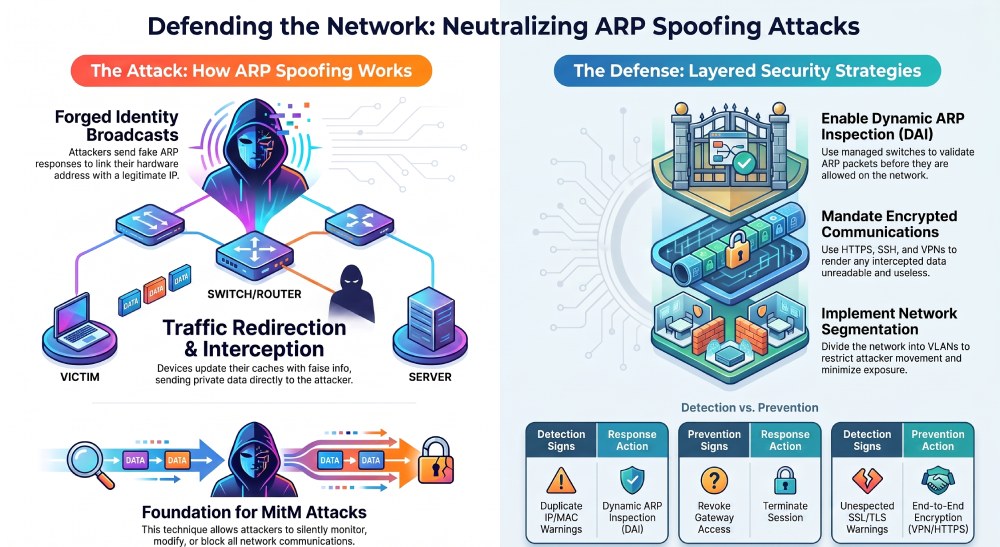
ARP spoofing occurs when an attacker sends forged ARP responses across a local network. These fake messages convince devices that the attacker’s MAC address belongs to another legitimate device, such as the network gateway or another workstation.
Once the devices update their ARP cache with the incorrect information, network traffic intended for the legitimate destination is redirected through the attacker’s device.
From there, the attacker can:
- Observe network traffic
- Capture confidential information
- Modify transmitted data
- Forward traffic to avoid detection
- Interrupt communications altogether
Because ARP does not include built-in authentication, devices generally trust the latest ARP reply they receive.
Why Do Attackers Use ARP Spoofing?
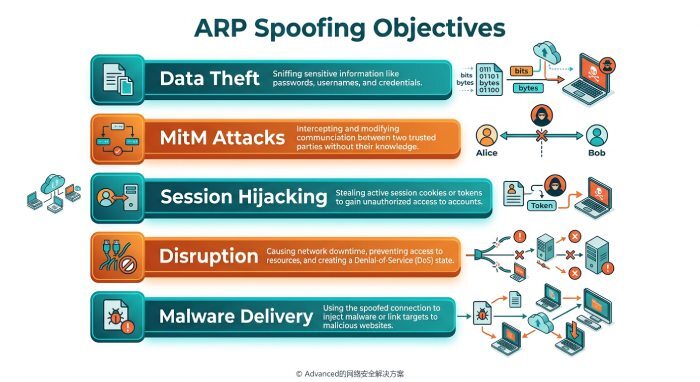
Attackers have several objectives when launching an ARP spoofing attack.
Stealing Sensitive Information
One of the most common goals is collecting usernames, passwords, financial information, confidential documents, and other valuable data transmitted across the network.
If communications are not encrypted properly, attackers may capture readable information directly.
Conducting Man-in-the-Middle Attacks
ARP spoofing often serves as the foundation for a man-in-the-middle (MitM) attack.
Instead of blocking communications, the attacker silently positions themselves between two devices, allowing them to monitor or alter traffic without either party noticing.
This technique may be used to:
- Read sensitive communications
- Modify downloaded files
- Inject malicious content
- Redirect users to fraudulent websites
Hijacking User Sessions
Attackers may capture session cookies or authentication tokens, allowing them to impersonate legitimate users without needing their passwords.
This can lead to unauthorized access to web applications, internal systems, or cloud services.
Disrupting Network Availability
In some cases, the objective is not data theft but service disruption.
By sending incorrect ARP information repeatedly, attackers can prevent devices from communicating properly, resulting in network outages or degraded performance.
Delivering Additional Malware
Intercepted traffic creates opportunities to distribute malware.
Attackers may replace legitimate downloads with infected files or redirect users to malicious websites that install ransomware, spyware, or remote access tools.
How an ARP Spoofing Attack Works
Although the attack can vary depending on the target environment, the general process follows these steps:
- The attacker gains access to the local network.
- They identify active hosts and the default gateway.
- Forged ARP replies are transmitted to targeted devices.
- Victims update their ARP tables with false MAC address mappings.
- Traffic intended for the gateway flows through the attacker’s device.
- The attacker captures, modifies, forwards, or blocks network traffic.
Because communications continue functioning in many cases, victims may not immediately recognize the attack.
Potential Consequences of ARP Spoofing
Organizations affected by ARP spoofing may experience a range of security issues.
- Credential Theft: Login credentials for email accounts, internal portals, VPNs, and business applications may be intercepted.
- Data Exposure: Sensitive business information, customer records, and confidential communications can be captured if transmitted without adequate encryption.
- Malware Infections: Attackers may inject malicious software into network traffic, allowing infections to spread throughout the organization.
- Financial Losses: Compromised credentials and stolen information may lead to fraudulent transactions, business interruption, regulatory penalties, and recovery costs.
- Loss of Customer Trust: A successful attack affecting customer information can damage an organization’s reputation and reduce confidence in its security practices.
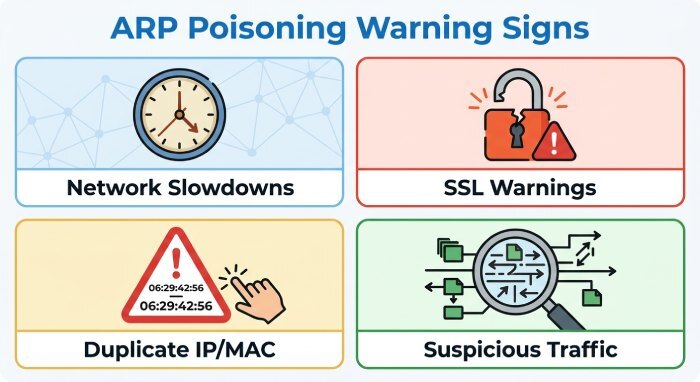
Signs That May Indicate ARP Spoofing
Detecting ARP spoofing can be challenging because the attack often operates quietly.
However, administrators should investigate if they notice:
- Unexpected network slowdowns
- Frequent connection interruptions
- Duplicate IP or MAC address warnings
- Changes in ARP cache entries
- Unusual gateway behavior
- Unexpected SSL certificate warnings
- Increased packet retransmissions
- Suspicious network monitoring alerts
Continuous network monitoring improves the chances of detecting abnormal ARP activity before significant damage occurs.
How to Prevent ARP Spoofing Attacks
Reducing the risk of ARP spoofing requires multiple layers of security, including following established network segmentation best practices to limit traffic exposure across subnets.
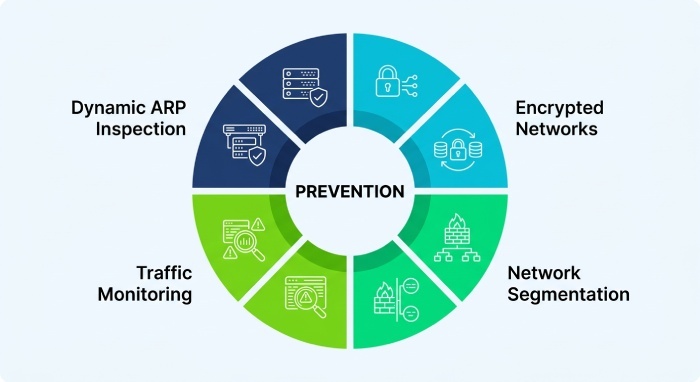
Enable Dynamic ARP Inspection
Dynamic ARP Inspection (DAI) is available on many managed switches. It validates ARP packets before allowing them onto the network, helping prevent forged ARP responses.
Use Encrypted Communications
Protocols such as HTTPS, SSH, TLS, and VPN connections help protect transmitted data even if attackers intercept network traffic.
Encryption significantly reduces the value of captured information.
Segment Your Network
Separating devices into multiple VLANs limits how far an attacker can move within a network and reduces the number of systems exposed to ARP-based attacks.
Configure Static ARP Entries Where Appropriate
Critical infrastructure devices, including servers and network gateways, may benefit from static ARP entries that cannot be modified through unsolicited ARP responses.
Because manual management can become complex, this approach is typically reserved for essential systems.
Monitor Network Traffic
Network monitoring solutions and intrusion detection systems can identify suspicious ARP broadcasts, unusual MAC address changes, or abnormal communication patterns.
Early detection allows security teams to respond before attackers achieve their objectives.
Keep Systems Updated
Operating systems, networking equipment, and security tools should receive regular updates to reduce vulnerabilities that attackers may exploit after gaining network access.
Implement Strong Access Controls
Preventing unauthorized devices from joining the network reduces opportunities for attackers to perform ARP spoofing.
Technologies such as Network Access Control (NAC), multi-factor authentication, and secure Wi-Fi configurations strengthen overall network security.
ARP Spoofing vs. ARP Poisoning
The terms ARP spoofing and ARP poisoning are often used interchangeably. Both describe the same attack technique in which false ARP messages are distributed to manipulate IP-to-MAC address mappings.
Some cybersecurity professionals use “ARP poisoning” to emphasize the corruption of ARP cache entries, while “ARP spoofing” focuses on the act of impersonating another device. In practice, both terms refer to the same type of network attack.
Best Practices for Organizations
Organizations can significantly reduce their exposure by following several security best practices:
- Deploy managed switches that support Dynamic ARP Inspection.
- Encrypt internal and external network communications.
- Segment networks to limit attacker movement.
- Monitor ARP traffic for unusual behavior.
- Apply security updates promptly.
- Restrict network access to authorized devices.
- Implement strong email security to protect against phishing and credential theft.
- Train employees to recognize suspicious network activity.
- Conduct regular vulnerability assessments and security audits.
Conclusion
ARP spoofing remains a serious threat to local networks because it exploits a protocol that was not originally designed with authentication in mind. By manipulating ARP communications, attackers can intercept sensitive information, hijack sessions, spread malware, and disrupt business operations.
Although the attack is relatively simple to execute on unsecured networks, organizations can greatly reduce the risk through layered security measures. Implementing encrypted communications, Dynamic ARP Inspection, network segmentation, continuous monitoring, and strong access controls helps create a more resilient network environment.
Understanding how ARP spoofing works enables businesses and IT teams to recognize potential threats early and take proactive steps to safeguard their systems, users, and valuable data.
General Manager
General Manager at DuoCircle. Product strategy and commercial lead across the email security portfolio.
Secure your email infrastructure
Protect, authenticate, and deliver. Contact our team to find the right solution.