How GDPR Email Compliance Affects Marketing, Consent, And Data Privacy

Quick Answer
GDPR email compliance ensures businesses collect valid consent before sending marketing emails while protecting personal data. It improves transparency, strengthens customer trust, supports data privacy, and helps organizations avoid legal penalties by following lawful email marketing practices.
GDPR email compliance has transformed the way businesses collect, manage, and use personal data in email marketing. Whether you’re sending newsletters, promotional campaigns, or product updates, complying with the General Data Protection Regulation (GDPR) is essential for protecting customer privacy, maintaining trust, and avoiding costly penalties. This guide explains how GDPR affects email marketing, consent management, and data privacy, while outlining the key principles, legal requirements, and best practices organizations should follow to build compliant, transparent, and secure email campaigns.
What GDPR Email Compliance Means for Marketers
GDPR email compliance requires marketers to treat email marketing as a regulated activity involving personal data, not merely a communications channel. Under the General Data Protection Regulation, any organization sending email newsletters, promotional campaigns, product updates, or direct marketing to EU residents or people in the European Economic Area must have a valid legal basis for processing personal data.
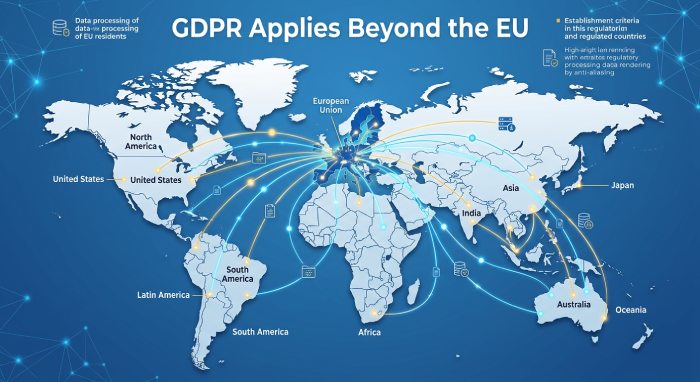
GDPR Applies Beyond the European Union
The GDPR applies not only to companies based in the European Union but also to businesses outside the EU and EEA that target or monitor individuals in those regions. This means a cloud-based email platform, Software as a service (SaaS) company, ecommerce brand, or B2B firm using LinkedIn lead forms may fall under European law if it collects names, email addresses, job titles, IP addresses, behavioral data, or other personal information from EU residents.
For email marketing, the most important GDPR concepts are consent, transparency, data minimization, lawfulness of processing, and accountability. Article 5, often referred to as Art. 5 GDPR, sets out core data protection principles such as fairness, purpose limitation, accuracy, storage limitation, integrity, and confidentiality. Article 6, or Art. 6 GDPR, explains the lawful bases for processing personal data, including consent and legitimate interest.
Email Compliance Is More Than Avoiding Spam
Email compliance is broader than avoiding spam filters or adding an unsubscribe link. A GDPR-compliant email policy should explain what personal data is collected, why it is collected, how it is used, how long it is retained, and how a data subject can exercise privacy rights.
Marketers must also consider other European regulations, including the ePrivacy Directive, which governs electronic communications and often requires an opt-in before sending marketing emails. In practice, GDPR, the ePrivacy Directive, and local privacy regulation work together to shape privacy compliance for email service providers and marketing teams.
Consent Requirements: Opt-Ins, Proof of Consent, and Withdrawal Rights
Consent is one of the most common legal bases used in email marketing, but GDPR sets a high standard. Under Art. 4, par. 11 GDPR, consent must be freely given, specific, informed, and unambiguous. In many marketing contexts, explicit consent is the safest approach, particularly when the campaign involves profiling, sensitive categories of personal data, or cross-border data sharing.
What Counts as Valid Opt-In Consent
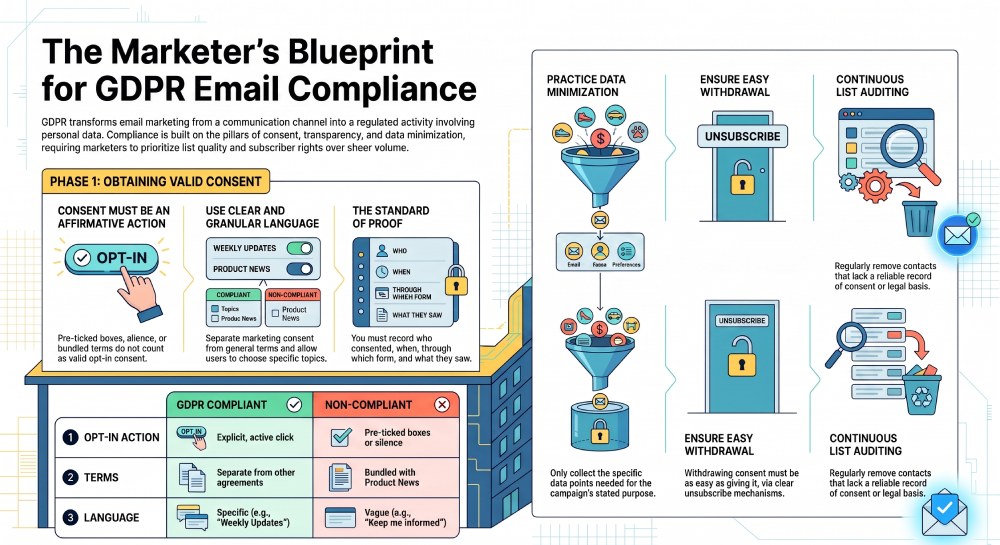
A valid opt-in requires affirmative action. Pre-ticked boxes, silence, bundled terms, or passive opt-out mechanisms are not enough. A user should knowingly choose to receive email security, marketing emails, and the opt-in language must be clear. For example, “I agree to receive weekly product updates and promotional emails” is more transparent than vague language such as “Keep me informed.”
Explicit consent should be separate from acceptance of general terms and conditions. If a user signs up for a webinar, downloads a report, or creates an account, the organization should not automatically add that person to all email newsletters unless the person has made a separate opt-in choice.
Record of Consent and Proof Requirements
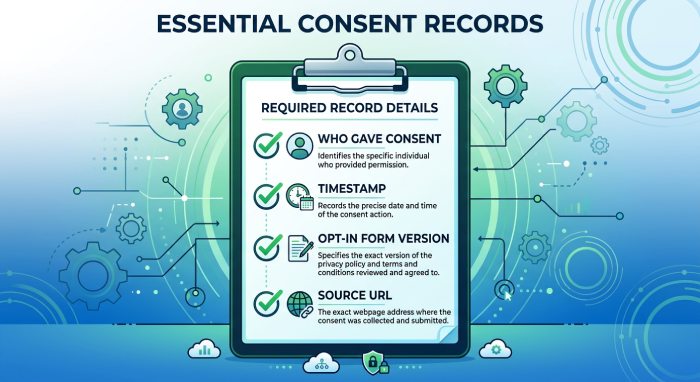
GDPR accountability means marketers must keep a record of consent. This record of consent should include who gave user consent, when consent was given, what message or form was shown, which checkbox was selected, and the source of the opt-in. Email compliance depends on being able to prove consent later, especially if a regulator, attorney, data protection officer, or European courts request evidence.
Tools such as Usercentrics help organizations manage consent signals, while email service providers often store timestamped consent logs. Adelina Peltea, associated with Usercentrics and often cited in privacy-focused marketing discussions, has emphasized the connection between trust, transparency, and compliant consent management.
Practical consent evidence to retain
Keep the opt-in form version, consent timestamp, IP address where appropriate, privacy notice version, source URL, and campaign category. This supports lawfulness of processing and helps demonstrate transparency under Article 13 disclosure obligations.
Withdrawal Rights and Unsubscribe Requirements
GDPR requires that individuals can withdraw consent as easily as they gave it. Every marketing email should include an unsubscribe mechanism that is clear, functional, and not hidden behind unnecessary steps. If a person withdraws consent, the organization must stop sending consent-based email marketing unless another legal basis clearly applies.
An unsubscribe request should not be treated as a data erasure request automatically, but it should suppress the address from future campaigns. If the data subject also invokes Article 17, the right to be forgotten, the organization may need to perform data erasure unless retention is legally required.
How GDPR Changes Email List Building, Segmentation, and Personalization
GDPR changed email list building by shifting the focus from quantity to quality. Large, purchased, or scraped lists often create serious email compliance risks because they may lack valid consent, transparency, and a lawful basis.
List Building Must Be Permission-Based
Marketers should avoid buying lists unless they can verify lawful collection, clear opt-in, and proper disclosures. Processing personal data from third-party sources requires careful due diligence. If a vendor cannot prove consent, the brand using the list may still be treated as the data controller and held responsible.
For B2B marketing, legitimate interest may sometimes support direct marketing, but it is not a shortcut around privacy rights. A legitimate interest assessment should consider the individual’s reasonable expectations, the nature of the personal data, and the ability to opt-out easily. Consent remains preferable for many email marketing programs, especially consumer-facing campaigns.
Segmentation and Personalization Require Transparency
Segmentation and personalization involve processing personal data to tailor content based on behavior, location, purchase history, industry, or engagement. GDPR permits personalization when there is a lawful basis, but transparency is essential. The privacy notice should explain how profiling or segmentation works and what personal data is used.
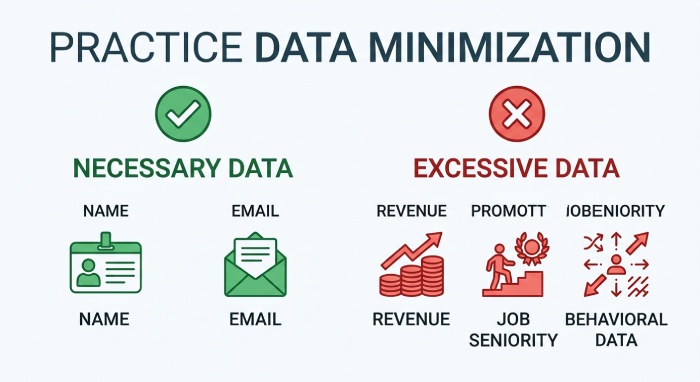
Data minimization is especially important. If a campaign only needs an email address and first name, collecting job seniority, company revenue, phone number, and behavioral data may be excessive. GDPR email compliance requires marketers to align personalization with data protection principles and lawfulness of processing.
Special Considerations for Minors and Sensitive Data
Where children are involved, parental permission may be necessary depending on the member state and the nature of the service. Marketers should also avoid using sensitive personal data in email marketing unless explicit consent and additional safeguards are in place. Explicit consent must be documented, granular, and easy to withdraw.
Data Privacy Obligations: Storage, Security, Access, and Retention
GDPR email compliance is also about how email data is stored, protected, accessed, and deleted. Marketing databases, CRM systems, automation platforms, and mailbox environments all create data protection obligations.
Secure Storage and Access Controls
Personal data used for email marketing should be protected through appropriate technical measures and organizational measures. Technical measures may include email encryption, two-factor authentication, access controls, secure APIs, audit logs, and data loss prevention. Organizational measures may include staff training, vendor management, role-based permissions, and incident response procedures.
Email safety matters because marketing databases are attractive targets for cyber attacks, phishing campaigns, and credential theft. A compromised mailbox or poorly configured cloud-based email platform can expose large volumes of personal information. Data security must therefore be built into email compliance from the start.
Encrypted email service providers such as ProtonMail promote privacy-focused communications, and ProtonMail Support provides guidance on features such as ProtonMail expiring email. While tools such as email encryption can improve confidentiality, GDPR compliance still depends on lawful collection, transparency, consent, and responsible data management.
Data Subject Access and Privacy Rights
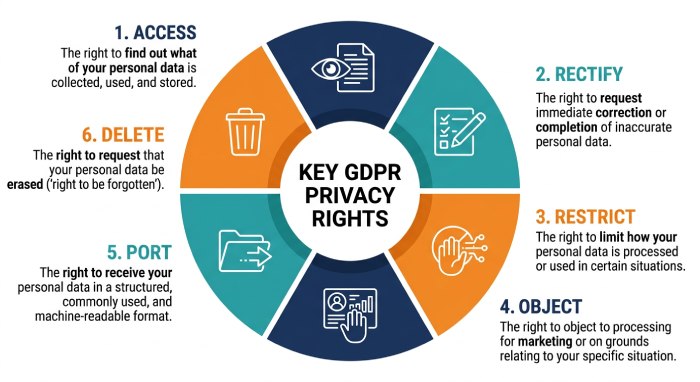
Individuals have privacy rights under GDPR, including the right to access, rectify, restrict, object, port data, and request deletion. A data subject may ask what personal data is stored, why it is used, and which third parties receive it. Marketers must be prepared to locate and export relevant data from email service providers, CRM systems, analytics platforms, and archived campaigns.
Article 13 requires clear information at the point of collection, including the identity of the data controller, purposes of processing, legal basis, retention periods, and privacy rights. This reinforces transparency and supports lawfulness of processing.
Email Retention and Deletion Rules
Email retention should be defined in a written email policy. GDPR does not set one universal retention period, but personal data should not be kept longer than necessary. Data storage rules should distinguish between active subscribers, unsubscribed contacts, suppression lists, inactive leads, and legal records.
Retention policies must also address data breach response. If a data breach affects email marketing data, the organization may need to notify regulators and, in high-risk cases, affected individuals. The Radicati Group has repeatedly reported the massive scale of global email usage, which helps explain why email remains a high-risk area for privacy compliance and security management.
Practical Steps to Build GDPR-Compliant Email Marketing Campaigns
A GDPR-compliant campaign combines good marketing strategy with legal discipline, privacy engineering, and operational accountability.
1. Build Consent Into Every Signup Flow
Obtaining valid consent starts with designing transparent and user-friendly signup forms.
- Use clear opt-in language.
- Separate marketing consent from other agreements.
- Avoid pre-checked boxes.
- Make explicit consent easy to understand and easy to withdraw.
- If offering multiple email newsletters, allow granular consent by topic or frequency.
Every signup form should link to a privacy notice explaining processing personal data, data storage, data retention, email retention, and privacy rights. This supports transparency and helps demonstrate lawfulness of processing under Art. 6 GDPR.
2. Audit Your Existing Email Lists
Regular audits help ensure your contact database complies with GDPR requirements.
- Review how each contact entered your database.
- Identify whether the legal basis is consent, legitimate interest, contract, or another basis under Article 6.
- Remove or suppress contacts where there is no reliable record of consent or no defensible legal basis.
For older lists, consider a re-permission campaign, but avoid emailing people where prior contact itself would violate email compliance rules. A data protection officer or qualified attorney can help assess gray areas, especially for cross-border campaigns involving the EU, EEA, and European regulations.
3. Align Campaign Operations With Data Protection
Compliance should be integrated into every stage of your email marketing workflow.
- Create a documented workflow for opt-in collection, unsubscribe handling, consent logging, access requests, and deletion requests.
- Train marketing, sales, customer support, and management teams so they understand GDPR, email compliance, consent, explicit consent, transparency, and data protection obligations.
Use reputable email service providers with strong data security controls, clear processor terms, and support for data erasure, suppression lists, and audit trails. If using vendors funded by or connected to European research initiatives such as the Horizon 2020 Framework Programme, still conduct normal vendor due diligence rather than assuming compliance.
4. Monitor, Test, and Improve Continuously
GDPR compliance requires ongoing monitoring rather than a one-time implementation.
- Regularly test unsubscribe links.
- Verify opt-in forms.
- Review data minimization practices.
- Update privacy notices.
- Confirm that explicit consent records remain accessible.
GDPR email compliance is not a one-time setup. Campaigns, vendors, privacy regulation, and European courts’ interpretations evolve over time. By combining privacy compliance with respectful email marketing, organizations can improve trust, reduce regulatory risk, and build more durable relationships with subscribers.
General Manager
General Manager at DuoCircle. Product strategy and commercial lead across the email security portfolio.
Secure your email infrastructure
Protect, authenticate, and deliver. Contact our team to find the right solution.