What Is Ping Spoofing? Understanding How It Works and How to Prevent It

Quick Answer
Ping spoofing is the practice of sending ICMP ping packets with a forged source IP address to hide an attacker's identity or deceive network devices. Prevent it by using ingress and egress filtering, monitoring ICMP traffic, and deploying firewalls and intrusion detection systems.
Network security threats continue to evolve as attackers discover new ways to disguise their activities and exploit trusted communication protocols. One such technique is ping spoofing, a method that manipulates Internet Control Message Protocol (ICMP) traffic to hide an attacker’s identity or deceive network devices.
Although ping requests are commonly used for network diagnostics and troubleshooting, cybercriminals can misuse them for reconnaissance, denial-of-service attacks, or network evasion. Understanding how ping spoofing operates helps organizations recognize suspicious activity and strengthen their network defenses.
This guide explains ping spoofing, its uses, associated risks, detection methods, and practical steps to reduce exposure.
What Is Ping Spoofing?
Ping spoofing refers to the practice of sending ICMP Echo Request or Echo Reply packets with a forged source IP address. Instead of revealing the attacker’s actual location, the packet appears to originate from another device or network.
Since many systems rely on ICMP messages for connectivity testing and network diagnostics, spoofed packets can create misleading network information and complicate security investigations.
The primary objective is usually to conceal the sender’s identity or manipulate how network devices interpret traffic.
Understanding ICMP and Ping
To understand ping spoofing, it helps to know how the ping command works.
Ping uses the Internet Control Message Protocol (ICMP) to determine whether a remote device is reachable. The process is straightforward:
- A computer sends an ICMP Echo Request.
- The destination device receives the request.
- It returns an ICMP Echo Reply.
- The sender measures the response time and packet loss.
Network administrators frequently use ping to:
- Verify connectivity
- Diagnose network issues
- Measure latency
- Confirm device availability
Because ICMP is lightweight and widely supported, it has become an attractive target for misuse.
How Ping Spoofing Works
In a normal ping operation, the source IP address accurately identifies the sending device.
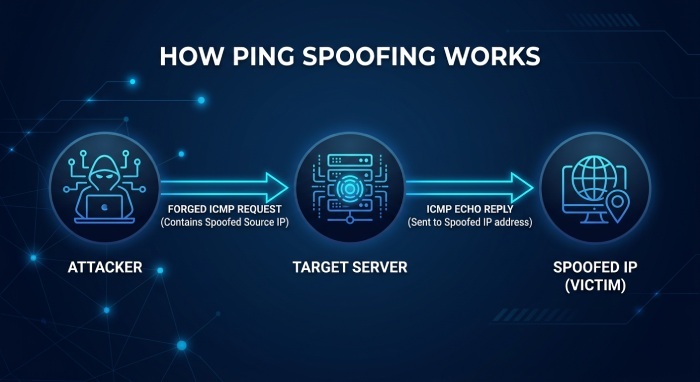
During ping spoofing, an attacker alters the packet header before transmission. The destination system receives what appears to be a legitimate request but responds to the forged address rather than the attacker’s real system.
The general process includes:
- Creating an ICMP packet.
- Replacing the legitimate source IP with a fake address.
- Sending the modified packet to the target.
- Causing responses to be directed elsewhere.
This approach makes attribution significantly more difficult.
Why Attackers Use Ping Spoofing
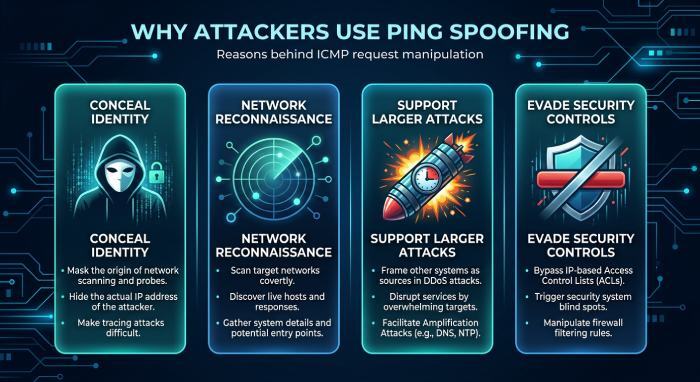
Ping spoofing serves several malicious purposes.
Concealing Identity
Attackers often spoof IP addresses to reduce the likelihood of being traced during reconnaissance or attacks.
Network Reconnaissance
Spoofed ICMP packets can help attackers collect information about firewalls, routers, and active hosts without immediately revealing their origin.
Supporting Larger Attacks
Ping spoofing is sometimes combined with broader attack strategies, including distributed denial-of-service (DDoS) campaigns and network scanning operations.
Evading Basic Security Controls
Some legacy security systems rely heavily on IP-based filtering. Spoofed packets may bypass poorly configured defenses.
Common Risks Associated with Ping Spoofing
Ping spoofing introduces several security concerns.
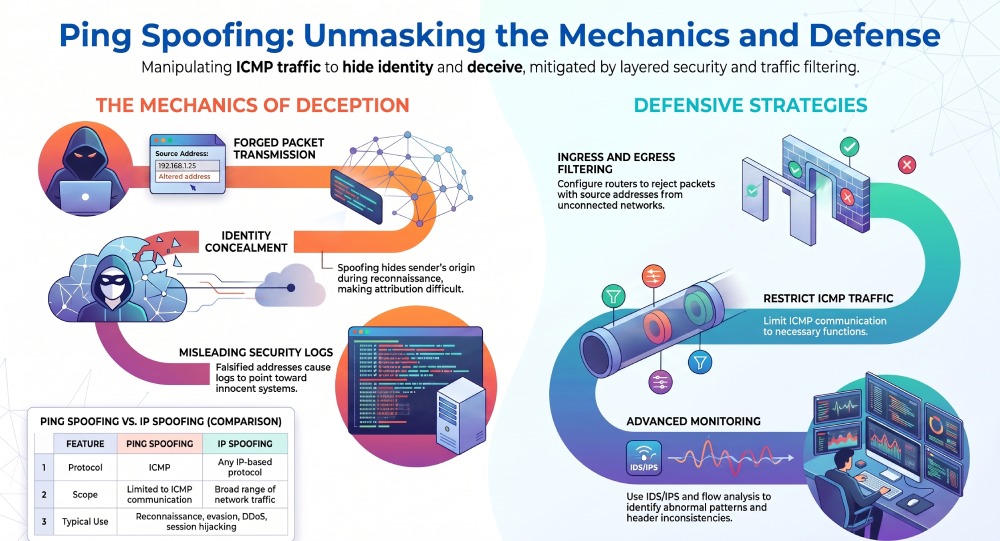
- Misleading Security Logs: Because the source address is falsified, security logs may point investigators toward innocent systems instead of the actual attacker.
- Network Confusion: Spoofed traffic can interfere with monitoring systems and make troubleshooting more challenging.
- Denial-of-Service Activities: Large volumes of spoofed ICMP traffic can overwhelm network resources or contribute to broader denial-of-service attacks.
- **Trust Exploitation: **Organizations that rely on trusted internal IP ranges without additional authentication may become vulnerable to spoofed traffic.
Signs of Possible Ping Spoofing
Although spoofing can be difficult to detect, certain indicators may suggest suspicious activity.
Watch for:
- Unexpected ICMP traffic spikes
- Responses from unfamiliar IP addresses
- Inconsistent network logs
- High volumes of Echo Requests from seemingly unrelated locations
- Unusual firewall alerts involving ICMP traffic
These symptoms warrant further investigation rather than serving as definitive proof.
How Security Teams Detect Ping Spoofing
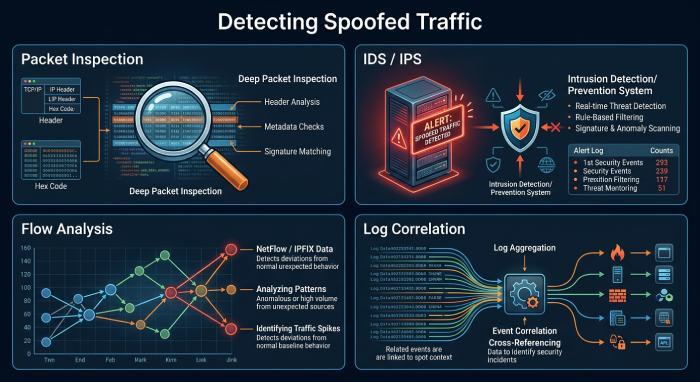
Effective detection usually involves multiple monitoring techniques.
- Packet Inspection: Analyzing packet headers can reveal inconsistencies between source addresses and expected routing behavior.
- Intrusion Detection Systems: Modern IDS and IPS platforms can identify abnormal ICMP traffic patterns and alert administrators.
- Flow Analysis: Network flow monitoring helps identify unusual communication patterns that may indicate spoofed traffic.
- Log Correlation: Comparing firewall, router, and endpoint logs often exposes discrepancies created by forged packets.
Can Ping Spoofing Be Prevented?
While eliminating spoofing entirely is difficult, organizations can significantly reduce the risk through layered security.
- Implement Ingress and Egress Filtering: Routers should reject packets with source addresses that should not originate from connected networks. This prevents many spoofed packets from entering or leaving the network.
- Restrict ICMP Traffic: Limit ICMP communication to necessary functions and block unnecessary requests where appropriate.
- Keep Network Devices Updated: Regular firmware and software updates help address vulnerabilities that attackers may exploit.
- Monitor Network Activity: Continuous traffic analysis allows administrators to identify abnormal ICMP behavior before it escalates.
- Deploy Network Security Solutions: Firewalls, intrusion prevention systems, and network monitoring platforms provide additional visibility and protection against spoofing attempts.
Ping Spoofing vs. IP Spoofing
Although related, these terms are not identical.
| Feature | Ping Spoofing | IP Spoofing |
|---|---|---|
| Protocol | ICMP | Any IP-based protocol |
| Main Purpose | Manipulate ping traffic | Hide the true source of network packets |
| Scope | Limited to ICMP communication | Broad range of network traffic |
| Typical Uses | Reconnaissance, evasion, ICMP attacks | DDoS attacks, session hijacking, scanning |
Ping spoofing is essentially a specialized form of IP spoofing focused on ICMP traffic.
Best Practices for Organizations
Improving network security requires a proactive approach.
Recommended practices include:
- Apply source address validation.
- Regularly review firewall rules.
- Monitor ICMP traffic trends.
- Segment sensitive network resources.
- Conduct routine vulnerability assessments.
- Train IT staff to recognize spoofing indicators.
- Enable comprehensive logging across network devices.
Combining these measures creates stronger protection against spoofing-related attacks.
Conclusion
Ping spoofing exploits the flexibility of ICMP by disguising the true origin of network packets. While the technique is often used to hide malicious activity, conduct reconnaissance, or support larger cyberattacks, organizations can reduce their risk through careful network monitoring, packet filtering, secure configurations, and layered security controls.
Understanding how ping spoofing works enables administrators to identify unusual traffic patterns more quickly and implement defenses that make spoofing attempts far less effective. As cyber threats continue to evolve, maintaining strong visibility into network communications remains an essential part of protecting modern IT environments.
Strengthen your overall cybersecurity strategy by pairing robust network defenses with DuoCircle’s SPF, DKIM, and DMARC email authentication solutions.
General Manager
General Manager at DuoCircle. Product strategy and commercial lead across the email security portfolio.
Secure your email infrastructure
Protect, authenticate, and deliver. Contact our team to find the right solution.