When to Hire a Data Annotation Company vs In-House

Quick Answer
Hire a data annotation company for specialized expertise, scalability, and faster delivery. Build an internal team when you need greater control, data security, consistent quality, and dedicated resources for ongoing AI projects. Choose based on your budget, workload, and long-term goals.

Every team thinks they’ll save money by hiring in-house. Sometimes that’s true. Usually it isn’t, not once you count the recruiting time, the training, the QA lead you now need, and the three weeks lost when your best annotator quits. A data annotation company skips most of that.
This article breaks down when it makes sense to opt for data annotation outsourcing and when it’s better to keep in-house annotation.
Check Your Annotation Volume
Before you compare team size or rates, estimate how much data you expect to annotate over the next 6-12 months. Volume alone is not enough. Look at how often new data arrives and how much that volume may change.
Stable workloads favor permanent teams
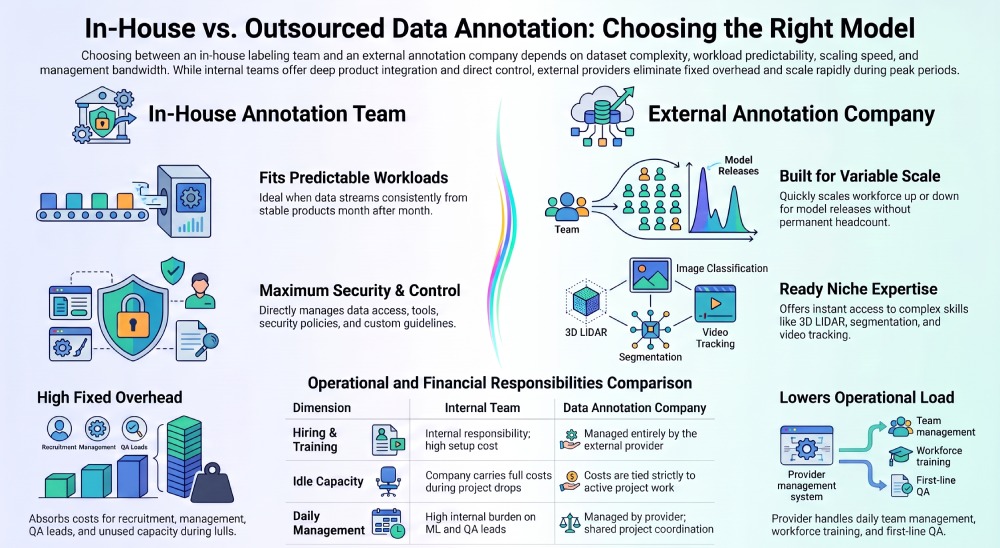
A data labeling team can make sense when annotation stays consistent month after month. For example, a company that receives a predictable stream of training data from the same product may have enough work to keep a permanent team occupied.
Check three things:
- Expected monthly data volume
- Average annotation time per item
- Workload you expect after the current project ends
Variable workloads favor external capacity
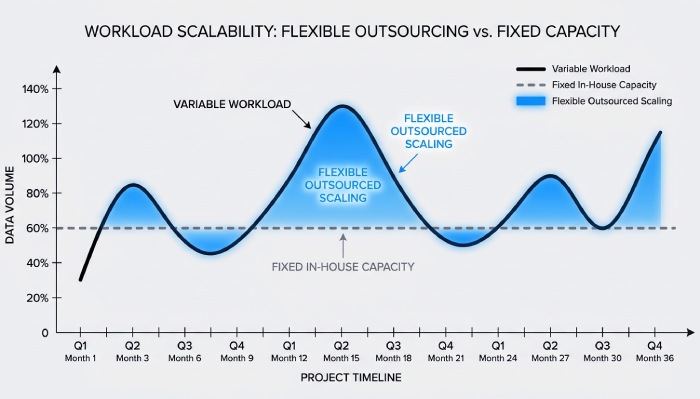
Demand often rises around a new model, dataset, or product release and drops afterward. In that case, a permanent headcount can leave you with excess capacity.
Estimate your normal workload and your peak workload separately. If the gap is large, external capacity may fit the project better than a fixed internal team.
Compare the Full Cost of Each Model
Once you know your expected workload, compare the full annotation costs rather than the rate per labeled item or hour.
Internal annotation costs extend beyond salaries
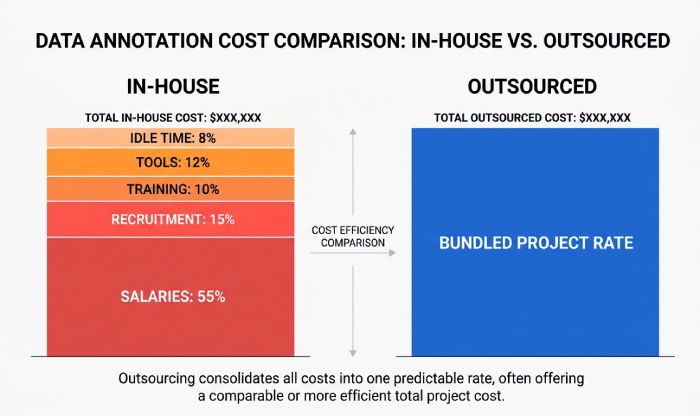
An in-house annotation team puts several expenses on your side. You pay for recruitment, staff training, salaries, team leads, QA specialists, annotation tools, and security controls.
You also carry the cost of staff turnover and unused capacity if project volume drops. Management time belongs in the calculation too. Someone has to assign work, answer annotation questions, review quality, and resolve repeated errors.
External pricing covers a different cost structure
A specialist data annotation company like Label Your Data usually combines annotation labor with workforce management, QA, staff training, and project coordination. Some providers also include annotation tools in the project rate.
That makes direct rate comparisons difficult. Compare the total cost required to produce an accepted dataset instead.
| Cost area | Internal team | Data annotation company |
|---|---|---|
| Hiring | Managed internally | Managed by provider |
| Training | Internal responsibility | Usually handled by provider |
| QA staff | Separate team or cost | Often included |
| Tools | Purchased or maintained internally | May be included |
| Idle capacity | Company carries the cost | Usually tied to active work |
| Management | High internal involvement | Shared with provider |
Compare How Fast Each Option Can Scale
Cost tells only part of the story. You also need to ask how quickly each model can respond when annotation volume rises.
Internal scale depends on recruitment and training
With in-house annotation, extra capacity usually means extra hires. New annotators need time to learn the guidelines, complete test tasks, and reach the expected quality level.
A larger team may also require more reviewers. If annotation demand doubles for a short period, permanent recruitment can create excess capacity once that peak ends.
External teams can add capacity faster
An AI outsourcing provider can draw from a larger workforce without adding permanent headcount to your company. AWS also distinguishes between private workforces and vendor-managed teams for data labeling. But ask for specifics before you rely on that capacity.
How many trained annotators can the provider add? How fast? Who reviews their work?
A larger team helps only if quality remains consistent as volume increases.
Look at the Expertise Your Project Needs
A large team won’t help much if the annotators lack experience with the task. As training data becomes more complex, gaps in expertise usually lead to more questions, longer reviews, and more corrections.
Internal teams build deeper product knowledge
An internal team can develop detailed knowledge of your product and annotation rules over time. This can help when labels depend on company-specific definitions or frequent input from your ML team.
The tradeoff appears when a new project requires skills your team has never used before.
External teams can provide specialist experience
A data annotation company usually already have annotators who work with tasks such as:
- 3D point clouds and LiDAR
- Instance or semantic segmentation
- Video object tracking
- Geospatial data
- Multilingual text
Don’t judge that experience from a capabilities list alone. Run a representative pilot and compare error types, edge-case decisions, review effort, and time per item.
Compare Management Load and Data Control
The team model also affects how much operational work stays inside your company and how directly you control access to project data.
Internal teams give you more direct control
With an internal data labeling team, your company controls staff access, annotation tools, storage, and security policies. This can suit projects with strict internal rules or sensitive datasets.
The tradeoff is management time. Someone must assign tasks, train new annotators, update guidelines, review quality, answer questions, and handle performance issues. As the team grows, that workload grows too.
Email security also matters when sharing annotation guidelines, project updates, and dataset files. Companies should implement SPF, DKIM, and DMARC to help protect business email from spoofing and phishing attacks.
External providers reduce daily management work
When you do data annotation outsourcing, most of the daily management goes to the provider, not you. Your team still writes the requirements, approves the guidelines, and checks the work. But you’re no longer managing individual annotators with AI outsourcing.
That’s less control on your end. So you need to check the vendor carefully. Ask where they store data, who can access it, and if annotators can download files.
NIST recommends that companies define access controls for external service providers and limit access to authorized people based on their roles.
It comes down to this: do you want more control, or less to manage day to day?
When a hybrid annotation model works better
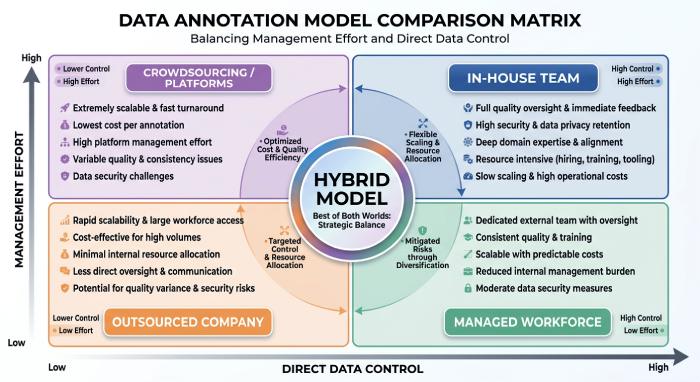
A hybrid model fits projects that need internal expertise without a large permanent team. Your experts can define labels, update guidelines, resolve edge cases, and review model-specific errors. An external provider can handle routine annotation and first-line QA. This way, your team stays focused on complex cases and adds capacity when demand rises.
General Manager
General Manager at DuoCircle. Product strategy and commercial lead across the email security portfolio.
Secure your email infrastructure
Protect, authenticate, and deliver. Contact our team to find the right solution.