How to Strengthen Outbound SMTP for Fintech Firms to Safeguard Customer Emails

Quick Answer
Fintech firms can strengthen outbound SMTP security by implementing SPF, DKIM, and DMARC, enforcing TLS encryption, monitoring email traffic, and using advanced threat protection. These measures help prevent phishing, protect customer communications, and improve email deliverability and trust.
Fintech firms rely on email to send account alerts, verification links, payment updates, and security notices. These messages carry financial context, which makes them attractive to attackers who want to impersonate trusted brands and trick customers into sharing credentials or authorizing transactions.
Strengthening the outbound Simple Mail Transfer Protocol (SMTP) reduces that risk by authenticating each message, preventing tampering, and improving deliverability.
Here’s how to implement SMTP for fintech to help you protect customer inboxes and preserve trust in every communication.
The Unique Email Security Pressure on Fintech
Fintech organizations operate under tighter security pressure than most industries because they sit at the intersection of financial data, identity verification, and real-time transaction alerts.
Attackers know that customers are more likely to trust emails about payments, balances, and fraud warnings, which makes spoofed domains highly effective.
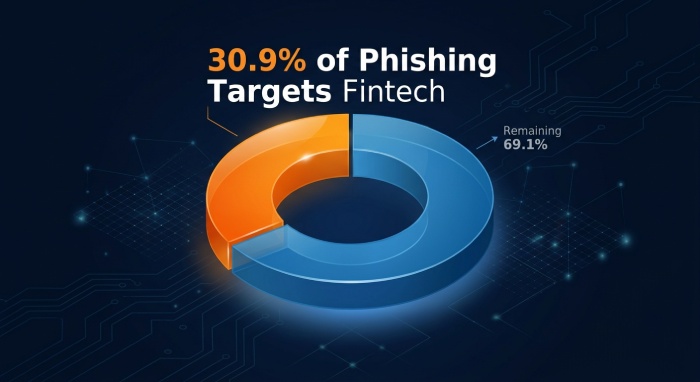
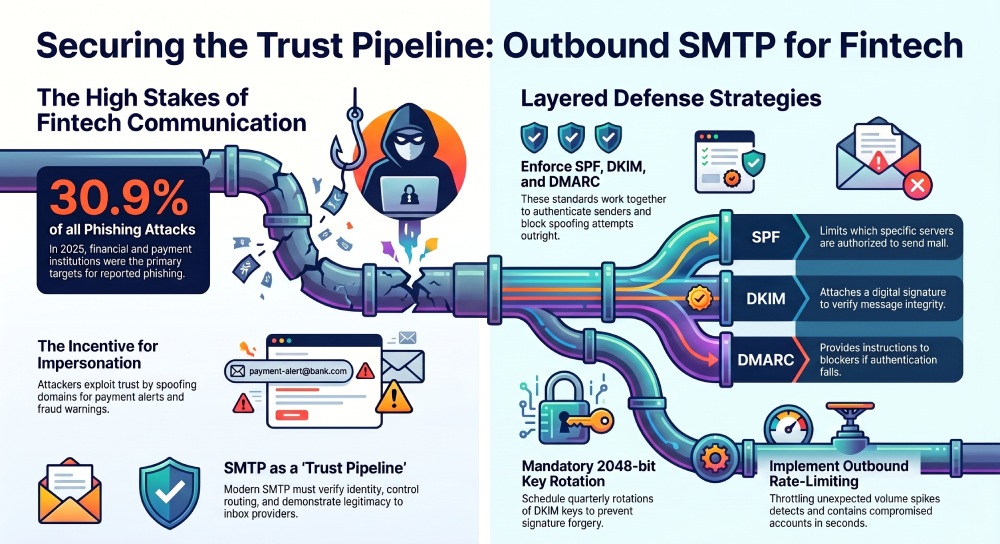
In 2025, financial and payment institutions alone made up 30.9% of all reported phishing attacks, which shows how consistently criminals target brands that move money.
This pressure is global. Emerging regions, such as the Nigerian fintech market, continue to experience rapid growth in digital banking adoption, which has increased the volume of customer communication and the incentive for impersonation attacks.
When fraudulent emails mimic trusted platforms, customers often struggle to differentiate between legitimate messages and malicious requests, especially when the communication appears to be a genuine balance update or transfer confirmation. Many types of applications in the fintech sector must implement robust security measures to protect users.
Regulators also assess whether firms can:
- Prevent unauthorized senders from broadcasting messages
- Maintain control over sending domains
- Encrypt sensitive data in transit
 A single spoofed message can lead to credential theft, unauthorized transfers, or compliance violations. Without strict controls, attacks can exploit email as a trusted means of financial communication.
DuoCircle helps fintech companies strengthen email security against rising phishing, fraud, and compliance risks.
What is Outbound SMTP?
Outbound SMTP is the process of sending messages from a business to customer inboxes. It’s powered by the Simple Mail Transfer Protocol (SMTP), a traditional protocol that routes messages across servers on the Internet.
When a user sends a message from an email client, the SMTP server formats and hands it off to other systems until it reaches the destination email address. Along the way, configuration and email settings determine which servers are authorized to send on behalf of a domain and how the message is authenticated.
Modern deployments build upon this older model by layering stronger protections. Firms increasingly require TLS encryption to prevent message interception and apply additional security protocols that verify the legitimacy of each sender and preserve the integrity of sensitive financial communication.
How Outbound SMTP for Fintech Works
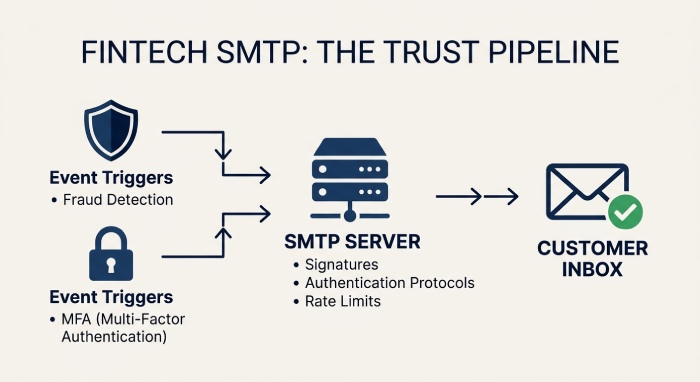
SMTP for fintech doesn’t operate as a simple email handoff. Instead, customer messages are event-driven:
- Account activity changes
- Fraud rules are triggered
- Verification codes are requested
Each event flows through the platform’s notification layer, which packages the message and sends it to an authorized SMTP server.
Different internal systems may send different communication types:
- Core banking platforms
- Support desks
- MFA tools
- Marketing systems
Each must align with pre-approved authentication rules so inbox providers can verify that the message is legitimate.
Once the SMTP server accepts a message, it:
- Attaches authentication signatures
- Checks routing policies
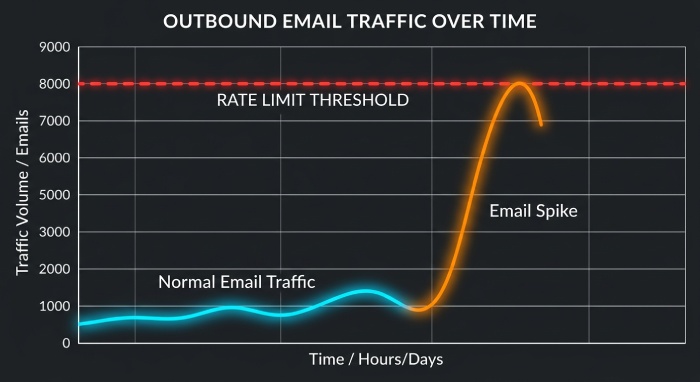
- Evaluates rate limits for suspicious spikes
From there, the message travels across interconnected services until it reaches the customer’s inbox, where filtering engines evaluate sender reputation, alignment, and previous delivery history.
 If authentication signals match and the domain has a strong reputation, the email is delivered normally. If anything looks suspicious, it may be delayed, routed to a promotions folder, or blocked outright. This is especially true for fintech marketing emails, but it can also apply to transactional emails.
Because customers rely on timely financial communication, fintech firms closely monitor delivery patterns to ensure that legitimate alerts arrive exactly when needed.
In this workflow, outbound SMTP is effectively a trust pipeline. It verifies identity, controls routing, and demonstrates to inbox providers that each message is legitimate.
Tips for Securing Outbound SMTP for Fintech
Strengthening outbound SMTP for fintech requires layered controls that verify senders, secure data in transit, and detect suspicious behavior quickly.
These strategies enable your fintech firm to maintain trust, protect customer accounts, and demonstrate regulatory diligence. Working with fintech integration services can also help organizations implement secure connections between email infrastructure, financial platforms, and compliance monitoring systems.
Enforce Authentication Standards
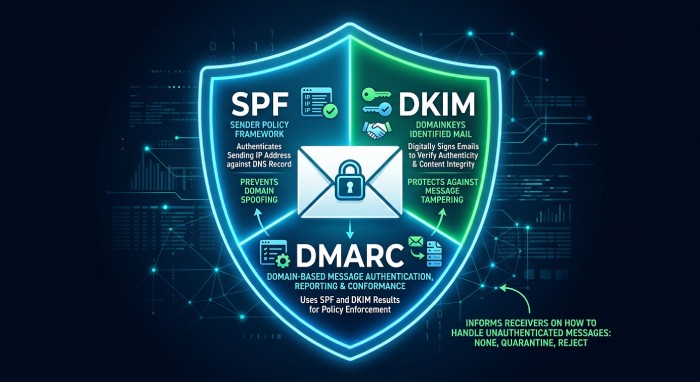
Use SPF, DKIM, and DMARC together to authenticate every message leaving the domain.
SPF limits which servers can send mail, DKIM verifies message integrity, and DMARC blocks spoofing attempts outright.
These standards prevent attackers from imitating financial alerts or account updates, helping inbox filters distinguish between legitimate and malicious communication.
Consistently enforcing authentication prevents fraudulent messages from reaching customers.
Use Modern Transport Encryption
Email often moves across multiple servers, which introduces opportunities for interception. Transport-layer protection ensures sensitive data remains private during each hop.
To protect your fintech’s reputation and security, require strong security protocols and enforce TLS encryption on outbound connections to prevent downgrade attacks.
Major email providers are increasingly expecting these protections and may penalize senders who don’t use them.
Ensuring email platforms support modern cryptography helps safeguard verification codes, balance updates, and customer identity data.
Rotate Cryptographic Keys
Cryptographic keys used for DKIM signing can weaken over time or be exposed through misconfiguration. Regular rotation prevents attackers from relying on older keys to forge signatures.
It’s essential to maintain 2048-bit keys, schedule quarterly key rotations, and use separate selectors for each sending service.
These methods protect the integrity of outbound messages and ensure that authentication signals remain trustworthy.
Implement Outbound Rate-Limiting
Attackers often compromise an inbox and immediately send thousands of emails to exploit customer trust or spread phishing links.
Rate-limiting thresholds can detect this pattern in seconds. When message volume spikes unexpectedly, SMTP controls should throttle output and flag the event for security review.
Early containment prevents damage to sender reputation and reduces the risk of blacklisting.
Block Unauthorized Relays
Open or misconfigured relays allow outsiders to send mail through your email infrastructure without permission.
This leads to instant reputation damage, customer confusion, and potential regulatory scrutiny. To prevent these issues, require authentication for all outbound submissions, disable anonymous access, and restrict relay privileges to known systems.
Preventing unauthorized relay abuse ensures that communications are tied to verified identities.
Monitor Domain Reputation
Inbox providers evaluate sender reputation on every message. A poor score can cause legitimate financial alerts to land in spam folders.
Since spam folders determine a major portion of email delivery, ensure your teams are monitoring blacklists, bounce patterns, and authentication failures regularly.
Continuous insight helps identify compromised accounts early and preserves reliable customer communication.
Segment Third-Party Senders
Many fintech platforms rely on external services, such as Amazon SES, to deliver transactional notifications.
Each vendor should be isolated using subdomains, unique DKIM selectors, and narrow SPF scopes.
This limits the impact of a vendor compromise and preserves clarity when reviewing authentication reports. Contract requirements should include DKIM signing and modern TLS support.
Secure Administrative Access
Administrative consoles tied to SMTP systems require strict governance. Access should be limited to essential staff and protected with multifactor authentication (MFA), and monitored for any suspicious behavior.
Weak or reused email credentials can lead to unauthorized configuration changes and message abuse.
Restricting email settings changes reduces the likelihood of accidental exposure and prevents attacks from altering routing behavior.
To further reduce risk, fintech firms should pair SMTP governance with an endpoint control platform that enforces device-level security for administrators accessing email infrastructure. By restricting privileged actions to compliant, monitored endpoints, organizations can prevent compromised laptops or mobile devices from being used to alter SMTP configurations or abuse sending privileges.
Implement Policy-Driven Templates
Standardized email templates enable fintech firms to control the tone, structure, and alignment of outbound messages to their sales leads.
Consistent message layouts make phishing attempts easier for customers to spot because attackers struggle to mimic the exact structure.
Templates also define what sensitive details can appear in subject lines or bodies, reducing the chance of leaking account information in inbox previews.
They align technical headers with authentication rules, which makes it easier for filters to trust the message instead of flagging it as suspicious.
Continuously Test for Weaknesses
Threats evolve constantly, and fintech email systems must evolve with them. Regular testing should include simulated spoofing attempts, TLS downgrade probes, and authentication misalignment checks.
These exercises reveal blind spots before attacks exploit them. Continuous validation ensures outbound SMTP for fintech remains resilient, compliant, and trusted by inbox providers.
FAQs
Why is outbound SMTP for fintech so important?
It verifies that financial alerts, verification codes, and balance updates come from authorized systems, not impersonators.
Can attackers spoof a fintech domain without proper controls?
Yes. Without authentication standards like SPF, DKIM, and DMARC, attackers can send messages that appear legitimate.
Do third-party senders increase risk?
They can. Vendors must be isolated with subdomains and required to sign messages to avoid trust issues.
Does TLS encryption matter if the message is already authenticated?
Yes. Authentication proves identity. TLS protects the content while it travels across networks.
Can rate-limiting really stop abuse?
Absolutely. It prevents compromised accounts from blasting out harmful messages in a short window.
Why do some legitimate emails still land in spam?
Reputation, formatting issues, misaligned authentication, and poorly tuned templates can trigger filtering.
Key Takeaways
- Outbound SMTP is a trust pipeline, not just a delivery system.
- Authentication standards (SPF, DKIM, DMARC) are mandatory for preventing spoofing.
- TLS encryption protects sensitive financial data while in transit.
- Cryptographic key rotation keeps authentication signals strong over time.
General Manager
General Manager at DuoCircle. Product strategy and commercial lead across the email security portfolio.
Secure your email infrastructure
Protect, authenticate, and deliver. Contact our team to find the right solution.