

DKIM Alignment Explained: Why “Pass” Is Not Always Enough
What does it really mean to send emails securely?
It’s not just about ensuring that the email reaches the recipient with a familiar sender name and branding. What also matters is whether receiving mail servers can verify that the domain shown to the recipient is genuinely authorized to send that message.
By verification, we don’t just mean running preliminary authentication checks that tell you whether the message was signed and delivered without alteration.
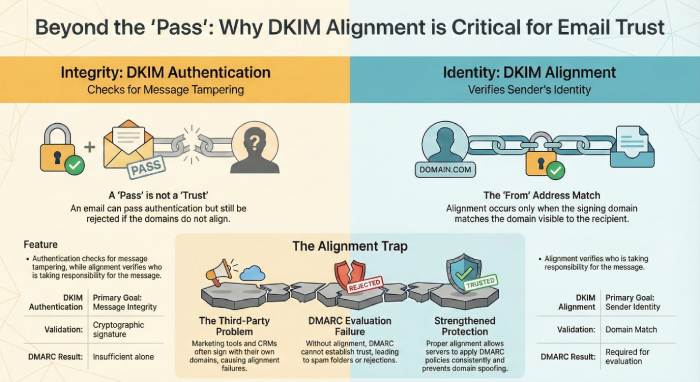
A DKIM “pass” confirms that the email has not been altered in transit and that it was signed using a valid cryptographic key. But it does not tell whether the domain that signed the message is the same as the one visible to the recipient in the “From” address. This is called DKIM alignment.
Let’s dig deeper to understand why emails that appear technically authenticated may still be filtered, quarantined, or rejected, and why authentication alone is not enough.

What is DKIM alignment?
On the surface, DKIM authentication and DKIM alignment might seem similar, but they are vastly different. While DKIM authentication focuses on whether an email was signed properly and its content remained unchanged in transit, DKIM alignment looks at who is taking responsibility for that message. It checks whether the domain used to sign the email matches the one the recipient sees in the “From” address.
What sets it apart from the “pass” result of DKIM authentication is that alignment is done on the domain level and is not limited to the message itself. However, this does not mean DKIM authentication is redundant. It simply confirms that the email is authenticated with a valid signature. But that’s not enough to confirm the sender’s identity and build trust.
A DKIM “pass” only tells receiving servers that the message was signed correctly and wasn’t altered along the way. It doesn’t tell you whether the domain that signed the email is the same domain the recipient is being asked to trust.
So, even if an email passes DKIM authentication, it can still run into delivery issues. This is because, if the signing domain and the “From” domain don’t match, the receiving servers will still treat the message as untrustworthy, particularly when the message is sent through third-party services.

How does DKIM alignment work?
When you send an email, two different domains work behind the scenes. The first one is the one shown in the “From” address, which represents where the email is coming from, and is visible to the recipient. The other is the domain used to sign the message in the DKIM signature.
When the message reaches the receiving server, it verifies both of these domains for further authentication checks. It compares the domain used to sign the message with the domain shown in the “From” address to see whether they match.
If the domains match, DKIM is considered aligned and is further qualified for DMARC evaluation. But if the domains do not match, DKIM alignment fails, even if the DKIM signature itself passes. If that happens, DMARC does not rely on DKIM to establish trust, and the message is considered unverifiable.
Why does DKIM alignment fail even when DKIM passes?
DKIM alignment fails when the domain that is used to sign the email is not the same as the domain in the “From” address. This does not mean that the email isn’t signed correctly, but there is a mismatch in the sender identity.
The email might be signed properly and may have remained unchanged during transit, but the identity shown to the recipient does not fully line up with the domain that signed the message.
This problem occurs when the email is sent through third-party services, such as marketing tools, CRM platforms, payment gateways, etc. These services and platforms use their own domain to send your emails.
So, even though the “From” address might show your brand’s name, the signing domain is the one controlled by the third-party service, not your own domain. Because of this, receiving mail servers see a difference between the domain that signed the email and the domain shown in the “From” address. Technically, the email is legitimate as even the third-party sender is authorized by you, but for the receiving server, if the domains don’t match, the message is considered untrustworthy.
When alignment fails, DMARC cannot confirm that the sender’s identity is trustworthy. As a result, the email may be treated with suspicion and can end up in spam, be quarantined, or be rejected, especially if you have implemented a strict DMARC policy.
Why is DKIM alignment the safer choice?
Knowing that the incoming message is signed with a valid signature and wasn’t tampered with along the way might seem like a valid assurance for the receiving servers, but that’s not enough. This check does not confirm whether the domain that signed the email is the same domain the recipient sees or expects.
With DKIM alignment, the recipient’s servers know that the sender can be trusted, as the sender’s domain matches the signing domain. In such cases, the signature and the sender’s name are not treated as two mutually exclusive aspects of the email.
This clarity allows receiving servers to evaluate the message with more confidence, instead of trying to make sense of each domain separately. That means, when the signature and the visible sender align, the servers handle the message with much more confidence. Once the receiving servers are confident about the sender’s identity, they can apply DMARC policies correctly and consistently.

Wrapping up
To truly build trust with the receiving servers and your users, it is important that you focus on both integrity and identity. For this confidence, you need a valid DKIM signature that proves that a message is intact, and proper alignment to prove that the message genuinely represents your domain.
When these two aspects work together, receiving servers can make clear and consistent decisions about how your emails should be handled. This not only improves deliverability but also strengthens protection against spoofing and misuse of your domain.
Want to know more about DKIM alignment? Contact DuoCircle today!