

Email rejections can silently undermine your campaigns, even when your content is top-notch. A frequent issue is an inadequately set up SPF record. As email service providers enhance their authentication requirements, a basic SPF configuration isn’t sufficient to ensure your emails land in inboxes or are successfully delivered.
This article delves into sophisticated SPF enhancement techniques that extend beyond the basics, aiding you in avoiding email rejections, boosting your sender reputation, and ensuring your messages are correctly authenticated within intricate sending systems.
Advanced SPF tips to reduce email rejection
Why advanced tuning matters
Sender Policy Framework is foundational to domain authentication, but modern inbox providers expect more than a basic SPF record. Advanced SPF optimization reduces false rejections, tightens email security, and protects domain reputation while keeping email deliverability high. Effective SPF implementation aligns policy frameworks across DMARC and DKIM, controls the SPF lookup limit, and prevents SPF errors and SPF duplicates that often trigger hard fails or temperror outcomes at receivers like Google and Yahoo.

Objectives and metrics
- Minimize SPF errors through rigorous SPF syntax validation and continuous SPF monitoring.
- Maintain DMARC-aligned mail streams by ensuring SPF alignment for both envelope-from and HELO identities.
- Reduce DNS overhead with controlled SPF mechanism ordering, safe SPF flattening, and proactive DNS management to stay within the SPF lookup limit.
- Operationalize SPF lifecycle management, including SPF update workflows, SPF maintenance, and SPF analytical reporting to detect deliverability issues early.
Why SPF Still Drives Rejection: Receiver Policies, DMARC Interplay, and Alignment
Receiver-side enforcement and policies
Mailbox providers enforce SPF policies differently. Google and Yahoo increasingly rely on stricter SPF evaluation and DMARC enforcement for high-volume senders. If your SPF record returns permerror (due to SPF syntax mistakes) or temperror (from excessive queries surpassing the SPF lookup limit), receivers apply their local policy—often resulting in rejection or junking, impacting email deliverability.
DMARC alignment and multi-identifier nuance
DMARC requires alignment between the domain in the visible From and authenticated identifiers. SPF alignment checks whether the domain in the Return-Path (or HELO) aligns with the From domain under DMARC. Misaligned Return-Path subdomains, SPF duplicates from overlapping policies, or SPF errors that break evaluation can cause DMARC to fail even when DKIM passes, harming email deliverability. Use DMARC reporting and a DMARC Checker to study aggregate failures and refine SPF implementation.
SPF alignment vs DMARC alignment
- SPF alignment is about the authenticated Return-Path or HELO domain aligning with the From domain.
- DMARC alignment considers both SPF and DKIM; if DKIM fails and SPF alignment is broken, DMARC p=reject will drive rejection. Coordinated Sender Policy Framework and DKIM keys underpin robust email authentication and email spoofing prevention.

SPF Architecture: Envelope-from Domains, HELO Names, and Custom Return-Path Subdomains
Designing the Return-Path for control
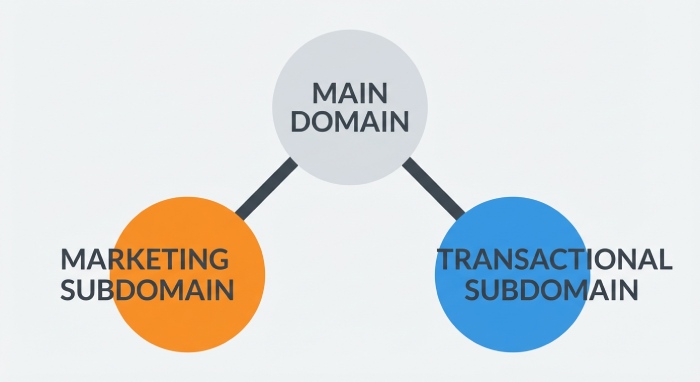
Architect your SPF DNS record so the envelope-from (Return-Path) uses a dedicated subdomain per email service provider. This enables precise SPF configuration and avoids SPF duplicates when multiple vendors publish overlapping ranges. A clean SPF implementation assigns each ESP a custom subdomain (e.g., esp1.mail.example.com) referenced via an SPF include statement.
HELO/EHLO fallback logic
Receivers may test SPF against the HELO/EHLO domain when the envelope-from is null (e.g., bounces). Ensure the HELO has a valid SPF record and passes SPF validation. This redundancy improves domain authentication and prevents unexpected SPF errors.
Segmentation per ESP and function
- Allocate distinct Return-Path subdomains per ESP, function (marketing vs. transactional), and geography.
- Maintain hosted SPF per subdomain to simplify centralized SPF management while limiting SPF record length growth.
Controlling DNS Lookups: Mechanism Ordering, CIDR Aggregation, and Avoiding Void/Expensive Queries
Order mechanisms to short-circuit early
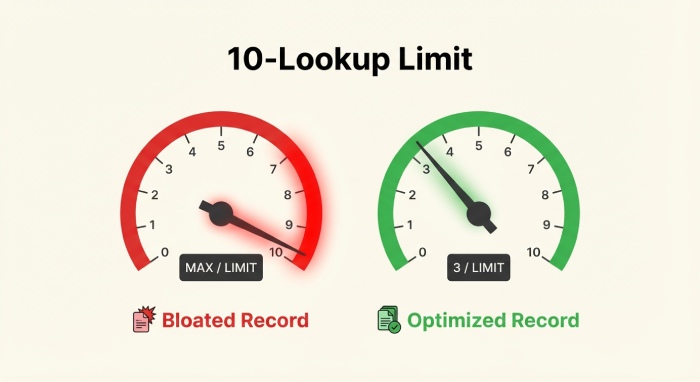
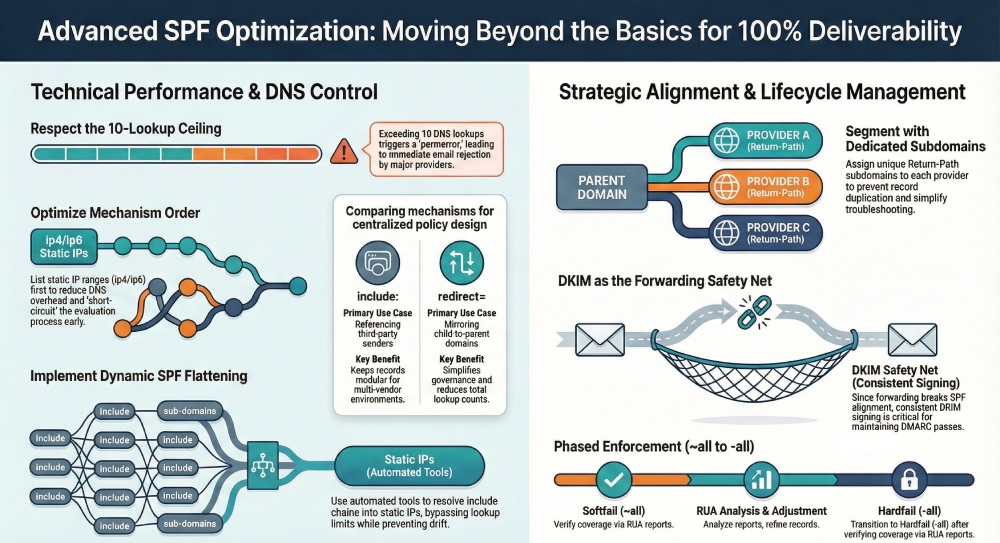
Optimize SPF mechanism order: ip4/ip6 first (with CIDR aggregation), followed by a minimal number of include directives, then a single redirect if needed, and finally ~all or -all per your SPF policies. Careful ordering reduces SPF record lookup overhead and keeps evaluation within the SPF lookup limit. Consistent SPF syntax and precise qualifiers prevent ambiguous matches and SPF errors.
Aggregate ranges and compress the record
CIDR aggregation and pruning of deprecated hosts control SPF record length and improve email deliverability. Periodic SPF evaluation and SPF maintenance prevent drift as providers add or retire ranges. Document each SPF mechanism’s purpose to avoid future SPF duplicates when teams add new includes.
Avoid void lookups and bloated recursion
Avoid include chains that lead to void or NXDOMAIN lookups. Excessive nested includes risk breaching the SPF lookup limit. Use DNSSEC for authenticity and robust DNS management; monitor for timeouts that create temperror conditions.
DNS and transport hygiene
- Ensure forward-confirmed PTR is not relied upon; SPF does not require it.
- Complement with MTA-STS and TLS-RPT so transport-layer failures don’t masquerade as deliverability issues unrelated to the SPF record.
include vs redirect: Centralized Policy Design for Multi-Domain/Multi-ESP Environments

When include is appropriate
Use an SPF include statement to reference third-party senders that publish their own ranges. This keeps your SPF DNS record modular but risks SPF duplicates if the same network is included via multiple vendors. Validate with an SPF checker before deployment to avoid SPF errors and to maintain email deliverability.
When redirect simplifies governance
Use redirect= when a child domain’s SPF policy should exactly mirror a parent’s. This improves SPF optimization by centralizing policy, reducing SPF deployment overhead, and simplifying SPF update workflows across brands. Redirect avoids multiple includes and can reduce SPF record lookup counts.
Hosted SPF for scale and control
Hosted SPF centralizes policy authoring with templated rules, version control, and automated rollouts. A mature hosted SPF approach enforces consistent SPF syntax, avoids errors and duplicates, and streamlines SPF management across the SPF lifecycle. Many organizations pair Hosted SPF with managed services and integrations for auditing and compliance.
Safe SPF Flattening: Static vs Dynamic, TTL Tuning, and Automated Drift Detection
Static flattening: proceed with caution
Static SPF flattening replaces include chains with resolved IPs. While this can cut DNS queries, it easily leads to SPF errors when vendor IPs change, creating deliverability issues. It also inflates SPF record length and invites SPF duplicates if multiple flattened segments overlap.
Dynamic flattening and Hosted SPF automation
Dynamic SPF flattening via hosted SPF platforms can refresh IPs automatically, preserving the SPF lookup limit while preventing SPF duplicates. Tools that integrate an SPF generator with policy templates reduce human error and maintain consistent SPF syntax across domains, improving domain authentication and email deliverability.
Tune TTLs and monitor continuously
Match TTLs to vendor change velocity; shorter TTLs for volatile providers, longer for static ranges. Pair with SPF monitoring and SPF analytical reporting to catch anomalies early. Automate SPF troubleshooting with alerting on permerror/temperror spikes and conduct periodic SPF evaluation across all domains.
Drift detection and rollback
- Use an SPF validation tool and an Email Header Analyzer in staging to confirm alignment and applied mechanisms.
- Enable automated drift detection with reputation and blacklist monitoring; if Threat Intelligence Service Feeds flag a new risky range, roll back via Deployment Services and documented SPF best practices.
Tooling, Validation, and Monitoring for Continuous SPF Maintenance

Checkers, analyzers, and hosted platforms
Adopt enterprise tooling such as PowerDMARC for end-to-end SPF optimization. Their SPF Checker, DMARC Checker, Domain Security Checker, and Email Header Analyzer help catch SPF errors, SPF duplicates, and alignment gaps before they hurt email deliverability. Automating SPF validation during CI using API & Developer Tools helps enforce correct SPF syntax at every SPF update.
Generators, deployment, and lifecycle processes
Use an SPF Generator to standardize SPF implementation across brands. Pair the generator with Hosted SPF for rollout and rollback, ensuring changes respect the SPF lookup limit. Build an operational runway: pre-change SPF evaluation, post-change SPF record lookup sampling, and scheduled SPF maintenance to control SPF record length. Include DKIM key rotation, DMARC reporting reviews, and BIMI checks in the same cadence to strengthen overall email authentication.
Visibility, reputation, and ecosystem controls
- Reputation Monitoring and Domain Analyzer: Track domain reputation, deliverability issues, and policy drifts that correlate with Sender Policy Framework failures.
- Threat Intelligence and compliance: Integrate Threat Intelligence Service Feeds with your SPF management to quarantine suspicious ranges. Align with broader cybersecurity controls and policy frameworks for auditability and compliance.
- Ecosystem partners: Leverage Webhosting & Domain Partner Program options and support services or managed services for complex multi-ESP topologies.
Practical checklist and integrations
- Confirm SPF policies per domain with an SPF checker before each release.
- Generate standard-compliant records using an SPF generator that enforces canonical SPF syntax.
- Verify DMARC, DKIM, and BIMI readiness; deploy MTA-STS and TLS-RPT to improve transport resilience.
- Enable DNSSEC where available to protect SPF DNS record integrity.
- Use PowerDMARC’s Hosted SPF and Deployment Services, plus integrations with email service provider platforms, to streamline SPF deployment across Google and Yahoo–targeted campaigns.
By implementing these advanced controls—careful SPF mechanism ordering, centralized include/redirect design, dynamic SPF flattening via hosted SPF, and rigorous validation with an SPF checker and SPF generator—you can harden Sender Policy Framework, maintain strict SPF alignment, avoid SPF errors and SPF duplicates, stay under the SPF lookup limit, and materially improve email deliverability without sacrificing operational agility.
Managing Third‑Party Senders: Shared IP Pools, IPv6 Dual‑Stack, and Provider Change Control
Shared pools, SPF alignment, and Sender Policy Framework realities
When you rely on an email service provider that uses shared IP pools, you must tune your Sender Policy Framework (SPF) policies for consistent SPF alignment without bloating your DNS. Reference vendors via the correct SPF include statements instead of copying IPs, and document each third party in your SPF DNS record. This approach supports SPF optimization, preserves domain authentication, and improves email deliverability by reducing SPF errors triggered by stale addresses. Periodically run an SPF record lookup to confirm each provider’s ranges, and use an SPF checker before every change to catch errors and duplicates.
Avoiding SPF duplicates in complex ecosystems
Large stacks commonly load multiple integrations for marketing, billing, and ticketing. Duplication occurs when two includes pull the same netblocks, introducing SPF duplicates that waste lookups and risk hitting the SPF lookup limit. Deduplicate your SPF record during SPF implementation and SPF maintenance, and consider a hosted SPF model to centralize SPF management across brands and regions.
IPv6 dual‑stack and the SPF mechanism choice
Modern providers publish IPv4 and IPv6. Validate that your SPF syntax covers ip6 mechanisms alongside ip4, A, and MX as needed. Misconfigured IPv6 can yield SPF evaluation mismatches across receivers that prefer v6, reducing email authentication consistency. Good SPF configuration balances mechanisms with minimal lookups, often aided by SPF flattening where appropriate to optimize for receivers at scale.

Provider rotations: flattening versus includes
Some vendors rotate IP space frequently. If your provider has strong change control and publishes accurate includes, stick with includes to avoid manual churn. Where rotations or nested includes risk the SPF lookup limit, tactical SPF flattening can help, but monitor for SPF update drift and automate refreshes through Hosted SPF or managed services to avoid SPF errors when vendors change.
Forwarding and Lists: Surviving with SRS, HELO Policies, and DKIM‑Based DMARC Alignment

Why forwarding breaks SPF and how SRS helps
Classic forwarding and mailing lists alter the MAIL FROM domain, causing legitimate messages to fail SPF evaluation at the receiver. Sender Rewriting Scheme (SRS) rewrites the envelope to preserve domain authentication across hops, dramatically improving email deliverability. Establish HELO/EHLO policies as a fallback SPF mechanism so receivers can evaluate HELO when MAIL FROM fails, and validate results with an email header analyzer.
DKIM as the reliable path to DMARC alignment
Because forwarding often defeats SPF alignment, sign all outbound mail with DKIM and ensure DMARC alignment via DKIM passes even when SPF fails. This DMARC strategy is a cornerstone of email spoofing prevention. Validate with DMARC reporting and tools like DMARC Checker and PowerDMARC to ensure SPF/DKIM/DMARC interplay behaves as designed across Google and Yahoo.
Qualifiers and Rollout Strategy: From ~all to -all, TempError/PermError Mitigation, and Gradual Enforcement

Picking qualifiers that fit your risk appetite
Early SPF deployment should start with v=spf1 … ~all while you complete inventory and run SPF analytical reporting. Move to -all when SPF validation shows good coverage and no unresolved senders. During the SPF lifecycle, document an escalation path for unexpected senders, and use SPF best practices to coordinate with internal teams and support services before tightening enforcement.
Handling TempError and PermError without collateral damage
TempError indicates transient DNS or resolver issues; PermError signals broken SPF syntax, excessive void lookups, or malformed mechanisms. Mitigate TempError with DNS resilience (Anycast NS, fast authoritative servers), and prevent PermError through rigorous SPF troubleshooting, an SPF validation tool, and pre‑deployment staging. Continuous SPF monitoring catches errors and duplicates introduced during urgent changes.
Phased SPF enforcement aligned with DMARC
Adopt a stepwise policy: start with DMARC p=none and SPF ~all, progress to DMARC quarantine, and then to DMARC reject with SPF -all. Use DMARC RUA feedback and seed testing to pace SPF enforcement. Keep a rollback plan for deliverability issues and define change windows for every SPF update to avoid business‑hour impacts.
DNS Resilience and Limits: TXT String Splitting, 512‑Byte UDP, Anycast NS, and Timeouts
Managing record length and the SPF lookup limit
Large ecosystems push SPF record length and reference chains. Respect the 10‑lookup ceiling by minimizing nested includes, removing SPF duplicates, and consolidating vendors. Where necessary, apply SPF flattening carefully to preserve coverage while controlling recursion. Keep an eye on policy frameworks like DMARC and BIMI that raise receiver scrutiny; errors in your SPF record can cascade into domain reputation hits.
TXT chunking, EDNS0, and receiver quirks
SPF is published as a TXT record; long tokens require TXT string splitting into 255‑character chunks. While EDNS0 helps exceed 512‑byte UDP responses, some resolvers and middleboxes still truncate. Test with an SPF checker across networks, and prefer Anycast NS with low RTT to minimize timeouts. Sign zones with DNSSEC for integrity, and validate reachability with a domain analyzer and Domain Security Checker.
Nameserver performance, timeouts, and hosted SPF
Mailbox providers penalize latency; slow DNS management contributes to TempError and downstream deliverability issues. Anycast NS, redundant POPs, and strict timeout tuning are essential. Hosted SPF and Hosted SPF services can offload complexity, enforce guardrails against the SPF lookup limit, and automate SPF maintenance, especially when combined with Deployment Services and managed services for global brands.
Monitoring and Optimization: DMARC RUA Analytics, Seed Testing, and MBP Postmaster Tools

DMARC reporting and SPF analytical reporting
Leverage DMARC RUA analytics to correlate SPF alignment outcomes with sending IPs, providers, and routes. Tools like PowerDMARC, DMARC Checker, and Reputation Monitoring map pass/fail by source, highlight SPF errors, and surface integrations that need remediation. Feed these insights into SPF optimization, guiding SPF implementation fixes, SPF configuration updates, and ongoing SPF management.
Seed testing and mailbox provider intelligence
Run diverse seed testing across geos and networks, then compare with Google Postmaster Tools and Yahoo Sender Hub for MBP‑level visibility. Combine blacklist monitoring and Threat Intelligence Service Feeds to catch emergent deliverability issues. Use an Email Header Analyzer to confirm the evaluated SPF DNS record, DKIM signature, and DMARC result in the field.
Tooling: SPF checker, SPF generator, and automation at scale
Standardize change control with an SPF checker, an SPF validation tool, and an SPF generator (for example, SPF Generator and SPF Checker from trusted vendors). Hosted SPF platforms and hosted services offer API & Developer Tools, integrations, and support services that enforce SPF best practices, streamline SPF deployment, and guard against SPF errors and SPF duplicates.
Many providers bundle Threat Intelligence Service Feeds, Webhosting & Domain Partner Program options, and compliance‑oriented managed services that align with broader email security initiatives like MTA‑STS, TLS‑RPT, and BIMI. For organizations investing in cybersecurity, pairing these with ongoing SPF monitoring and periodic SPF evaluation ensures resilient domain authentication and consistent email deliverability.
Governance, documentation, and continuous SPF update hygiene
Document every SPF include statement, owner team, and renewal date, then review quarterly as part of SPF maintenance. Automate SPF record lookup and alerting for provider changes. Keep an auditable trail through Deployment Services to satisfy compliance and demonstrate robust email authentication controls.
FAQs
What is the most common cause of SPF failures with third‑party senders?
The top culprits are missing includes, SPF duplicates, and exceeding the SPF lookup limit. Regular SPF record lookup and an SPF checker before each change significantly reduce these SPF errors.
Should I flatten my SPF record?
SPF flattening can help when nested includes approach the lookup limit or when providers are unstable, but it increases SPF update overhead. Prefer includes when vendors maintain accurate ranges, or use hosted SPF to automate flattening safely.
How do I handle forwarding that breaks SPF?
Implement SRS at forwarders and rely on DKIM for DMARC alignment. Ensure DKIM is consistently signed so DMARC passes even if SPF alignment fails in transit.
When is it safe to move from ~all to -all?
After you inventory all legitimate senders, validate with DMARC RUA analytics and seed testing, and see stable pass rates. Phase the change alongside DMARC enforcement to mitigate deliverability issues.
How do DNS limits affect my SPF DNS record?
Long records require TXT string splitting, and excessive includes risk UDP truncation and timeouts. Use Anycast NS, DNSSEC, and an SPF validation tool to ensure resilience and integrity.
Which tools should I use to manage SPF?
Combine an SPF generator, SPF checker, and DMARC reporting with platforms like PowerDMARC, Domain Security Checker, and an Email Header Analyzer. Hosted SPF or managed services help enforce SPF best practices and automate SPF maintenance.
Key Takeaways
- Treat SPF optimization as an ongoing SPF lifecycle with monitoring, analytics, and disciplined SPF maintenance.
- Control the SPF lookup limit by deduplicating includes, minimizing recursion, and using cautious SPF flattening or hosted SPF.
- Survive forwarding by deploying SRS and relying on DKIM‑based DMARC alignment when SPF alignment fails.
- Roll out enforcement in phases, moving from ~all to -all with DMARC reporting, seed testing, and postmaster data from Google and Yahoo.
- Invest in tooling and services SPF checker, SPF generator, DMARC analytics, and managed services to enhance email deliverability and domain authentication at scale.