

LinkedIn Fraud Spike, SIM Scam Bust, UK VIPs Targeted – Cybersecurity News [March 30, 2026]
This edition covers all the major cyber incidents of recent times that every cybersecurity enthusiast must be aware of. 1.3 million LinkedIn users are at risk of cyber scams. 600+ illegally routed Indian SIM cards have been nabbed in Cambodia, which otherwise would have been used to carry out malicious cyber scams. High-profile individuals are at risk of social engineering attacks via WhatsApp and Signal. Meanwhile, it has become way too easy for cybercrooks to target elderly people by using artificial intelligence.
Spike in LinkedIn cyber scam incidents!
LinkedIn is a highly trusted professional networking platform with a user base of 1.3 million people. But in recent times, LinkedIn scams have surged rapidly. There are a whopping 83 million fake profiles on the platform as detected by LinkedIn. A staggering 117 million cyber scam attempts have already been made between January and June 2025. Most of these scams target both interested job seekers and high-level executives. Employment and job scams alone leaped from $90 million to $500 million in 2024.
The fact that LinkedIn users showcase their incomes, aspirations, backgrounds, employers, and other details makes it easy for scammers to target their potential victims. Besides, DMs and comments from complete strangers are an integral part of the platform’s operational structure. Users always expect recruiters, colleagues, partners, etc., to approach them.
Cybercrooks reach out to the victims by impersonating support staff, executives, peers, and recruiters. Their ultimate motive is to gain access to either sensitive data or money.
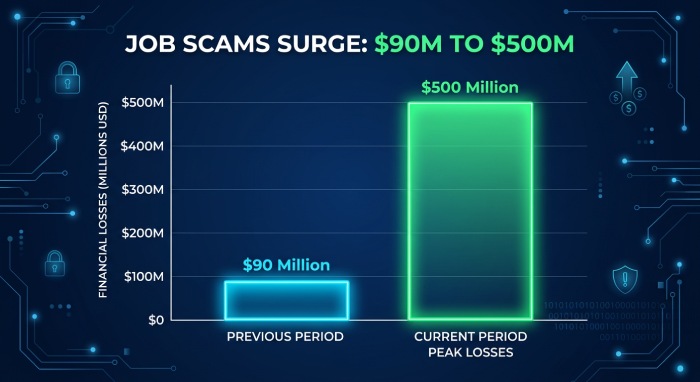
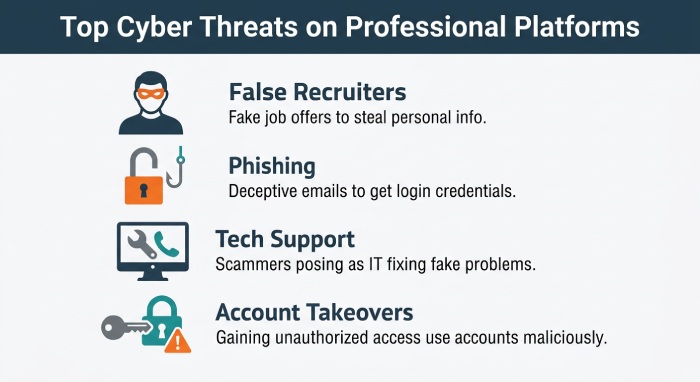
There are mainly 10 different types of LinkedIn cyber scams, including false recruiter scams, job offer scams, tech support scams, LinkedIn to WhatsApp scams, phishing email scams, crypto and investments scams, romance scams, account takeover scams, survey scams, and spear phishing scams.
600+ SIM cards illegally routed in Cambodia confiscated by Indian cyber authorities!
A highly sophisticated cybercrime racket has been busted by Indian cybersecurity authorities in Cambodia. They have confiscated over 600 Indian SIM cards that were illegally routed to Cambodia. If not confiscated, these SIM cards would have been used to carry out global cyber scams.
The authorities have nabbed 5 culprits so far. The campaign came to light just a few days back, on March 31. Airport authorities at Rajiv Gandhi International Airport intercepted a passenger and recovered 198 SIM cards. It was through him that the authorities got to know about the entire organized network and their involvement in SIM card smuggling for cyber fraud activities.
The worst part about this scam is the process of procuring the SIM cards. These SIM cards were activated using the legal ID proofs and other documents of naive, unaware individuals.
The cyberfraud syndicate in Cambodia was highly structured and intricately layered. There were different teams that took care of financial transactions, SIM procurement, logistics, and fraud execution.
High-profile individuals in the UK prone to social engineering attacks via Signal and WhatsApp!
NCSC, the UK’s National Cyber Security Center, has urged high-profile individuals such as academics, journalists, politicians, and lawyers to remain cautious against social engineering attacks. These high-risk individuals are on the radar of nation-state threat actors.
Some prominent government officials have already been targeted by threat groups.
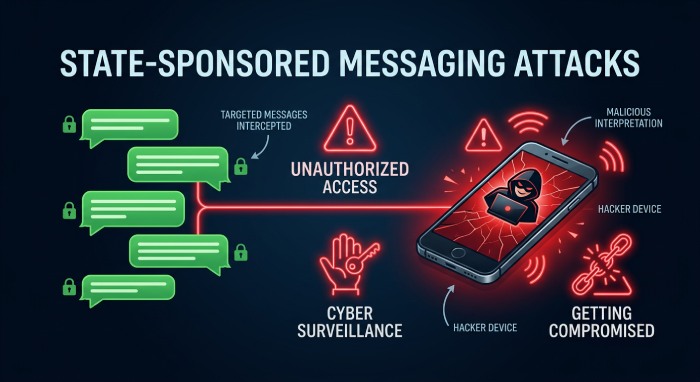
Google’s Threat Intelligence Group issued a warning back in February about state-sponsored actors targeting Signal users’ accounts.
Most of the time, these threat groups rely on social engineering tactics to compel users into linking their Signal, FB, or WhatsApp accounts to hacker-controlled devices. This interlinking enables threat actors to access all the messages on victims’ devices.
Scammers always try to persuade victims to share sensitive data, such as account recovery codes or login credentials.
Elderly people becoming easy targets of cybercrooks– thanks to AI!
Artificial intelligence is increasingly being used to target unsuspecting commoners, like the elderly strata of society. Recently, threat actors targeted an 86-year-old grandmother with an AI-enhanced vishing campaign that cost her $6,000.
A cybercrook impersonated her granddaughter and called her, asking for money. The scammer shared a fabricated story about being detained by police and needing financial assistance to hire an attorney. The grandmother agreed to share the amount in cash, which was collected by one of the threat actors in person.
The poor grandmother said she fell for the scam because the scammer’s voice sounded exactly like her granddaughter’s.
The elderly people are the favorite targets of the cybercrooks because they generally have accumulated savings and investments. Also, old people tend to be less tech-savvy and are not well-versed in modern technology. They are highly likely to trust voices that sound familiar, as generally, old people don’t have clarity around vishing and other related cyberattacks.
Artificial Intelligence enables threat actors to design sophisticated cyberattacks that appear realistic and credible. This increases the success rate of the scams. Cybercrooks have been using different types of AI-backed scams, such as deepfake videos and images, voice cloning, predictive targeting, and AI-powered phishing.
Cybersecurity experts have urged elderly people to think twice before parting with their hard-earned money. They should appoint a trusted family member to regularly monitor bank credit card statements. Opting for telecom services that help detect scams in real time can prove to be quite helpful in blocking malicious calls. Also, a much-needed step is to have a safe word that only “close family members” would know and use to identify themselves over calls in such critical times. Relying on a trusted family member to set parameters as to what is a safe withdrawal and what is not is also a much-needed step to secure the savings of an elderly member.