SPF Macro Explained: A practical Guide To Overcoming The 10 DNS Lookup Limit

Quick Answer
SPF caps DNS lookups at 10 per evaluation. Stitching together 3 or 4 third-party services (marketing platform, CRM, ticketing, cloud relay) routinely pushes records to 15 to 30 lookups, returning permerror and breaking legitimate mail at receivers like Gmail. SPF macros (%{i} client IP, %{d} MAIL FROM domain, %{h} HELO) substitute message metadata into mechanism domains at evaluation time, letting one mechanism authorize many sources. Macros are allowed in include, a, mx, ptr, exists, redirect, and exp; not in ip4, ip6, or all. Keep expanded labels under 63 bytes per label and 255 total, design bounded resolution to avoid recursion, and test before publishing. Used correctly, macros consolidate authorization into fewer lookups without losing coverage.
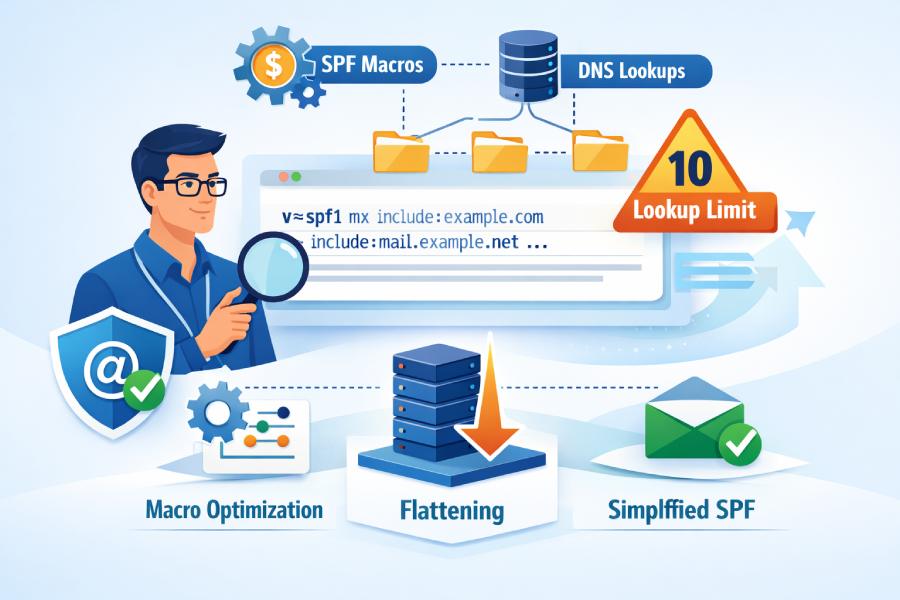
Email authentication can feel deceptively simple, until SPF records start failing and legitimate messages land in spam. One of the most common and frustrating causes is the SPF 10 DNS lookup limit, a technical restriction that many organizations hit as they add third-party email services.
This practical guide breaks down SPF macros in clear terms and shows how to use them effectively to simplify your SPF record, stay within lookup limits, and keep your email deliverability intact.
Why the SPF 10 DNS lookup limit exists and how it breaks real-world senders
The Sender Policy Framework (SPF standard) was designed to keep email authentication lightweight and predictable. To that end, the SPF policy caps the number of DNS lookups at 10 during SPF validation. This constraint prevents abusive or accidental recursion that would otherwise hammer the Domain Name System (DNS), threaten email security, and delay SMTP processing. Each DNS lookup in an SPF record can cascade through include directive chains, A/MX lookups, and other mechanisms, so the limit keeps validation time-bounded for the receiving host.
In practice, modern mail flows use multiple third-party services, marketing platforms, ticketing systems, CRM automation, and cloud relay providers. Each provider publishes its own SPF include chain. A domain owner who stitches together three or four services can unintentionally create complex SPF records that perform 15-30 lookups. When the SPF check hits the 10-query ceiling, the result is an SPF failure or a permerror, and the email message may be subjected to harsher SPF filtering. Legitimate authorized mail sent from marketing.foo.com via server1.mail.esp.com can therefore fail at major receivers like Google despite being an authorized sender.
This breakage is especially painful for senders operating at global scale across Europe and Africa where multiple regional sending hosts are common. The fix isn’t to abandon SPF, but to use smarter SPF record configuration patterns, especially SPF macros, to concentrate authorization into fewer lookups without sacrificing coverage or SPF record validity.

SPF fundamentals in 5 minutes: mechanisms, modifiers, and what actually count toward the limit
Before using SPF macros, ensure your SPF record format and SPF syntax are sound.
- What SPF is: SPF (Sender Policy Framework) evaluates whether the sending host’s IP address is permitted to send on behalf of an authorized domain. This happens during the SMTP (Simple Mail Transfer Protocol) transaction, usually at MAIL FROM or HELO/ EHLO time.
- Core signals: SPF evaluation uses message metadata such as the MAIL FROM domain (aka the envelope sender), the HELO/ EHLO hostname, and the client IP address observed by the receiving server.
- Mechanisms that may trigger DNS lookup and count toward the limit:
- include directive (aka SPF include)
- a (A/AAAA lookups for a domain)
- mx (MX lookup + A/AAAA lookups)
- ptr (reverse PTR and forward-confirmation checks)
- exists (query existence of a hostname)
- redirect (effectively replaces the current record, continuing evaluation)
- Mechanisms that do not cause lookups:
- ip4, ip6, all (no DNS lookup)
- exists can be “constant-cost” if you design the hostname to resolve locally, but it
- still counts as one DNS lookup.
- Modifiers:
- redirect modifies the active record (counts because it triggers further evaluation).
- exp can trigger a lookup for failure explanations; treat it cautiously so it doesn’t
- exacerbate DNS lookup pressure.
- What actually counts:
Each distinct DNS lookup consumed by these SPF mechanisms or the redirect modifier contributes to the 10-lookup budget. - SPF record implementation errors, like long chains of nested includes, burn the budget quickly.
- Void lookups and timeouts also harm reliability; design for deterministic SPF expansion.
Use SPF tools (e.g., Instant SPF**, PowerDMARC, and** DMARC Advisor) for SPF record testing before deployment, and consider Valimail’s Authenticate for policy monitoring and DMARC alignment.
SPF macros 101: where macros are allowed, syntax, and safe expansion rules
SPF macros allow dynamic substitution of message metadata into domain names used by SPF mechanisms. They enable macro expansion that adapts authorization to the message source at evaluation time.
- Where macros are allowed:
- In domain-spec parameters of mechanisms: include, a, mx, ptr, exists
- In modifiers: redirect and exp
- Not in IP literals or the all mechanism
- Syntax and macro sequence:
- General form: %{macro-letter transformers delimiters}
- The macro letter represents a piece of message metadata (e.g., %{i} for client IP address, %{d} for the domain in MAIL FROM).
- Optional transformers include r (reverse dot-order) and number truncations, with custom delimiters.
- Macro expansion occurs during SPF validation of an SMTP transaction, after the HELO/ EHLO and MAIL FROM command stages provide context, and before a final SPF pass verdict.
- Safe expansion rules:
- Keep expanded labels within DNS limits (63 bytes per label, 255 bytes total).
- Prevent unbounded recursion: design macros that resolve to a bounded hostname.
- Sanitize expectations: macros reflect message metadata and should not encode secrets.
- Test with multiple clients and servers; SPF record testing is essential for validation and SPF record configuration sanity.
The macro toolbox: the most useful macro letters (%{i}, %{d}, %{s}, %{l}, %{h}, %{o}, %{t}, %{r}, %{v}) with practical examples
Use these macro letters to encode authorized sender context into a single-lookup authorization model.
1. Sender and domain context: %{s}, %{l}, %{o}, %{d}
- %{s}: Full MAIL FROM local@domain (mailfrom identity). Example: For MAIL FROM command “promo@marketing.foo.com,” %{s} expands to promo@marketing.foo.com.
- %{l}: Local-part only. With the same message, %{l} is promo. Combine as %{l}.user.auth.example.net to create per-user authorization namespaces.
- %{o}: Domain minus local-part (organizational domain approximation in SPF). Here, %{o} is marketing.foo.com. Useful for tenant or subdomain routing.
- %{d}: Envelope domain being evaluated in SPF. If SPF evaluation follows redirect to foo.com, %{d} would be foo.com. Example: exists:%{d}.spfcheck.example.net.

a. Practical pattern
- exists:%{l}.%{o}.%{d}.v=spf.auth.example.net lets you key authorization by user, subdomain, and evaluated domain in a single DNS lookup.
2. Connection and hostname context: %{i}, %{h}, %{r}, %{v}
- %{i}: Client IP address of the sending host. Example expansion: 198.51.100.25 or IPv6 form. Often reversed with %{ir} for tree-like delegation: 25.100.51.198.authorized.spf.example.net.
- %{h}: HELO/ EHLO hostname from the client. Example: If the client says EHLO server1.mail.esp.com, %{h} is server1.mail.esp.com.
- %{r}: Receiving host’s domain name. Useful for diagnostics (e.g., %{r}.log.spf.example.net) but avoid making authorization receiver-dependent.
- %{v}: IP version literal (“in-addr” for IPv4, “ip6” for IPv6). Often used to branch IPv4/IPv6 logic in hostnames.
b. Example macro sequence
- exists: %{ir}.%{v}.auth.%{d}.spf.example.net
- Here, macro expansion yields a deterministic hostname the receiver can query exactly once.
3. Time and audit context: %{t}
- %{t}: The approximate current timestamp at SPF evaluation time (seconds since epoch). Useful for short-lived, cache-friendly labels: exists:%{ir}.%{t}.window.spf.example.net. Use with caution to avoid excessive DNS churn.
4. Putting it together with RCPT TO and headers
Although SPF evaluates envelope identities rather than email headers, you can align macro design with RCPT TO command routing or downstream DMARC. For example, use %{d} and %{o} to correlate the authorized domain with DMARC policy alignment, while the RCPT TO address remains independent.
One-lookup authorization with the exists mechanism: designing a macro-driven SPF endpoint
The exists mechanism returns a match if the provided hostname resolves to any address. By leveraging SPF macros to encode message metadata into that hostname, you can compress complex SPF mechanisms into a single DNS lookup and still achieve fine-grained authorization.
Design pattern
- SPF record: v=spf1 exists:%{ir}.%{d}.auth.spf.example.net -all
- Rationale: %{ir} encodes the client IP address in reverse form; %{d} anchors the authorized domain. The receiving server performs one DNS lookup. If the hostname exists (A/AAAA), SPF pass occurs; otherwise, SPF failure.
Implementation steps
- Build an authorization namespace in your DNS:
- For each authorized sender, create a record such as
- 25.100.51.198.foo.com.auth.spf.example.net. IN A 127.0.0.2
- For IPv6, mirror the structure with %{v} and nibble-reversed %{i} if desired.
- Optionally, segment by subdomain or EHLO hostname:
- %{ir}.%{h}.%{d}.auth.spf.example.net enables tying authorization to the claimed EHLO identity (e.g., server1.mail.esp.com).
- Maintain entries through automation:
- Sync with third-party services to add/remove hostnames as providers change IP space.
- Consider an internal API or provisioning pipeline that updates DNS whenever a sending host is added.
Caveats and safety
- Cacheability and TTLs: Keep TTLs reasonable; over-dynamic labels (e.g., heavy use of %{t}) reduce cache efficiency.
- Avoid receiver-specific authorization via %{r}; it may behave inconsistently across
- receivers and harm SPF record validity.
- ptr is fragile; prefer exists with explicit hostnames over PTR-based authorization.
- Redirect and include directive still count; with exists, aim to remove long SPF include chains and collapse complex SPF records into a single exists.
Operational testing and evaluation
- Perform SPF record testing across representative SMTP paths:
Simulate EHLO/HELO, MAIL FROM, and RCPT TO combinations that reflect production. - Validate behavior for both IPv4 and IPv6 clients.
- Use SPF tools from Instant SPF**, PowerDMARC, and** DMARC Advisor to model DNS
- lookup counts and confirm an SPF pass.
- Pilot with major receivers (e.g., Google) and inspect logs for the SPF pass verdict during SPF evaluation.
Example: consolidating third-party services
- Instead of multiple nested includes from different providers, publish:
- v=spf1 exists:%{ir}.%{d}.auth.spf.example.net -all
- In DNS, create entries for each provider’s netblock as they apply to your authorized domain. This collapses multiple lookups (include + a + mx) into one predictable DNS lookup while maintaining authentication for the email message.
SMTP transaction walkthrough
- Client connects; sends HELO/ EHLO with a hostname like server1.mail.esp.com.
- MAIL FROM command specifies the envelope domain (e.g., marketing.foo.com).
- The receiving host checks the SPF record for marketing.foo.com and evaluates exists with macro expansion.
- If the constructed hostname resolves, the server records an SPF pass and proceeds with normal handling of the SMTP transaction.
Governance and ecosystem notes
- Coordinate SPF record implementation with DMARC to maintain alignment and robust email authentication.
- Valimail (including Authenticate), PowerDMARC, and DMARC Advisor offer visibility and automation. These platforms can help you formalize an SPF policy that uses macro-driven exists while maintaining authorized domain mappings at scale.
- For broader context in email security and cybersecurity.
Centralizing policies with redirect and macros: multi-domain and multi-tenant patterns

Centralizing your SPF record strategy simplifies management across brands, regions, and tenants while honoring the SPF standard. A hub domain can publish a single Sender Policy Framework policy, and child domains can reference it via redirect= or an include directive. Combined with SPF macros, you can adapt one policy to many contexts and preserve accurate email authentication, SPF validation, and consistent SPF check results.
When to use redirect= vs include
- redirect=
- Use when a subdomain should inherit a parent SPF policy entirely. The child’s SPF record contains only v=spf1 redirect=parent.example.com -all. The receiving host evaluates the parent’s mechanisms as if they were local.
- Keeps a single source of truth and ensures uniform SPF mechanisms, reducing DNS lookups and avoiding drift in complex SPF records.
- include directive
- Use include when aggregating multiple third-party services or when a domain needs to layer service-specific authorization. The include directive pulls in another SPF record’s mechanisms but preserves local policy.
- Ideal when each tenant needs additional IP address blocks or hostname patterns beyond the centralized baseline.
Both approaches rely on the same SPF standard, work within the Domain Name System, and help maintain valid SPF syntax. In either case, macro expansion using an SPF macro or multiple SPF macros can inject context like the MAIL FROM domain or the sending host IP address.
Delegation across brands and regions
A multinational enterprise can delegate a central SPF policy while varying regional sending. For example:
- Brand roots: example.com, example.eu, example.africa
- Marketing subdomains: marketing.foo.com, emea.marketing.foo.com
- Redirect subdomains to a shared policy (spf.example.com) and add regional includes for authorized mail originating in Europe and Africa. This preserves a single SPF record format while allowing regional mechanisms to reflect the actual message source and authorized sender ranges.
Macro-driven tenants and subdomains
In multi-tenant ESP scenarios, SPF macros let you publish a single policy that maps tenant identity to a tenant-specific include. For instance:
- v=spf1 include:%{i}.ip.tenants.spf.example.net include:%{d}.d.tenants.spf.example.net -all
Here, the macro letter i expands to the connecting IP address and d expands to the domain, allowing dynamic include resolution per tenant. Macro sequence design must be safe, predictable, and respect the SPF record validity limits and DNS lookup budget.
Example macro sequence pattern
- Use %{s} (sender), %{l} (local-part), and %{d} (domain) macro letters sparingly to route to tenant scopes, e.g., include:%{d2}.tenants.spf.example.net where %{d2} selects a subdomain like marketing.foo.com.
- Use %{p} or %{i} only when necessary; avoid excessive metadata replacement that could inflate SPF expansion.
- Always test macro expansion under real SMTP transaction conditions (EHLO/HELO, MAIL FROM command, RCPT TO command) to confirm the receiving host evaluates the same path you planned.
Reducing lookups without losing coverage: replacing a/mx/ptr, consolidating includes, and controlled flattening
Staying under 10 DNS lookups per the SPF standard is critical. Replace expensive mechanisms, consolidate chains of include directive references, and flatten with control where appropriate to maintain email authentication fidelity.
1. Swap expensive mechanisms
- Replace a and mx with explicit ip4/ip6 or a dedicated include of a published, static netblock. Relying on MX indirection drives multiple DNS lookups.
- Avoid ptr; it’s discouraged by the Sender Policy Framework and causes SPF failure in some implementations due to reverse-mapping inconsistency.
- Prefer concise ip4:203.0.113.0/24 style mechanisms over resolving hostnames unless the hostname is stable and cached.
a. Consolidate include directive chains
- If multiple third-party services each publish nested includes, aggregate them behind your own single include that you control, e.g., include:saas.example.com. This reduces lookup fan-out and centralizes SPF record configuration.
- Coordinate with providers like Google, PowerDMARC, Valimail, and Instant SPF to use their minimal include endpoints and avoid deprecated paths.
2. Controlled flattening and TTL hygiene
Flattening converts includes and hostnames into direct IP address mechanisms. Do it selectively:
- Only flatten well-known, slow-changing blocks. Respect DNS TTLs so that flattened entries are refreshed before address churn.
- Use automation from Authenticate (Valimail product) or DMARC Advisor to snapshot, re-validate, and republish flattened records safely as part of your SPF record implementation.
b. Monitoring SPF expansion
Track live SPF expansion with SPF tools that simulate DNS lookup depth and path coverage. Verify that changes in a provider’s SPF include don’t push you over the 10-lookup ceiling. Repeat SPF record testing after every provider change to maintain consistent SPF pass verdict rates.
Putting it together: reference architectures that stay under 10 lookups for complex SaaS stacks
Enterprises using multiple ESPs, CRM platforms, and transactional services can stay within the SPF standard by modularizing policies, using carefully authored SPF macros, and enforcing a lookup budget.

1. Typical B2C marketing + transactional mix
- Compose a parent SPF record: v=spf1 include:base.example.com include:txn.example.com include:mkt.example.com -all
- txn includes a small set of ip4/ip6 mechanisms for payment and notifications.
- mkt resolves to a curated set of includes for server1.mail.esp.com and other marketing senders.
- Tenants like marketing.foo.com use redirect= to the parent, with an optional local include for campaign-specific hosts. This keeps email authentication consistent while allowing campaign agility.
a. Sample SPF record format snippets
- Parent: v=spf1 include:global.example.com -all
- Tenant: v=spf1 redirect=global.example.com
- Macro-enhanced include: include:%{d}.clientpool.example.net, where the macro letter d selects the authorized domain pool based on the MAIL FROM.
2. Global enterprises in Europe and Africa with regional sends
- Publish regional pools: eu.example.com and africa.example.com with localized IP address ranges and provider includes.
- Use macro expansion keyed to EHLO to steer to the nearest pool during SPF evaluation, for example include:%{h}.regionpool.example.com where %{h} reflects the EHLO/HELO hostname.
- Ensure DNS TTLs align with provider change cadence across regions and that SPF expansion remains below the limit during peak sending.
a. Third-party services and authorized sender alignment
- Maintain an inventory of third-party services and map each to an include endpoint you control. Validate each change through SPF check pipelines and update DMARC alignment expectations accordingly.
- Verify that the MAIL FROM and the authenticated domain remain aligned under DMARC even as SPF mechanisms evolve.
Risks, gotchas, and performance: void lookups, DNS TTLs, macro pitfalls, and security considerations
The Sender Policy Framework is deterministic, but operational details can bite. Guard against void results, stale caches, and unsafe macro sequence designs that erode email security.
1. Void query detection and SPF failure handling
- A void lookup occurs when an include or mechanism yields no records. Too many voids can trigger an SPF failure, even if other paths would have produced an SPF pass.
- Monitor for providers whose records occasionally return NXDOMAIN. Build guardrails with health checks and fallback authorized sender blocks to preserve an SPF pass during transient outages.
a. Macro letter safety and metadata replacement
- Limit macro letters to the minimum: s, l, d, i, and h are common for message metadata selection. Avoid chaining macros that expose unnecessary email headers or sensitive message metadata.
- Test metadata replacement under varied SMTP transaction states to ensure consistent behavior across receiving host implementations.
2. Security notes and performance
- Keep macros from leaking tenant identifiers beyond what is necessary for authentication. Proper SPF record configuration avoids revealing client details in DNS labels.
- Review your SPF policy as part of broader cybersecurity programs and DMARC enforcement. Validate that SPF filtering remains performant under burst loads and that the client and server resolvers cache within TTLs to reduce latency.
a. DNS, Simple Mail Transfer Protocol edge cases
- Some MTAs handle HELO-only SPF differently; ensure you publish policies that pass both MAIL FROM and HELO checks. The Simple Mail Transfer Protocol nuances matter because SPF is evaluated during SMTP.
- Confirm behavior with providers like Google that may weigh SPF results alongside DKIM and DMARC; strive for consistent SPF pass outcomes across all paths.
Implementation checklist and testing: tools, validation steps, and ongoing monitoring

Treat SPF record implementation as an engineering discipline: design, validate, deploy, and observe. Document each mechanism and include directive, and ensure the Domain Name System changes are staged and reversible.
1. SPF tools and SPF check workflow
- Use SPF tools from PowerDMARC, DMARC Advisor, Valimail, and Instant SPF to model SPF expansion, DNS lookup counts, and coverage. Automate nightly SPF check jobs to detect drift.
- Capture SMTP logs showing EHLO/HELO, MAIL FROM, RCPT TO, the sending host IP address, and the receiving host decisions to correlate SPF validation with production traffic.
a. SPF record testing across EHLO/HELO paths
- Test both domains that send an email message in the envelope (MAIL FROM) and those asserted in the HELO line. Validate authorized domain behavior for bounce addresses and null senders.
- Confirm the SPF pass verdict when presented with typical message source patterns, and capture results in a dashboard for ongoing SPF evaluation.
2. Validation of SPF record validity and SPF filtering
- Lint for SPF syntax, ensure the SPF record format is below 255 chars per string and within TXT aggregation limits. Confirm that -all, ~all, or ?all align with your SPF policy.
- Validate SPF mechanisms against production traffic; remove unused includes. Ensure authorized mail is not overbroad to avoid abuse and maintain authentication integrity.
FAQs
How do redirect and include differ in an SPF record?
redirect= hands off evaluation to another domain’s policy entirely, while an include directive imports mechanisms into the current record. Use redirect for inheritance and include for aggregation under the SPF standard.
When should I use SPF macros in production?
Use an SPF macro when you need context-aware routing, such as tenant or region selection. Keep macro sequence logic minimal, test macro expansion under real SMTP conditions, and avoid leaking sensitive message metadata.
What causes “too many DNS lookups” in SPF?
Nested includes, a/mx mechanisms, and hostname indirections often push expansion beyond 10. Consolidate includes, replace a/mx/ptr with ip4/ip6, and apply controlled flattening with appropriate DNS TTLs.
How do I test both HELO and MAIL FROM paths?
Capture SMTP transaction logs and run SPF record testing using EHLO/HELO inputs and the envelope MAIL FROM and RCPT TO. Validate that both checks produce an SPF pass where expected.
Which tools help manage complex SPF records?
Solutions from Valimail (including Authenticate), DMARC Advisor, PowerDMARC, and Instant SPF can model SPF expansion, monitor SPF record validity, and automate updates. Pair them with continuous SPF check pipelines.
Key Takeaways
- Centralize Sender Policy Framework policies with redirect and include directive patterns, augmenting with carefully scoped SPF macros.
- Reduce DNS lookups by replacing a/mx/ptr, consolidating includes, and applying controlled flattening aligned with DNS TTLs.
- Reference architectures can keep complex SaaS stacks under 10 lookups while preserving email authentication and SPF validation.
- Monitor for void lookups, macro pitfalls, and regional variability; maintain strict SPF record configuration hygiene.
- Automate SPF record testing and SPF evaluation with reputable SPF tools, and align outcomes with DMARC and broader email security controls.
General Manager
General Manager at DuoCircle. Product strategy and commercial lead across the email security portfolio.
Secure your email infrastructure
Protect, authenticate, and deliver. Contact our team to find the right solution.