

Why DIY-ing DMARC could cost you more than you think
DMARC looks simple at first. You add a record, check some reports, and slowly move to a stricter policy. It feels like a small task that your team can handle without much effort. That’s why many businesses choose to manage it on their own in the beginning.
keep track of all these senders and make sure everything is set up correctly.
This is where problems start. If you don’t have full visibility, you might block emails that are actually important. Or you might miss emails that shouldn’t be allowed at all. Even a small mistake in setup can affect your email security and email delivery.
Another issue is that DMARC is not a one-time setup. You have to keep checking reports, fixing issues, and updating settings as things change. New tools get added, and old ones change how they send emails. It needs regular attention.
So while doing DMARC on your own may seem like a good idea at first, it can take more time and effort than expected. In this article, we’ll look at why this happens and what challenges you might face when managing DMARC by yourself.
What is the true cost of DIY-ing DMARC?
Implementing email authentication protocols like DMARC may appear to be a technical task that can be managed internally. However, it involves much more than simply publishing a record and expecting it to function correctly.
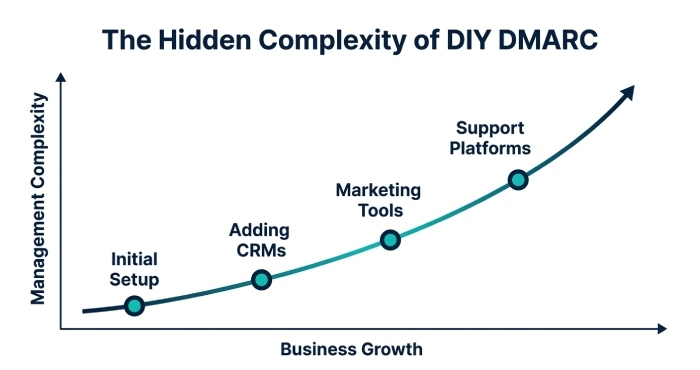
The initial setup is only a small part of the process. In practice, DMARC requires continuous monitoring, regular updates, and careful coordination across all email-sending sources. As your email environment grows, maintaining accuracy and control becomes increasingly complex.
More importantly, even minor errors can have a wider impact. Misconfigurations can affect email delivery, disrupt communication, or create gaps in your overall security.
To better understand this, it is important to look at where these hidden costs come from and how they impact your email ecosystem over time.
The effort to build expertise is often underestimated
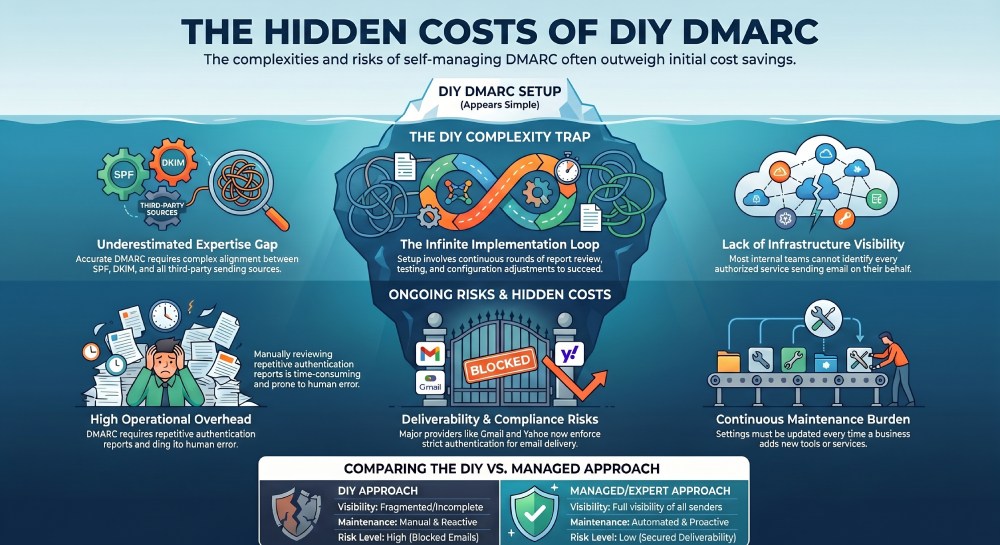
As mentioned earlier, DMARC is not just about adding a record. It requires a clear understanding of your email flows, all the systems that send emails on your behalf, and how to apply the right policy without affecting legitimate email delivery.
This is where many teams face difficulties. In most cases, there isn’t complete visibility into all authorized sending sources. As a result, a significant amount of time is spent identifying these sources, validating them, and ensuring they are configured correctly.
At the same time, it is important to understand how SPF, DKIM, and DMARC work together. Even a small misalignment between them can lead to authentication failures and impact email delivery.
Another challenge is that DMARC implementation is rarely perfect on the first attempt. It typically involves multiple rounds of reviewing reports, making adjustments, testing configurations, and repeating the process until everything works as expected.
All of this requires consistent time and effort. During this phase, there may still be issues with email delivery, along with potential gaps in protection. This makes the overall cost of implementation much more than just the initial setup.
Operational and overhead costs add up over time
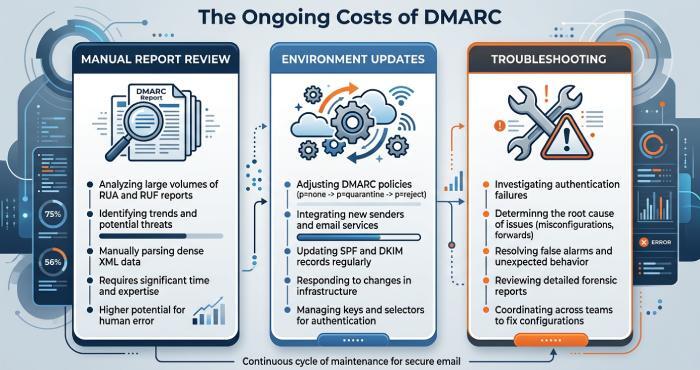
Once DMARC is implemented, the ongoing work begins. You start receiving DMARC reports that provide details about email sources, authentication results, and any suspicious activity. Reviewing these reports manually can be time-consuming and repetitive. It also increases the chances of missing important signals that may require immediate attention.
The effort does not end there. As your email environment evolves, new tools and services are introduced, and existing systems may change how they send emails. Each of these changes needs to be reviewed and properly configured to ensure DMARC continues to function correctly. Missing even a small step can lead to authentication failures or email delivery issues.
There is also the added burden of troubleshooting. If an issue arises, such as a sudden drop in email delivery or repeated authentication failures, identifying the root cause can take significant time and effort. Without clear visibility or expertise, resolving these issues is not always straightforward.
Security and compliance risks are easy to miss
With the rise in phishing and domain spoofing attacks, email providers have become stricter in how they handle incoming messages. If your emails do not meet their latest requirements, they may be filtered out or blocked entirely. This can result in missed communications and disruptions to business operations.
Internal management of DMARC can make it easy to overlook these risks. Many organizations do not anticipate how frequently requirements change or how much effort is needed to stay compliant. As providers such as Gmail, Yahoo, and Outlook continue to enforce stricter policies, maintaining proper authentication and compliance becomes more critical.
It is no longer enough to simply set up DMARC. It must be correctly configured, continuously monitored, and regularly updated. Without this, your emails may fail to reach recipients, or your domain may become vulnerable to misuse.
While setting up DMARC may seem manageable, handling it independently is often not the most effective approach. The complexity and ongoing effort require the right level of expertise. If you’re looking for a team of experts to help you implement and manage DMARC for your domain, reach out to us!