

Email remains an essential communication tool for businesses, utilized for everything from transactional notifications to marketing initiatives and customer interaction. However, to ensure your emails reliably reach their intended inboxes in a secure and effective manner, a basic mail server isn’t enough. This is precisely where SMTP relay services become essential.
When considering the acquisition of an SMTP relay service, it’s crucial to take a strategic approach. Not all providers deliver the same quality in terms of performance, security, or customer support. Opting for the wrong service can result in poor email delivery, a tarnished sender reputation, and missed opportunities.
Below is an extensive guide outlining seven key factors you should evaluate prior to selecting an SMTP relay service, designed to empower you to make a well-informed decision.
1. Deliverability Rates and Sender Reputation
The essence of any SMTP relay service lies in its effectiveness in delivering emails. When deliverability rates are high, your messages are more likely to reach recipients’ inboxes instead of being diverted to spam or blocked.
A reliable provider will proactively oversee its sending infrastructure to uphold a solid IP reputation. This involves keeping tabs on blacklists, fostering connections with Internet Service Providers (ISPs), and implementing stringent anti-spam measures for users on their platform.
It’s wise to verify if the provider supplies dedicated IP addresses. For those sending a large volume of emails, dedicated IPs are crucial as they protect your reputation from being impacted by others. If you’re on the same IP as spammers, your deliverability could decline, even with good practices in place.
Moreover, seek out integrated features like:
- Systems for managing bounces
- Feedback loops with ISPs
- Lists to exclude invalid recipients
A transparent service provider will offer insights into your sender score and delivery metrics, enabling you to enhance your email performance continually.
2. Scalability and Performance Under Load

Initially, your business may only generate a small number of emails, but as you expand, your needs will change. Whether you’re managing seasonal promotions, onboarding new customers, or dispatching system notifications, your SMTP relay service should be capable of accommodating both consistent and unexpected increases in email volume.
Scalability goes beyond just sending more emails; it’s about preserving performance during that process. Some providers set strict limits on sending or may reduce your email delivery speed if you surpass specific thresholds, which can hinder the timely dispatch of important messages.
Seek out services that provide:
- Adaptable sending limits or pay-as-you-go options
- High throughput for mass campaigns
- Load balancing across several servers
- Effective queue management to prevent delays
A scalable SMTP relay guarantees that your email system can grow in line with your business, ensuring smooth operations and eliminating the need for costly transitions.
3. Security, Compliance, and Authentication Protocols
The security of email communication has become increasingly important due to the escalating number of phishing attacks and tighter data protection regulations. When considering SMTP relay services, it’s essential to prioritize security rather than treat it as an afterthought.
A trustworthy provider will implement key authentication methods, including:
- SPF (Sender Policy Framework) for validating sending servers
- DKIM (DomainKeys Identified Mail) to maintain the integrity of messages
- DMARC (Domain-based Message Authentication, Reporting & Conformance) for enforcing policies and safeguarding against impersonation
These methods not only enhance email security but also boost your reputation with recipient servers, leading to better email deliverability.
Additionally, make sure to look for:
- TLS encryption to protect emails during transmission
- Secure API access that uses authentication tokens
- Adherence to regulations such as GDPR or other local data protection laws
A robust SMTP relay service safeguards your organization and your recipients from potential risks.
4. Ease of Integration and Developer Flexibility
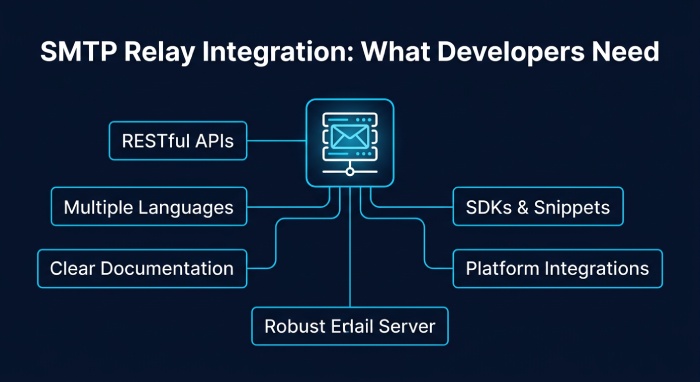
An SMTP relay service should enhance your efficiency, not hinder it. Whether you’re adding email functionality to a website, SaaS tool, CRM, or mobile app, the integration process ought to be seamless.
Most providers supply traditional SMTP credentials that are simple to set up. However, many modern companies gain more advantages from using API-based sending, which offers increased flexibility and management.
When assessing integration options, keep the following in mind:
- The existence of RESTful APIs
- Support for various programming languages
- Comprehensive and current documentation
- SDKs and code examples for quicker setup
- Ready-made integrations with platforms such as WordPress, Shopify, or popular CRMs, which can significantly streamline your efforts.
A developer-centric SMTP relay service can cut down on setup time, reduce errors, and enable your team to concentrate on feature development instead of resolving email delivery issues.
5. Analytics, Monitoring, and Reporting
Making decisions based on data is crucial for enhancing the effectiveness of your email campaigns. Without adequate analytics, you’re essentially navigating in the dark, unaware of what strategies succeed and which fall flat.
Selecting a reliable SMTP relay provider is key, as they should provide comprehensive reporting tools that illuminate every phase of the email process.
Important metrics to monitor include:
- Rates of successful deliveries
- Open and click-through rates
- Types of bounces (hard vs. soft)
- Instances of spam complaints and unsubscribe figures
More advanced platforms may offer features such as real-time dashboards, webhook alerts, and in-depth logs for troubleshooting.
Leveraging these insights enables you to:
- Quickly detect deliverability problems
- Enhance subject lines and email content
- Keep your mailing list well-maintained
- Boost engagement rates
Access to detailed data allows you to fine-tune your email strategy more effectively.
6. Pricing Model and Cost Efficiency

When selecting an SMTP relay service, cost is often a key consideration, but it shouldn’t be the sole factor. While a budget-friendly option may catch your eye initially, unforeseen costs or subpar service can result in greater expenses over time.
SMTP relay providers generally determine their pricing based on several factors, such as:
- The monthly email volume
- Pay-as-you-go plans
- Subscription levels with specific limits
In your assessment of pricing, it’s essential to look past the initial rates and take into account:
- Charges for dedicated IPs
- Fees for extra features like analytics or customer support
- Overage charges if you surpass your plan’s limits
- Setup or onboarding costs
Moreover, evaluating the overall value is critical. A slightly pricier service that offers superior deliverability and support may provide a better return on investment than a cheaper, less reliable choice.
Ensuring clear and transparent pricing helps avoid unexpected costs as your email usage increases.
7. Customer Support and Service Reliability
Even top-notch SMTP relay services can face challenges, such as temporary outages, misconfigurations, or issues with email deliverability. In such cases, having a responsive and knowledgeable support team is crucial.
When selecting a provider, consider the following aspects of their support:
- Is assistance offered around the clock?
- What support channels are available (live chat, email, phone)?
- Do enterprise plans include dedicated account managers?
- How quickly do they attend to urgent problems?
Reliability of the service is equally significant. Seek providers that guarantee:
- High uptime (99.9% or more)
- Redundant systems
- Explicit Service Level Agreements (SLAs)
Exploring customer feedback and case studies can provide valuable insights into how the provider manages real-life scenarios.
A reliable SMTP relay service with excellent customer support is essential for maintaining smooth and efficient email operations.
Final Thoughts
Investing in an SMTP relay service goes beyond a mere technical acquisition; it represents a key strategic element of your communication framework. Selecting the appropriate service can significantly improve your email deliverability, bolster your sender reputation, and support your business expansion.
Conversely, picking the wrong provider can result in unfavorable inbox placement, security risks, and operational challenges that can incur substantial costs to resolve.
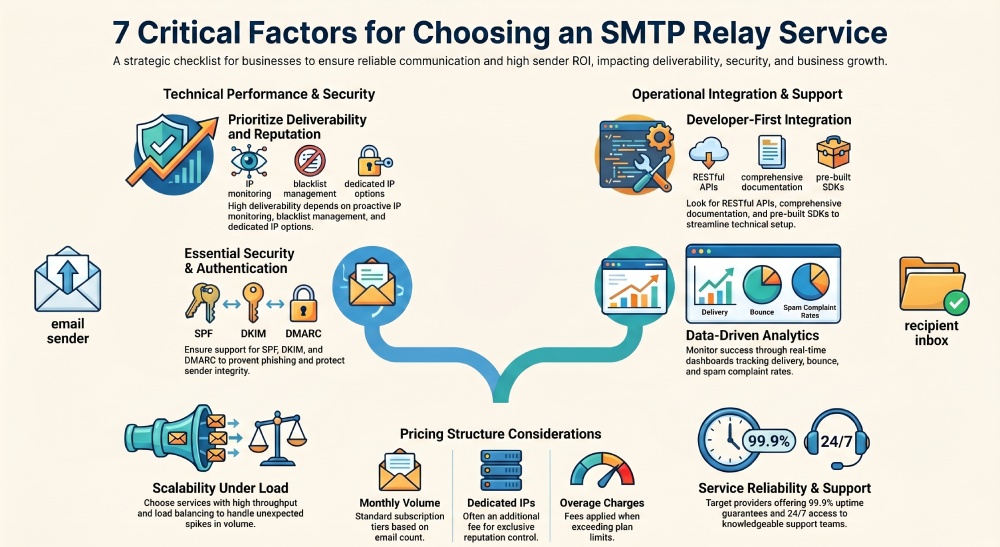
To make an informed choice, it’s essential to thoroughly examine seven important aspects: deliverability, scalability, security, integration, analytics, pricing, and customer support. Doing so will enable you to select a service that meets your current and future needs effectively.
Take the necessary time to compare different providers, test out their features, and evaluate their performance before making a decision. In the realm of email communication, dependability and trust are paramount — and the appropriate SMTP relay service will foster both.