
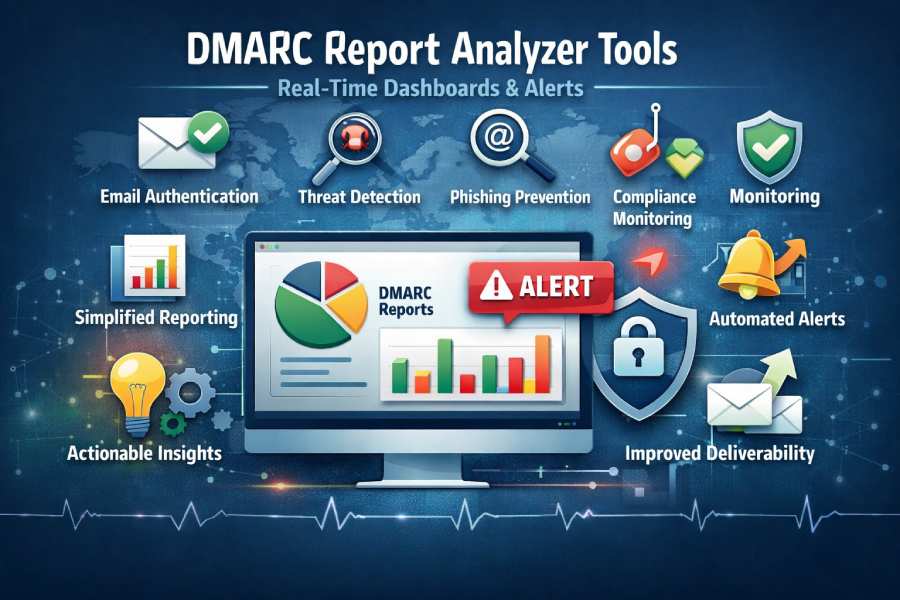
A modern DMARC report analyzer with live dashboards and proactive alerts changes how organizations interpret DMARC aggregate reports, turn XML reports into insight, and act on threats. Whether you’re getting started with DMARC or moving through DMARC toward full enforcement, a robust DMARC Management Platform combines immediate visibility, automated report analysis, and guided policy tuning.
The following reasons focus on why real-time telemetry and notifications in a DMARC tool matter for email authentication, domain compliance, and email deliverability across organizations of all sizes from small businesses to enterprises, MSPs, and IT agencies.
Reason 1: Instant, real-time visibility into DMARC alignment health
A DMARC analyzer with live dashboards surfaces pass/fail trends by domain, sending source, mailbox provider, and time, so anomalies are obvious the moment they appear. Instead of waiting for manual parsing of aggregate reports, a DMARC report analyzer centralizes RUA reports, converts XML reports with an XML to Human Converter, and continuously refreshes visualization layers.
What live dashboards reveal about your DMARC report data

- End-to-end domain overview: See alignment outcomes (SPF, DKIM, DMARC) by domain and subdomain, mapped to each sending service (e.g., Google Workspace, Amazon SES, EasyDMARC relay, or on-prem gateways).
- Provider trends: Compare Gmail and Yahoo pass rates to ensure you meet Gmail DMARC requirements and Yahoo DMARC requirements as your DMARC policy evolves.
- Source-level insights: A source viewer groups IPs, ASNs, and providers, flagging unknown sources for rapid triage.
- Time-based pivots: Visualize hourly spikes or gradual drift with interactive charts derived from DMARC aggregate reports.
Features that transform XML reports into decisions
- XML to Human Converter: Translates XML reports into readable summaries, cutting the time-to-insight for security teams, MSPs, and IT agencies.
- Streamlined report analysis: The DMARC report analyzer correlates aggregate reports and RUA reports with authentication results, so you can validate email authentication pathways without spreadsheets.
- Tooling at hand: Built-in utilities like DMARC Domain Checker, DMARC Inspector, and DMARC Record Wizard help validate your DMARC record and related configuration during deployment.
Why this matters for compliance and domain health
Real-time dashboards make domain compliance measurable. A DMARC Management Platform shows how enforcement affects email security, highlights gaps before audits, and supports security & compliance frameworks such as SOC readiness and MISA-aligned workflows. For regulated sectors Educational Services, Financial Services, Government, Healthcare, Non-governmental Organizations, Nonprofit Organizations, Technology Services, and Utilities—continual visibility into DMARC report insights is critical to maintaining domain health while adhering to policy and privacy policy commitments.
Reason 2: Faster threat detection with proactive alerts
A modern DMARC tool should do more than store data; it should accelerate threat detection. With configurable alerts and an alert central, security and mail teams receive immediate notifications when failure rates spike, new/unknown sending sources appear, alignment drifts, or policy bypasses are detected.
Configurable thresholds and workflows that reduce response time
- Alerts to your stack: Send notifications to Slack, email, or your SIEM for immediate action. The dmarcian platform and other DMARC Management Platform options offer flexible routing so alerts reach the right responders.
- Threshold logic: Set granular rules per domain, provider, or source to catch anomalies across DMARC aggregate reports and RUA reports without generating noise.
- Centralized triage: An alert central links each alert to the underlying XML reports and visualizations, so analysts can jump from notification to evidence in seconds.
Real-world impact across teams and industries
- For MSPs and IT agencies, multi-tenant dashboards cut through the volume of aggregate reports and provide standardized report analysis across client domains.
- For organizations operating at scale enterprises as well as small businesses automated alerts shrink mean time to detect and resolve misconfigurations, improving email authentication outcomes.
- For platform and compliance leaders, alerts enforce governance for DMARC policy changes and bolster security & compliance documentation.

Integrated tooling for better security decisions
Pair alerts with diagnostic tools: use SPF Surveyor to examine SPF record syntax and publishing issues, run DKIM Inspector and DKIM Validator to verify keys and signatures, and employ DMARC Inspector to confirm alignment settings. These capabilities, supported by respected DMARC data providers, turn a DMARC analyzer into a true incident response ally for email security and broader cybersecurity programs.
Reason 3: Accelerated path to p=reject with guided policy tuning
Moving from p=none to quarantine and finally to reject can be risky without real-time feedback. A DMARC report analyzer that supports policy simulation and readiness tracking makes moving through DMARC predictable and safe, minimizing the risk of blocking legitimate mail.
Simulate enforcement and track readiness KPIs
- Policy simulation: Preview how a change from none → quarantine → reject will affect pass rates by domain and provider using historical aggregate reports and live RUA reports.
- Readiness metrics: Dashboards display alignment percentages, volume by authenticated sources, and exceptions that require technical guidance or deployment services.
- Continuous feedback loop: As XML reports arrive, the XML to Human Converter and report analysis pipelines verify whether your DMARC policy adjustments improved domain compliance or introduced regressions.
Built-in assistants for configuration and deployment
- DMARC Record Wizard: Validate record syntax, policy tags, and alignment modes before publishing.
- DMARC Domain Checker and DMARC Inspector: Confirm that records resolve correctly and that organizational domains inherit the right policies.
- SPF Surveyor, DKIM Inspector, and DKIM Validator: Diagnose SPF record syntax limits (mechanisms, lookups) and DKIM key issues to improve alignment.
- Getting started with DMARC: Many platforms offer a DMARC Academy, a Forum, and a dmarc dictionary so teams can learn best practices, supported by news & knowledge blog resources.
Governance, assurance, and support
Enterprises seeking security & compliance assurance (e.g., SOC reporting, BCorp commitments) benefit from policy audit trails and documented KPIs. Providers like dmarcian and EasyDMARC complement the dmarcian platform or comparable DMARC Management Platform options with dedicated support and deployment services, ensuring complex deployments across Google, Yahoo, Amazon SES, and legacy systems are executed with minimal risk.
Reason 4: Deliverability gains and brand protection

Deliverability and brand trust hinge on consistent alignment. A DMARC tool with live dashboards links authentication success to reputation outcomes, enabling data-backed adjustments that improve inbox placement and reduce impersonation.
Improve pass rates and meet mailbox provider expectations
- ISP and mailbox visibility: Track pass rates by Gmail, Yahoo, and other providers to align with Gmail DMARC requirements and Yahoo DMARC requirements.
- BIMI readiness: Validate the prerequisites for BIMI, often a byproduct of strong email authentication and a stable DMARC policy.
- Sender reputation: Use real-time report analysis from DMARC aggregate reports to curb lookalike abuse and spoofing campaigns before they damage your brand.
Protect your domain and streamline operations
- Domain overview and source viewer: Confirm which platforms (e.g., Google Workspace, Amazon SES, marketing tools) are properly authenticated, and quickly quarantine or remove rogue senders.
- Free and paid tooling: Many teams start with free DMARC tools and a free DMARC report analyzer to assess baseline posture, then graduate to a full DMARC Management Platform for scale, multi-domain governance, and advanced alerts.
- Data stewardship and trust: Reputable DMARC data providers and platforms emphasize privacy policy transparency and rigorous security & compliance controls aligned to frameworks like SOC and MISA membership expectations.
Who benefits and how to operationalize
Organizations across sectors Educational Services, Financial Services, Government, Healthcare, Nonprofit Organizations, Non-governmental Organizations, Technology Services, and Utilities gain consistent domain health, improved email deliverability, and a measurable reduction in abuse. MSPs and IT agencies can standardize triage and remediation playbooks, leveraging alert central and live dashboards to deliver dedicated support to clients.
To put it all together, an enterprise-grade DMARC analyzer helps you:
- Normalize XML reports via an XML to Human Converter and correlate RUA reports for faster decision-making.
- Use DMARC report analyzer dashboards for immediate visibility into DMARC report trends and aggregate reports across domains.
- Automate alerts tied to DMARC policy thresholds, scaling threat detection without manual effort.
- Validate SPF, DKIM, and DMARC record posture with built-in diagnostics and wizards, supported by deployment services where needed.
As you evaluate options whether the dmarcian platform, EasyDMARC, or another DMARC Management Platform look for a vendor that offers comprehensive documentation, a vibrant Forum, and training (e.g., DMARC Academy), along with a news & knowledge blog that keeps pace with evolving standards. Also ensure the provider demonstrates clear commitments to cybersecurity, compliance, and customer trust.
Finally, confirm that the platform’s DMARC toolset includes:
- Consistent handling of DMARC aggregate reports from diverse DMARC data providers.
- Robust report analysis with clear pathways from XML reports to actions.
- Real-time dashboards, thoughtful alerts, and an alert central for prioritization.
- Extensible integrations for SIEM, ticketing, and collaboration tools.
- Support for free DMARC tools to get started, then scalable licensing for organizations as they mature.
With these capabilities, your DMARC report analyzer becomes a control plane for email authentication and domain compliance turning raw data into decisive action and tangible brand protection.
Reason 5: Centralized, scalable oversight for multi-domain portfolios

Unified multi-domain and multi-tenant views
A modern DMARC Management Platform centralizes oversight across brands, regions, and business units so MSPs, IT agencies, and global enterprises can standardize operations. Instead of juggling spreadsheets and inboxes, a capable DMARC tool consolidates DMARC aggregate reports from DMARC data providers like Google, Yahoo, and Amazon into a single domain overview with a source viewer for fast triage.
That unified view lets organizations validate email authentication posture, enforce DMARC policy across subsidiaries, and track domain compliance for small businesses as well as complex enterprises in Financial Services, Healthcare, Government, Technology Services, Utilities, Educational Services, and Nonprofit Organizations.
By normalizing RUA reports and XML reports, a DMARC report analyzer provides consistent report analysis across every sending source, regardless of geography. Teams can pivot aggregate reports per brand or per geography, and a DMARC analyzer augments the XML to Human Converter to surface readable insights without losing raw detail.
Vendors like dmarcian and EasyDMARC offer multi-tenant experiences that align with MSPs managing hundreds of DMARC record configurations, moving through DMARC phases from monitoring to enforcement.
RBAC, tagging, and standardized operations
Enterprises need fine-grained role-based access control (RBAC) to segment sensitive domains and apply least privilege at scale. Within a DMARC Management Platform, tagging helps categorize sources (marketing, transactional, third-party SaaS) and align them to DMARC policy exceptions, domain compliance milestones, and alerts. Standardized templates, a DMARC Domain Checker, DMARC Inspector, and DMARC Record Wizard accelerate deployment while ensuring SPF record syntax and DKIM alignment remain consistent.
For governance, central routes alert high-priority alerts to the right owners, and domain health dashboards provide real-time report analysis. Dedicated support and deployment services help teams with deployment, technical guidance, and getting started with DMARC. Many organizations also leverage free DMARC tools for early assessments, then scale into a fully managed DMARC report analyzer and DMARC tool backed by SOC reporting, MISA-aligned integrations, and BCorp-inspired transparency.
Reason 6: Deep drill-downs and data enrichment for root-cause analysis
Pivot analysis to IP/ASN/geo and source classification
When aggregate reports indicate a spike in failures, responders need to drill down from summary to detail. A robust DMARC analyzer lets analysts pivot from aggregate views to specific IPs, ASNs, and geographies, then classify sources as legitimate, unknown, or malicious. The XML to Human Converter makes XML reports readable, while preserving fields essential for threat detection such as source IP, SPF/DKIM results, and policy-applied disposition. This speeds email authentication investigations and reduces time-to-remediation across organizations of every size.
RUA reports often contain ambiguous or partial identifiers. By enriching DMARC aggregate reports with WHOIS, ASN ownership, and provider metadata, a DMARC report analyzer adds confidence to report analysis and helps separate legitimate marketing tools from impostors. Correlating these RUA reports with SMTP telemetry and TLS-RPT signals gives a fuller picture of delivery paths, forwarding behaviors, and downgrade attempts that may affect email deliverability and domain compliance.

Correlating SPF/DKIM/ARC/TLS-RPT signals
Root-cause analysis requires correlating multi-layer signals. A well-designed DMARC Management Platform aligns SPF Surveyor findings, DKIM Inspector results, and DKIM Validator checks with each DMARC report to identify broken keys, out-of-date selectors, and misconfigured vendors. It also surfaces ARC-influenced forwarding scenarios that impact alignment at Google or Yahoo and ensures your posture aligns with Gmail DMARC requirements and Yahoo DMARC requirements as they evolve.
Handling forwarding and ARC at scale
Forwarding breaks alignment for legitimate flows. The platform’s XML to Human Converter highlights ARC seals, so teams can detect mailing-list behavior, align DMARC policy exceptions judiciously, and maintain email authentication outcomes without whitelisting entire IP ranges. Combined with a source viewer, analysts quickly resolve whether to authorize or block a sender while preserving domain compliance.
Reason 7: Automation and ecosystem integrations
1. Automation playbooks and DNS updates
Automation closes the gap between detection and action. Through APIs and webhooks, a DMARC tool can trigger workflows to approve or deny new sources, update DNS via the DMARC Record Wizard, and notify owners in Slack or Microsoft Teams. That same automation can open tickets, enrich cases with XML reports, and attach a human-friendly view generated by the XML to the Human Converter. For recurring patterns expired DKIM keys, SPF includes exceeding 10 lookups, or SPF record syntax errors policy-driven playbooks remediate issues proactively while honoring DMARC policy and long-term domain compliance.
A mature DMARC report analyzer supports guardrails change reviews, policy approvals, and rollback options to protect production. Alert central orchestrates alerts to SOC and incident queues, while threat detection rules flag anomalous sources. Free DMARC tools can seed initial discovery, but at scale, the DMARC Management Platform operationalizes report analysis so MSPs and enterprises can sustain outcomes.
a. Sample webhook payload considerations
To integrate with SIEM/SOAR and data lakes, ensure payloads include normalized fields: domain, source IP/ASN, count by disposition, SPF/DKIM/DMARC results, ARC indicators, TLS-RPT errors, and pointer to the raw XML reports plus the XML to Human Converter version. This structure enables correlation across email security layers and preserves an audit trail.
2. Ecosystem integrations to SIEM/SOAR and collaboration
Modern teams expect integrations with Splunk, Microsoft Sentinel, ServiceNow, Jira, and data lakes. The dmarcian platform and peers provide APIs to stream aggregate reports and RUA reports, enabling cross-domain report analysis with other telemetry. Collaboration tools route ownership to marketing, IT, and security stakeholders, and a domain overview ensures the right resolver updates occur with minimal risk. Training through DMARC Academy, a community Forum, and a dmarc dictionary or news & knowledge blog helps teams sustain process maturity and keep pace with policy changes.
For a broader security posture, many organizations also invest in cybersecurity controls that complement email authentication and reporting pipelines.
Reason 8: Audit-ready reporting and executive communication

Executive stakeholders need clear, defensible metrics. Dashboards that transform DMARC aggregate reports into KPIs percent aligned, unauthorized source counts, enforcement coverage let leaders evidence DMARC policy adherence and domain compliance to auditors. Scheduled compliance packages bundle RUA reports, XML reports, and the XML to Human Converter outputs, forming audit-ready proof of email authentication enforcement across brands.
Enterprises in regulated sectors (Government, Financial Services, Healthcare, and Utilities) often align reporting to security & compliance frameworks and demonstrate adherence to privacy policy commitments. SOC requirements, MISA ecosystem participation, BCorp-grade transparency, and vendor attestations strengthen third-party risk narratives. Audit packs map findings to DMARC record changes, deployment timelines, and SLA attainment, while a DMARC report analyzer generates executive summaries suitable for boards and Non-governmental Organizations or Nonprofit Organizations with limited technical background.
To meet Gmail DMARC requirements and Yahoo DMARC requirements, the platform’s alert central highlights gaps that threaten email deliverability, then guides moving through DMARC with getting started with DMARC checklists and technical guidance. Tools such as DMARC Domain Checker, DMARC Inspector, DKIM Validator, and SPF Surveyor supplement recurring health checks.
References to DMARC data providers clarify which mailbox providers reported which anomalies, and domain health widgets show the effect of each remediation. Whether using dmarcian, EasyDMARC, or another vendor, free DMARC tools (including a free DMARC report analyzer) can seed adoption before scaling into enterprise deployment services that offer dedicated support.
Ultimately, standardizing executive communications around a consistent DMARC Management Platform narrative policy, enforcement, exceptions, and outcomes keeps leadership focused on risk reduction while enabling technology services teams to iterate. Integrations with Amazon SES, Google Workspace, and Yahoo sending stacks help validate alignment preflight, and a well-documented privacy policy plus change-control logs make audits predictable.
FAQs
What’s the difference between RUA reports and aggregate reports?
RUA reports are the standardized XML feedback streams defined by DMARC; aggregate reports is a common shorthand for the same data. A DMARC report analyzer ingests these XML reports and uses an XML to Human Converter to present readable summaries for report analysis.
How do drill-downs improve root-cause analysis?
Pivoting from aggregate views to IP/ASN/geo quickly isolates misconfigured or malicious sources. Correlating SPF, DKIM, ARC, and TLS-RPT signals inside a DMARC analyzer accelerates decisions while preserving email authentication integrity.
Can automation safely update my DMARC record and DNS?
Yes. With guardrails, a DMARC tool can propose and stage changes via a DMARC Record Wizard, validate SPF record syntax, and confirm DKIM alignment before committing. Approvals, alerts, and rollback options maintain domain compliance.
How do we communicate status to executives and auditors?
Use dashboards that translate DMARC aggregate reports into KPIs, SLAs, and compliance evidence. Scheduled packages include RUA reports, XML reports, and summarized outputs from an XML to Human Converter to demonstrate DMARC policy enforcement.

Which teams benefit from multi-tenant oversight?
MSPs, IT agencies, and large enterprises managing many brands or geographies gain the most. Centralized RBAC, tagging, and a source viewer streamline report analysis for organizations across government, healthcare, financial services, and beyond.
Do free DMARC tools suffice for ongoing operations?
Free DMARC tools and a free DMARC report analyzer are excellent for getting started with DMARC and discovery. At scale, a full DMARC Management Platform adds automation, integrations, and security & compliance reporting.
Key Takeaways
- Centralized, RBAC-enabled DMARC Management Platforms standardize operations across multi-domain portfolios for MSPs and enterprises.
- Deep drill-downs from aggregate reports to IP/ASN/geo, enriched by XML to Human Converter outputs, accelerate accurate root-cause analysis.
- Automation via APIs/webhooks updates DNS, routes alerts, and integrates DMARC report streams with SIEM/SOAR and collaboration tools.
- Audit-ready dashboards convert RUA reports and XML reports into KPIs and executive summaries aligned to DMARC policy and compliance.
- Free DMARC tools help teams get started, while advanced DMARC report analyzers and DMARC tools sustain enterprise-grade email authentication.